
ALS & Social Security Disability Benefits: How to Qualify for SSDI Under SSA Listing 11.10
TELL US WHAT HAPPENED SO WE CAN HELP. FREE CONSULTATION

Contact Us About Your Case
FREE Consultation Today.
ALS Disability Benefits: How to Qualify for SSDI Under SSA Listing 11.10
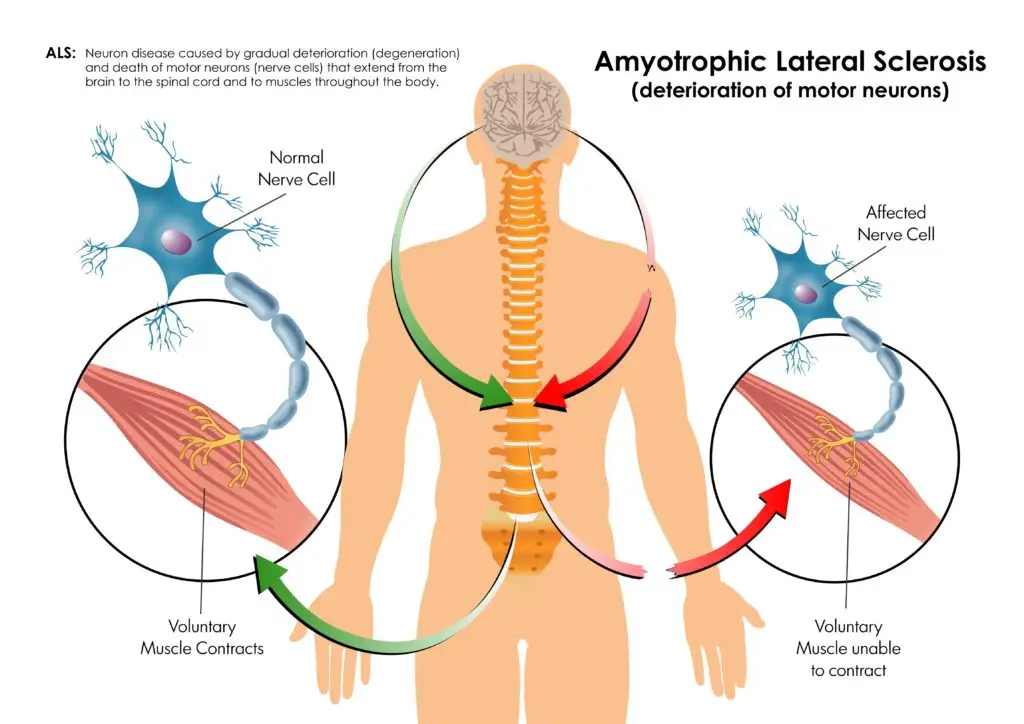
Amyotrophic lateral sclerosis (ALS) is a progressive, fatal neurological disease that destroys the motor neurons responsible for voluntary muscle movement. Because ALS rapidly affects mobility, speech, swallowing, and breathing, the Social Security Administration treats ALS differently from nearly every other neurological disorder.
Under SSA Listing 11.10, a medically documented diagnosis of ALS is considered automatically disabling. This makes ALS one of the fastest and most straightforward conditions to qualify for SSDI or SSI — but only when medical documentation is complete.
This guide explains how ALS and social security disability claims work, what medical evidence SSA requires, and how MLF Legal helps Americans secure benefits quickly.

Understanding SSA Listing 11.10: ALS
SSA Listing 11.10 is unique. Unlike epilepsy, Parkinson’s, MS, or cerebral palsy, ALS does not require proof of functional limitations. SSA states that a medically documented diagnosis of ALS is sufficient to meet the listing.
This means:
No need to prove inability to work
No need to document daily activity limitations
There is no need to show a 12‑month duration of severity
No need for extensive functional testing
ALS is also part of the Compassionate Allowances program, which accelerates claim processing.
How to Meet SSA Listing 11.10
To meet the listing, you must show one thing:
A medically documented diagnosis of ALS
SSA requires:
Clinical findings of upper and lower motor neuron disease
EMG or nerve conduction studies (when needed)
Neuroimaging to rule out other causes
Documentation of disease progression
SSA emphasizes that no single test proves ALS, and negative EMG results do not rule it out if clinical findings support the diagnosis.
Common ALS Symptoms That Support SSDI Claims
While SSA does not require functional evidence to meet the listing, ALS typically causes:
Motor Symptoms
Muscle weakness
Loss of dexterity
Difficulty walking or standing
Falls or instability
Progressive paralysis
Speech & Swallowing Symptoms
Slurred speech
Difficulty speaking
Trouble swallowing
Choking episodes
Respiratory Symptoms
Shortness of breath
Reduced lung capacity
Need for ventilatory support
Other Symptoms
Muscle cramps
Fasciculations
These symptoms often make full‑time work impossible long before the disease reaches advanced stages.
Evidence Needed to Win an ALS SSDI Claim
Even though ALS is automatically disabling, SSA still requires a complete medical file. Strong claims include:
Neurological Documentation
Diagnosis from a neurologist
EMG/NCV results
MRI or CT scans
Documentation of progression
Treatment Records
Clinic notes
Respiratory evaluations
Speech/swallowing assessments
Physical therapy notes
Supporting Evidence
Statements from caregivers
Assistive device documentation
Hospitalization records
Most ALS denials occur because the initial application lacks sufficient diagnostic documentation.
Why ALS Claims Are Sometimes Delayed or Denied
Even with a clear diagnosis, SSA may delay or deny claims when:
Records come from a primary care provider instead of a neurologist
Diagnostic testing is incomplete
Medical records do not clearly state “ALS”
The claimant applies without attaching medical evidence
SSA requests additional documentation and it is not provided quickly
MLF Legal ensures your ALS claim is complete, accurate, and properly supported from day one.
How MLF Legal Helps With ALS Disability Claims
Our social security disability attorneys:
Gather and organize all medical evidence
Coordinate with neurologists for clear diagnostic documentation
Ensure your claim is flagged for Compassionate Allowances
Handle all communication with SSA
Prepare appeals if needed
Fight for maximum back pay and ongoing benefits
- Build a case using residual functional capacity for ALS if the listing cannot be met
FAQs: ALS & Social Security Disability Benefits
Does ALS automatically qualify for SSDI?
Yes. A medically documented diagnosis of ALS meets SSA Listing 11.10.
Do I need functional evidence to qualify?
No. SSA does not require proof of limitations for ALS claims.
How fast are ALS claims approved?
ALS claims are typically expedited through Compassionate Allowances.
Do I need an EMG to qualify?
Not always. Clinical findings may be sufficient.
Can caregivers provide supporting statements?
Yes. Caregiver statements help strengthen medical documentation.

Contact MLF Legal for a Free Disability Case Evaluation
If ALS prevents you from working, or another medical condition prevents you from working, you may qualify for Social Security Disability benefits.
MLF Legal represents disability applicants nationwide. Based in Dallas, Texas, we help individuals across the country pursue disability benefits.
Our social security lawyers can review your situation for free and explain your options.
📞 Call MLF Legal at 214-357-1782 to request a free consultation.
Next Steps:
1st Sign up For a Free One-on-One Disability Case Evaluation
Contact us today to schedule your personalized one-on-one free phone consultation with one of our dedicated legal professionals. Our experienced social security lawyers are here to provide the expert legal guidance and support you need throughout the entire process of your case.
We understand the complexities involved in social security disability claims and are committed to helping you achieve the best possible outcome. Don’t hesitate to reach out and take the first step toward securing the justice you deserve.
2nd Download Free E-Books
Social Security Disability
Navigating the Social Security Disability Benefits process can be complex, but understanding the key steps can help. From gathering medical records to completing the application, this process ensures eligible individuals receive the support they need. Seeking guidance from experts can simplify the journey and increase the chances of a successful outcome.
Call MLF Legal today
214-357-1782
Fill out our online form
for a free consultation.
We only get paid if we win your case.