
Aggravation of Cervical Degenerative Disc Disease in Texas Workers’ Comp Claims
FREE CONSULTATION
Contact Us About Your Case
FREE Consultation Today.
Aggravation of Cervical Degenerative Disc Disease in Texas Workers’ Comp Claims
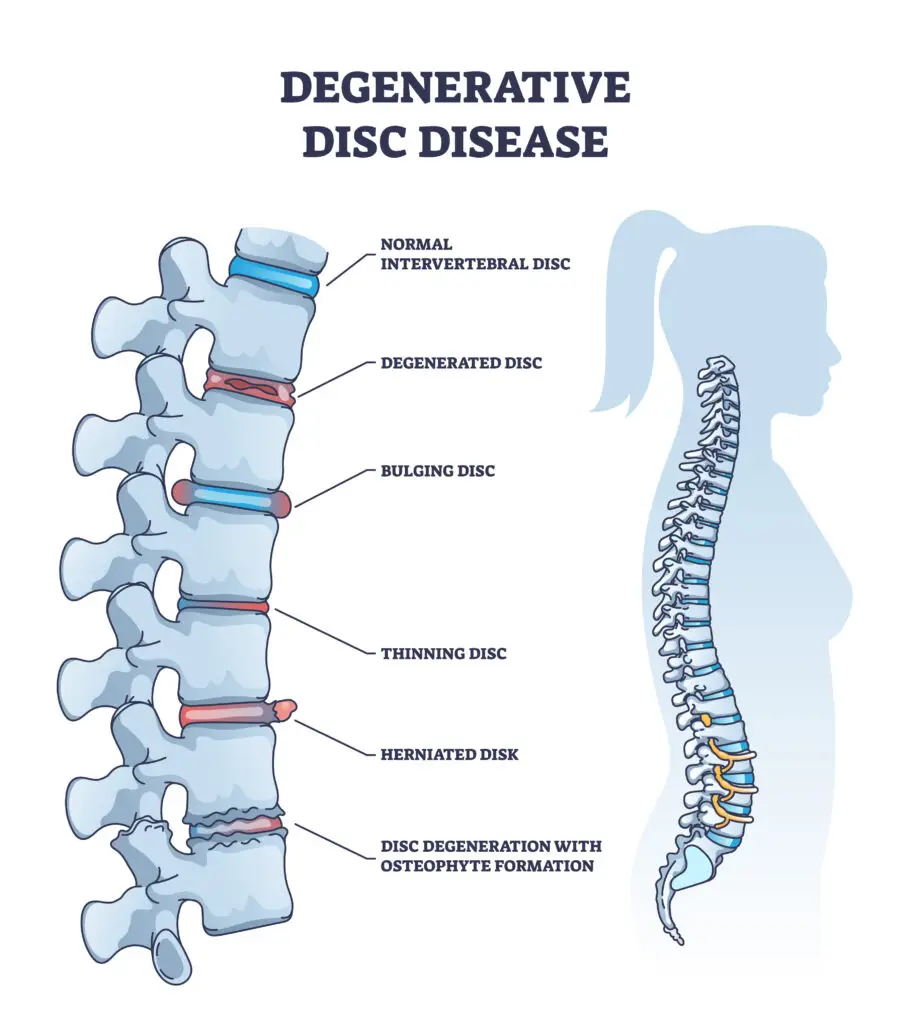
Degenerative disc disease is one of the most common preexisting findings encountered in Texas workers’ compensation neck injury claims. After a workplace fall, lifting accident, vehicle collision, or other traumatic event, an MRI may reveal disc degeneration, loss of disc height, disc bulges, osteophytes, or other age-related changes.
The insurance carrier then makes a familiar argument:
“The MRI shows degeneration. This was already there before the accident.”
Sometimes the carrier is correct that degeneration existed before the work injury. Cervical degenerative disc disease can exist without symptoms, even when imaging shows substantial abnormalities.
But that does not answer the workers’ compensation question.
The real issue is:
Did the workplace accident cause additional damage or harm to the cervical spine that was not there before?
If it did, the worker may have sustained an aggravation of a preexisting condition, rather than merely experiencing symptoms from the natural progression of degeneration.
Texas workers’ compensation recognizes aggravation of a preexisting condition as an injury concept, but the aggravation must constitute a new injury rather than simply a temporary recurrence of symptoms. MLF Legal’s existing aggravation guide discusses this distinction in greater detail.
This post explains how cervical degenerative disc disease can exist before an accident, how workplace forces can cause additional damage to an already degenerative cervical spine, and what medical evidence can distinguish a compensable aggravation from a temporary flare-up.
What Is Cervical Degenerative Disc Disease?
The cervical spine contains intervertebral discs between the vertebral bodies.
Each disc contains:
- An outer annulus fibrosus
- An inner nucleus pulposus
The discs help distribute loads while permitting movement of the cervical spine.
Over time, discs can undergo degenerative changes. Cervical degenerative disease is associated with aging and can occur without producing symptoms. Degenerative cervical spine disease – BMJ Best Practice notes that degenerative cervical disease can be asymptomatic even when radiographs or MRI demonstrate significant degeneration. [bestpractice.bmj.com]
Degenerative cervical changes may eventually be associated with conditions such as:
- Disc-space narrowing
- Disc bulging
- Osteophyte formation
- Foraminal narrowing
- Cervical radiculopathy
- Spinal cord compression
Neurologic problems can develop when degenerative changes create compression of cervical nerve roots or the spinal cord.
Degeneration Does Not Necessarily Mean Disability
This point is critical.
A worker can have cervical degeneration and still:
- Have no significant neck pain
- Require no neck treatment
- Have no arm symptoms
- Have normal strength
- Work full duty
- Perform heavy labor
- Have no functional limitations
Medical literature recognizes that cervical degenerative changes visible on imaging may be asymptomatic. [bestpractice.bmj.com]
That distinction becomes extremely important after a workplace accident.
An MRI obtained after an accident may show degeneration that existed beforehand, but the worker’s post-accident condition may still be different from the pre-accident condition.
The causation analysis therefore cannot stop with:
“There was preexisting degeneration.”
It must ask:
“What additional damage or harm did the accident cause?”
What Is an Aggravation Injury?
This concept needs to be used carefully.
For purposes of the medical and legal analysis we are developing throughout this series:
An aggravation means additional damage or harm that was not present before the workplace injury.
That distinction prevents the term “aggravation” from becoming shorthand for:
“The worker hurts more now.”
Pain matters, but increased pain by itself does not describe what happened anatomically or medically.
A persuasive causation opinion should identify the additional damage or harm supported by the evidence.
What Additional Damage or Harm Can Occur?
The exact additional injury must be determined from the evidence in the individual case.
Depending upon the worker’s medical findings, the claimed aggravation may involve a newly developed or objectively worsened condition such as:
- Disc injury
- Disc herniation or protrusion
- Annular injury
- Additional nerve-root compromise
- New cervical radiculopathy
- New neurologic dysfunction
- Another traumatic condition superimposed on the degenerative cervical spine
The physician should identify the actual additional condition rather than simply state:
“The work injury aggravated degenerative disc disease.”
That conclusion needs an explanation.
Motor Vehicle and Equipment Collisions
Workers injured in:
- Truck collisions
- Company vehicle accidents
- Forklift accidents
- Heavy-equipment incidents
may experience rapid acceleration and deceleration of the cervical spine.
The worker’s neck may undergo combinations of:
- Flexion
- Extension
- Rotation
- Compression
- Shear
The relevant medical question is whether those forces caused additional cervical damage beyond the preexisting degenerative condition.
Falls From Ladders, Scaffolds, or Elevations
Falls can generate substantial impact forces.
Depending upon how the worker lands, the cervical spine may experience combinations of:
- Axial loading
- Flexion
- Extension
- Rotation
- Sudden deceleration
A causation opinion should consider the height, landing mechanism, body position, and subsequent objective findings rather than merely state that the worker “fell.”
Heavy Lifting
Heavy lifting can also create substantial spinal loading, particularly when the worker is:
- Carrying material away from the body
- Lifting overhead
- Twisting while lifting
- Trying to control a shifting load
- Catching something that suddenly drops
The more useful causation question is not simply:
“Can lifting cause neck pain?”
It is:
“What mechanical loading occurred during this particular event, and is that mechanism medically consistent with the additional cervical injury being diagnosed?”
Sudden Pulling or Jerking
A worker’s body may be suddenly pulled by:
- Machinery
- Tools
- Falling materials
- Cables
- Equipment
- A shifting load
These events can produce combined forces rather than a single movement.
The cervical spine may simultaneously undergo rotation, flexion, extension, or distraction.
A Degenerative Disc Can Sustain a New Injury
This is an important medical concept.
The fact that a disc was already degenerative does not mean it is incapable of sustaining another injury.
Trauma literature recognizes that post-traumatic disc damage can arise through compression, distraction, rotation, and translation depending upon the energy involved.
That means the proper question is not:
“Was this cervical disc perfectly normal before the accident?”
Instead:
“What condition existed before the accident, and did the accident cause additional damage to it?”
Disc Bulges, Protrusions, and Herniations
These terms commonly appear in workers’ compensation MRI reports.
A post-accident MRI may demonstrate:
- Disc bulge
- Disc protrusion
- Disc herniation
- Disc extrusion
- Foraminal narrowing
- Nerve-root impingement
Importantly, the presence of preexisting degeneration does not automatically establish whether a particular disc abnormality was also preexisting.
That is a causation determination.
See Cervical Herniated Discs, Disc Protrusions & Disc Bulges.
Comparing Old and New MRIs
When pre-injury imaging exists, actual comparison of the studies may provide particularly useful evidence.
A physician may evaluate whether there has been a change in:
- Disc morphology
- Disc displacement
- Herniation
- Foraminal narrowing
- Neural involvement
- Other structural findings
If an objective structural change is demonstrated after the work accident, the physician should explain whether that represents additional damage that was not present before.
But the absence of an older MRI does not necessarily answer causation either.
Many workers had no reason to obtain cervical imaging before being injured.
No Prior MRI Does Not Mean No Causation Case
Consider a construction worker who performed heavy labor for years without disabling cervical symptoms.
After a significant fall, the worker develops:
- Neck pain
- Arm pain
- Numbness
- Weakness
An MRI obtained afterward shows both:
- Multilevel degeneration
- A cervical disc abnormality affecting a nerve root
There is no prior MRI for comparison.
The correct response is not automatically:
“We cannot prove anything because there is no prior MRI.”
The physician can still evaluate:
- Pre-injury medical history
- Pre-injury functional ability
- Mechanism of injury
- Immediate or subsequent symptoms
- Physical examination
- Neurologic findings
- Post-accident imaging
- Electrodiagnostic evidence
- Clinical progression
Symptoms After Aggravation of Cervical Degenerative Disc Disease
Workers may experience:
- New neck pain
- Increased neck pain
- Restricted cervical motion
- Shoulder or scapular pain
- Radiating arm pain
- Numbness
- Tingling
- Burning sensations
- Arm weakness
- Hand weakness
- Reduced grip strength
The pattern becomes especially significant when it corresponds anatomically with objective evidence of nerve-root involvement.
Aggravated Degenerative Disc Disease and Cervical Radiculopathy
One of the most important potential consequences is cervical radiculopathy.
Degenerative cervical disease can produce nerve-root compression and cervical spondylotic radiculopathy.
The workers’ compensation question may become whether the employee already had that neurologic condition before the accident or whether additional cervical injury resulted in new nerve-root dysfunction afterward.
Relevant objective findings may include:
- Muscle weakness
- Reflex changes
- Sensory abnormalities
- Positive electrodiagnostic findings
Aggravated Degeneration and Foraminal Stenosis
Degenerative cervical disease can also narrow the openings through which nerve roots exit.
A worker may therefore already have:
Cervical foraminal stenosis
before the workplace accident.
The important question is again whether the workplace event produced additional damage or harm that altered the worker’s cervical or neurologic condition.
Aggravation Is Different From a Temporary Flare-Up
This distinction can determine the outcome of the entire case.
Suppose a worker has cervical degeneration and experiences neck soreness for several days after physical work but then returns completely to the previous condition.
That presents a different medical question than a worker who suffers an accident and develops:
- New structural injury
- New neurologic deficits
- New radiculopathy
- Additional disc pathology
- Other objectively demonstrable harm
MLF Legal’s aggravation article explains that Texas workers’ compensation distinguishes a new aggravation injury from a temporary flare-up of a preexisting condition.
That is why a doctor should identify the additional damage or harm, not merely use the word “aggravation.”
The “Made It Symptomatic” Problem
Doctors sometimes write:
“The accident made the preexisting degeneration symptomatic.”
That may accurately describe the timing of symptoms, but it can leave an important question unanswered:
What additional damage or harm did the accident cause?
For a stronger causation opinion, the physician should identify the new injury or measurable worsening supported by the medical evidence and explain how the accident produced it.
That produces a much more defensible opinion than simply equating new symptoms with aggravation.
Diagnosing an Aggravated Cervical Condition
The evaluation may include:
Medical History
The physician should determine whether the worker previously had:
- Neck treatment
- Cervical injections
- Neck surgery
- Radicular symptoms
- Work restrictions
Physical Examination
The examination may evaluate:
- Cervical motion
- Strength
- Reflexes
- Sensation
- Upper-extremity function
MRI
MRI may identify the cervical degenerative and structural abnormalities present after the accident.
EMG/NCS
Electrodiagnostic testing may help evaluate suspected nerve-root dysfunction.
Prior Records
Prior examinations, imaging, and work-status records can help define the worker’s baseline condition before the accident.
Why Pre-Injury Function Matters
Pre-injury function does not, by itself, prove traumatic structural damage.
But it can be an important piece of the overall causation analysis.
Compare:
Before the accident
- Full-duty work
- No significant cervical treatment
- No arm numbness
- No weakness
- No restrictions
with:
After the accident
- Persistent neck pain
- Radicular symptoms
- Objective neurologic abnormalities
- Treatment escalation
- Work restrictions
That clinical change deserves a medical explanation.
The physician must then determine whether the accident caused additional damage or whether symptoms instead reflect the natural progression of the degenerative disease.
Why Insurance Companies Dispute Cervical Degenerative Disc Aggravations
These claims generate predictable defenses.
Carriers may argue:
- The MRI is entirely degenerative
- The abnormalities are age-related
- Nothing structurally changed
- The accident caused only a cervical strain
- The worker had the condition for years
- Radiculopathy is degenerative
- Surgery treats only preexisting disease
- The accident caused a temporary flare-up
The most effective response is not to deny that degeneration exists when it plainly does.
Instead, the medical evidence should answer:
What existed before, what additional damage or harm occurred, and how did the workplace accident cause that change?
Medical Treatment
Treatment depends on what additional cervical condition is actually established.
Depending upon the diagnosis, treatment may include:
- Medication
- Physical therapy
- Activity modification
- Appropriate work restrictions
- Injections in selected cases
- Evaluation for surgery when significant neurologic or structural pathology warrants it
The fact that a worker had degeneration before the accident should not substitute for an individualized determination of what condition now requires treatment.
When Cervical Surgery Becomes Disputed
This is where aggravation disputes often become high stakes.
A surgeon may recommend treatment for pathology involving:
- Disc herniation
- Nerve-root compression
- Foraminal stenosis
- Other cervical structural abnormalities
The carrier may respond:
“The surgery treats degeneration, not the work injury.”
That dispute often turns on whether the medical evidence establishes an additional compensable injury superimposed upon the preexisting degeneration.
The surgeon’s causation analysis can therefore become critical.
Impairment Ratings After an Aggravated Cervical Injury
Establishing the full compensable extent of injury is important before maximum medical improvement and impairment are determined.
For detailed discussion of cervical DRE categories, radiculopathy, objective findings, surgery, MMI, and spinal impairment disputes, see:
Impairment Ratings for Lumbar and Cervical Spine Injuries in Texas Workers’ Compensation
A carrier’s acceptance of only a cervical strain while disputing the additional cervical pathology can become extremely important when impairment is eventually evaluated.
What a Strong Medical Causation Opinion Should Explain
A conclusory letter saying:
“Work aggravated degenerative disc disease.”
leaves too much unanswered.
A stronger opinion addresses:
What condition existed before the accident?
Identify the preexisting degeneration honestly.
Was it symptomatic?
Describe relevant prior treatment and functional status.
What workplace event occurred?
Be specific.
What forces acted upon the cervical spine?
Discuss flexion, extension, rotation, compression, distraction, or combined loading as supported by the actual mechanism.
What happened clinically afterward?
Describe symptoms and examination findings.
What objective evidence exists?
Discuss imaging and neurologic findings.
What additional damage or harm occurred?
This is the critical question.
Why did the work accident cause that additional injury?
Connect the biomechanics to the anatomy and medical evidence.
That is a causation opinion rather than merely a conclusion.
How MLF Legal Handles Aggravated Cervical Degenerative Disc Claims
These cases should not be approached by pretending the worker had a pristine cervical spine before the accident.
Usually, that is unnecessary.
Instead, we focus on separating:
what was already there
from
what the workplace accident added.
That may involve:
- Obtaining prior medical records
- Reviewing prior cervical imaging
- Comparing pre- and post-injury function
- Developing the accident mechanism
- Analyzing cervical biomechanics
- Identifying new structural findings
- Establishing radiculopathy when supported
- Obtaining medical opinions identifying additional damage or harm
- Challenging an artificially narrow cervical-strain diagnosis
- Fighting for appropriate treatment and surgery
- Preparing workers for designated doctor examinations
- Challenging MMI and impairment determinations when appropriate
- Litigating extent-of-injury disputes at BRCs and CCHs
The strongest argument is often not that degeneration did not exist.
It is:
Degeneration existed, but that was not the worker’s entire condition after the accident. The workplace event caused additional damage or harm.
The Bottom Line
Cervical degenerative disc disease is common, and it may exist without symptoms.
A workplace accident does not erase that preexisting condition.
But the preexisting condition does not erase a legitimate workplace injury either.
When trauma acts upon a degenerative cervical spine, the issue is whether it causes additional damage or harm that was not present beforehand. Disc trauma can involve mechanical forces including compression, distraction, rotation, and translation, depending upon the energy and mechanism involved.
A proper causation analysis therefore asks:
What was there before?
What forces did the workplace accident generate?
Was anything different after?
What additional damage or harm occurred?
And does the medical evidence explain why the accident caused that change?
That framework produces a far stronger Texas workers’ compensation aggravation case than simply arguing over whether an MRI contains the word“degenerative.”
Call to Action
If an insurance carrier is blaming your cervical condition entirely on preexisting degenerative disc disease after a workplace injury, call the workers’ compensation lawyers at MLF Legal today.
We fight for injured workers — not insurance companies.
FAQs: Aggravation of Cervical Degenerative Disc Disease in Texas Workers’ Comp Claims
Yes. Degenerative cervical changes can be present on imaging without producing symptoms.
Yes, when the work injury causes a genuine aggravation of the preexisting condition. The key issue is identifying the additional damage or harm that was not present before the workplace injury, rather than merely documenting increased symptoms. MLF Legal’s existing aggravation guide discusses the Texas aggravation concept in greater detail.
Often, when this type of aggravation occurs, we have to litigate an extent of injury issue before the Division of Workers’ Compensation. Cervical degenerative disc disease in Texas workers’ comp claims is often disputed because of its pre-existing nature. Insurance companies overlook the concept of aggravation, so hearings become inevitable.
No. Degeneration tells us that preexisting changes are present. It does not, by itself, answer whether the workplace accident caused another cervical injury or additional damage to the preexisting condition.
Depending upon the case, useful evidence may include prior medical records, old and new imaging, pre-injury work status, post-injury examinations, neurologic findings, EMG/NCS testing, and a physician’s reasoned explanation of the additional damage or harm.
Aggravation of cervical degenerative disc disease in Texas workers’ comp claims almost always requires a good causation letter.
Not necessarily. The stronger analysis identifies the new injury or additional damage or harm supported by the evidence and explains why the workplace event caused it.
Degenerative cervical disease can produce nerve-root compression and cervical radiculopathy. Whether a worker’s particular radiculopathy resulted from the workplace aggravation requires an individualized causation analysis.
In this scenario, a causation letter is almost always necessary to pursue liability for nerve root irritation or radiculopathy arising from an aggravation of cervical disc disease in Texas workers’ comp claims.
That may create an extent-of-injury dispute when the medical evidence supports additional cervical pathology. The physician should specifically identify the additional condition and explain its causal relationship to the workplace accident.
Injured at work in Texas and your employer doesn’t have workers’ comp?
You may have the right to sue and recover full compensation.
Contact MLF Legal today for a free consultation. You pay nothing unless we win your case.
Next Steps:
1st
Sign up For a Free One-on-One Work Comp Case Evaluation
NEXT LEGAL STEP
Get a Legal Opinion
Contact us today to schedule your personalized one-on-one free phone consultation with one of our dedicated legal professionals. Our experienced Worker’s Comp Lawyers are here to provide the expert legal guidance and support you need throughout the entire process of your case.
We understand the complexities involved in Worker’s Compensation claims and are committed to helping you achieve the best possible outcome. Don’t hesitate to reach out and take the first step toward securing the justice you deserve.
2nd
Download Free E-Books
NEXT LEGAL STEP
Workers' Compensation

Applying for workers compensation can be a challenging process. It involves filing a claim, providing medical documentation, and navigating the approval process. Seeking guidance from a workers’ compensation attorney can help ensure your rights are protected and your claim is handled properly.
LET’S GET STARTED
Call MLF Legal today
214-357-1782
Fill out our online form
for a free consultation.
We only get paid if we win your case.