
Cervical Foraminal Stenosis in Texas Workers’ Compensation Claims
FREE CONSULTATION
Contact Us About Your Case
FREE Consultation Today.
Cervical Foraminal Stenosis in Texas Workers’ Compensation Claims
Cervical foraminal stenosis is a common condition in Texas workers’ compensation claims, particularly when an injured worker develops neck pain, radiating arm pain, numbness, tingling, or weakness after a workplace accident.
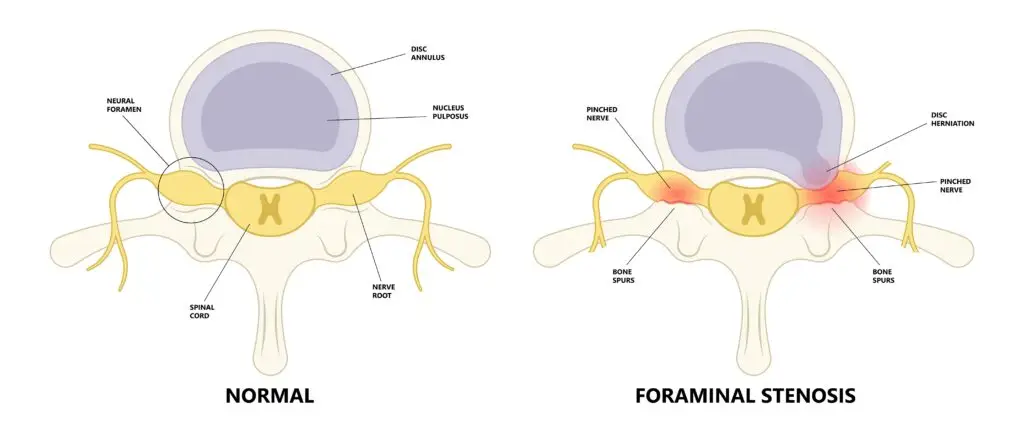
Unlike some traumatic cervical injuries, cervical foraminal stenosis frequently develops gradually from degenerative changes that existed before the work accident. Degenerative disc disease, loss of disc height, bone spurs, thickened ligaments, and arthritic changes can narrow the neural foramen, the opening through which a cervical nerve root exits the spine.
That does not end the workers’ compensation analysis.
A worker may have preexisting foraminal narrowing that never caused significant symptoms or functional problems before the accident. The real issue may be whether the workplace event caused additional damage or harm to the cervical spine that aggravated the preexisting stenosis and resulted in new or increased nerve-root compromise.
As we have emphasized throughout this series:
An aggravation requires additional damage or harm that was not there before the workplace injury.
The presence of preexisting degeneration does not answer that question.
This post explains what cervical foraminal stenosis is, how workplace injuries can interact with preexisting stenosis, how stenosis causes cervical radiculopathy, and how these conditions become disputed in Texas workers’ compensation claims.
What Is Cervical Foraminal Stenosis?
Along each side of the cervical spine are openings called neural foramina.
Cervical nerve roots travel through these openings as they leave the spinal canal and extend toward the:
- Shoulder
- Arm
- Forearm
- Hand
- Fingers
Cervical foraminal stenosis means that one or more of these openings has become narrowed.
When that narrowing becomes sufficient to compress or irritate a nerve root, workers may develop pain and neurologic symptoms extending from the neck into the upper extremity, like Cervical Radiculopathy.
What Causes Cervical Foraminal Stenosis?
Cervical foraminal stenosis is commonly associated with gradual degenerative changes in the cervical spine.
Those changes may include:
- Degenerative disc disease
- Loss of disc height
- Bone spurs or osteophytes
- Facet-joint changes
- Bulging discs
- Thickening of surrounding ligaments
These changes can progressively reduce the space available for the exiting nerve root.
This is precisely why cervical foraminal stenosis creates challenging workers’ compensation cases.
The worker may have had narrowing before the accident.
But that does not necessarily mean the worker had the same medical condition, functional impairment, or nerve-root involvement before the accident.
Preexisting Foraminal Stenosis and Workplace Injuries
This is the central issue in many Texas workers’ compensation claims involving foraminal stenosis.
Imagine a worker who has degenerative narrowing at C5-6 before an accident.
Before the injury, the worker:
- Works full duty
- Has no disabling neck pain
- Has no radiating arm pain
- Has no documented weakness
- Has no work restrictions
The worker then experiences a significant workplace accident and develops:
- Neck pain
- Radiating arm pain
- Hand numbness
- Weakness
- Reflex abnormalities
- Other evidence of nerve-root involvement
An MRI after the accident shows foraminal stenosis.
The carrier may immediately respond:
“The stenosis is degenerative and preexisting.”
But that only addresses when some of the narrowing developed.
It does not answer the more important question:
Did the work accident cause additional damage or harm to the cervical spine that aggravated the preexisting stenosis and produced a new or worsened condition?
That requires a genuine medical causation analysis.
What Is an Aggravation of Cervical Foraminal Stenosis?
We need to be precise here.
Simply becoming symptomatic does not automatically prove a compensable aggravation.
A proper aggravation analysis asks what additional damage or harm resulted from the work injury.
The physician should identify what changed.
Depending on the medical evidence in the particular case, that additional harm might involve:
- New disc pathology
- Additional disc displacement
- New or increased nerve-root compromise
- New neurologic dysfunction
- Another traumatic cervical condition that reduces available foraminal space
The exact additional injury must be supported by the worker’s medical evidence.
The important point is this:
Preexisting stenosis and a new workplace injury can exist at the same time.
The physician’s job is to distinguish the condition that was already present from the additional damage or harm caused by the workplace event.
See Aggravation Injuries.
A Useful Causation Framework
Rather than asking only:
“Did the worker already have foraminal stenosis?”
a more complete medical analysis asks a series of questions:
What was there before?
Did the worker already have degenerative narrowing?
What happened during the accident?
Which forces acted upon the cervical spine?
What changed afterward?
Did new structural or neurologic abnormalities develop?
What additional harm occurred?
Is there evidence that the accident created a new injury or materially worsened an existing cervical condition?
Does the anatomy match the symptoms?
Does the affected level and nerve root correlate with the worker’s actual neurologic presentation?
This framework prevents the causation analysis from stopping at the word“degenerative.”
How Workplace Accidents Can Affect a Stenotic Cervical Spine
A worker with preexisting narrowing has less available space surrounding a cervical nerve root than someone with a completely open neural foramen.
A workplace accident may subject that cervical spine to significant mechanical loading.
Potential mechanisms include:
- Motor vehicle collisions
- Falls from ladders or scaffolds
- Slips and falls
- Heavy lifting accidents
- Sudden twisting
- Falling objects
- Machinery accidents
- Sudden pulling events
- Direct impacts to the upper body
The medical analysis should then examine the actual forces involved.
Flexion and Extension
A workplace collision or fall can rapidly move the cervical spine forward and backward.
These movements alter loading across:
- Cervical discs
- Facet joints
- Ligaments
- Other stabilizing structures
In an already narrowed motion segment, additional traumatic pathology may become clinically significant.
Rotation
Many workplace accidents involve rotation as well as flexion or extension.
For example, the worker may be:
- Looking sideways during a collision
- Twisting while lifting
- Turning when struck
- Rotating during a fall
The treating physician should consider the worker’s actual position and the direction of force when evaluating causation.
Compression and Combined Loading
High-energy workplace events can involve compression together with flexion, extension, or rotation.
Real accidents rarely create one perfectly isolated biomechanical force.
That is why the most persuasive causation opinions usually explain the complete mechanism of injury rather than simply naming the accident.
Cervical Disc Herniations and Foraminal Stenosis
Disc pathology is particularly important.
A worker may have degenerative foraminal narrowing and then sustain additional disc injury during the workplace accident.
A disc herniation or other disc displacement may further reduce the space surrounding the nerve root or contribute to nerve-root inflammation.
Disc bulging and degenerative disc changes are recognized contributors to foraminal narrowing, and a cervical herniated disc can also irritate or compress an adjacent nerve root.
See Cervical Herniated Discs, Disc Protrusions & Disc Bulges.
Cervical Foraminal Stenosis and Radiculopathy
Foraminal stenosis becomes especially significant when it affects the exiting cervical nerve root.
The resulting cervical radiculopathy may produce:
- Radiating arm pain
- Numbness
- Tingling
- Weakness
- Reflex abnormalities
- Loss of grip strength
- Functional problems in the hand or arm
Cervical foraminal stenosis is a recognized cause of cervical radiculopathy.
Importantly, foraminal narrowing on MRI does not always cause symptoms. Some people have imaging evidence of stenosis without pain or neurologic deficits.
That fact cuts both ways in a workers’ compensation case.
A carrier cannot logically rely on the MRI to prove the narrowing existed while simultaneously assuming that the worker necessarily had the same symptomatic nerve-root condition before the accident.
Those are separate medical questions.
Which Cervical Levels Are Involved?
The specific symptoms depend upon which exiting nerve root is affected.
A worker may experience symptoms involving the:
- Shoulder
- Upper arm
- Forearm
- Thumb
- Fingers
- Hand
The critical question is whether the worker’s:
symptoms + examination findings + imaging + electrodiagnostic evidence
form a medically coherent pattern.
Symptoms of Cervical Foraminal Stenosis
Workers may report:
- Neck pain
- Neck stiffness
- Shoulder pain
- Radiating arm pain
- Burning pain
- Numbness
- Tingling
- Hand symptoms
- Weakness
- Reduced grip strength
When foraminal narrowing affects a cervical nerve root, symptoms can extend into the arm or hand and include neurologic deficits such as numbness, reflex abnormalities, or weakness.
Diagnosing Cervical Foraminal Stenosis
A meaningful diagnosis combines imaging with the clinical findings.
Physical Examination
The physician may evaluate:
- Cervical range of motion
- Strength
- Sensation
- Reflexes
- Upper-extremity function
MRI
MRI is commonly used to evaluate degenerative cervical changes and the degree of foraminal narrowing.
The MRI may describe:
- Mild foraminal stenosis
- Moderate foraminal stenosis
- Severe foraminal stenosis
- Disc protrusion or bulging
- Osteophytes
- Facet changes
- Nerve-root impingement
CT
CT may provide additional information about the bony structures contributing to narrowing.
EMG/Nerve Conduction Studies
Electrodiagnostic testing may become important when cervical radiculopathy is disputed.
The MRI Does Not Determine Causation by Itself
An MRI can show foraminal stenosis.
It does not automatically tell us:
- When the narrowing became clinically significant
- Whether the worker was symptomatic before the accident
- Whether additional disc injury occurred
- Whether the accident produced additional neurologic harm
- Whether current symptoms are causally related to the workplace injury
Those questions require interpretation of the entire medical record.
Comparing Pre-Injury and Post-Injury Evidence
When prior medical records or cervical imaging exist, they can become extremely important.
A physician may be able to compare:
Before the accident
- Imaging findings
- Symptoms
- Neurologic function
- Work status
- Treatment history
with:
After the accident
- New imaging findings
- New symptoms
- New weakness
- New sensory abnormalities
- New reflex changes
- New treatment requirements
The comparison may help identify the additional damage or harm necessary to establish an aggravation.
Why “It Was Preexisting” Is Not the End of the Analysis
Suppose an MRI demonstrates longstanding foraminal stenosis.
The carrier says:
“This existed before the accident.”
That may be true.
But the next question is still:
What did the workplace accident do?
Did it cause another cervical injury that materially changed the worker’s condition?
Was there additional damage or harm?
Did the worker develop objectively supported nerve-root dysfunction that was not there before?
The existence of an underlying condition and the existence of a compensable aggravation are not mutually exclusive.
Medical Treatment for Cervical Foraminal Stenosis
Treatment depends on the severity of the stenosis, symptoms, neurologic findings, and associated cervical pathology.
Initial treatment for cervical radiculopathy related to foraminal stenosis is often conservative when concerning or progressive neurologic findings are absent.
Treatment may include:
- Medication
- Physical therapy
- Activity modification
- Appropriate work restrictions
- Targeted injections in selected cases
More significant or persistent neurologic problems may require additional evaluation.
When Surgery May Become Necessary
Surgical treatment may become an issue when workers develop circumstances such as:
- Persistent severe symptoms
- Progressive neurologic dysfunction
- Failure of conservative treatment
- Other significant neurologic complications
These are among the circumstances in which surgical intervention is considered for symptomatic foraminal stenosis and cervical radiculopathy.
The procedure selected depends on the actual anatomy responsible for nerve-root compromise.
Why Insurance Companies Dispute Cervical Foraminal Stenosis Claims
These claims create predictable carrier defenses.
Insurance companies may argue:
- The stenosis is degenerative
- The stenosis existed before the accident
- The workplace event caused only a cervical strain
- MRI abnormalities are age-related
- Arm symptoms are unrelated
- There is no cervical radiculopathy
- Surgery addresses a preexisting condition
- Current disability is unrelated to work
The worker’s case becomes significantly stronger when the medical evidence does more than simply say:
“The accident aggravated the stenosis.”
The physician should explain what additional damage or harm occurred and why the workplace event caused it.
Impairment Ratings and Cervical Foraminal Stenosis
Foraminal stenosis can become relevant to impairment when it is associated with compensable cervical pathology and particularly when supported neurologic abnormalities are present.
The Texas impairment analysis should be performed according to the required methodology rather than assuming that an MRI diagnosis automatically generates an impairment percentage.
For the detailed cervical impairment discussion, see:
Impairment Ratings for Lumbar and Cervical Spine Injuries in Texas Workers’ Compensation
The strategic point is critical:
The full compensable extent of the cervical injury should be correctly determined before MMI and impairment are evaluated.
Building a Strong Causation Case for Aggravated Foraminal Stenosis
A persuasive medical opinion should address:
The Preexisting Condition
What cervical degeneration or stenosis existed before the accident?
Pre-Injury Function
Was the worker symptomatic, under treatment, or restricted from work?
Mechanism of Injury
What happened during the workplace event?
Biomechanical Forces
How did the cervical spine move or load during the event?
Post-Injury Changes
What new structural, neurologic, or functional abnormalities developed?
Objective Evidence
What do physical examinations, MRI, and electrodiagnostic studies show?
Additional Harm
Most importantly:
What damage or harm exists after the accident that was not present before it?
That final question should be directly answered whenever the physician gives an aggravation opinion.
How MLF Legal Handles Cervical Foraminal Stenosis Claims
We focus on separating preexisting anatomy from the additional injury caused by the workplace accident.
That may include:
- Examining prior cervical records
- Comparing old and new imaging
- Establishing pre-injury work capacity
- Developing the accident biomechanics
- Identifying new neurologic findings
- Establishing cervical radiculopathy where supported
- Obtaining medical opinions identifying additional damage or harm
- Challenging an artificially narrow “cervical strain” diagnosis
- Fighting for appropriate treatment
- Preparing workers for designated doctor examinations
- Challenging premature MMI and incorrect impairment ratings
- Litigating extent-of-injury disputes at BRCs and CCHs
A worker does not need a perfectly normal spine before the accident to sustain a legitimate workplace cervical injury.
The issue is what the workplace event actually changed.
The Bottom Line
Cervical foraminal stenosis frequently presents as a preexisting degenerative condition in workers’ compensation claims. Bone spurs, disc degeneration, disc-height loss, and other changes may have gradually narrowed the neural foramen long before the workplace accident.
But identifying preexisting stenosis is only the beginning of the causation analysis.
The critical question is:
Did the workplace accident cause additional damage or harm that was not there before?
When a worker with preexisting stenosis suffers additional cervical injury and develops new or worsened nerve-root compromise, the physician should identify the additional harm and explain how the forces of the workplace event produced it.
That is a much stronger medical and legal analysis than either side simply pointing to the word“degenerative” on an MRI report.
Call to Action
If you developed neck pain, radiating arm pain, numbness, tingling, or weakness after a workplace accident and the insurance carrier is blaming your symptoms entirely on preexisting foraminal stenosis, call the workers’ compensation lawyers at MLF Legal today.
We fight for injured workers — not insurance companies.
FAQs: Cervical Foraminal Stenosis in Texas Workers’ Compensation Claims
It frequently develops from degenerative cervical changes such as disc degeneration, loss of disc height, bone spurs, and thickened ligaments.
Yes. Foraminal narrowing can appear on imaging without associated pain or neurologic deficits.
Potentially, yes, but the medical evidence should establish more than increased symptoms. A proper aggravation analysis identifies additional damage or harm that was not present before the work injury and connects that additional condition to the workplace event.
Yes. Narrowing of the neural foramen can compress or irritate the exiting cervical nerve root and produce radiculopathy.
The presence of degeneration does not answer whether the accident caused additional injury. The medical analysis should compare the worker’s pre-injury condition with the structural, neurologic, and functional condition after the workplace accident.
Not automatically. Because foraminal stenosis can exist without symptoms, the imaging should be correlated with the worker’s symptom distribution, examination, neurologic findings, and other relevant testing.
It may become relevant depending upon the compensable cervical conditions and associated objective findings. For the detailed Texas spinal impairment analysis, see MLF Legal’s Impairment Ratings for Lumbar and Cervical Spine Injuries in Texas Workers’ Compensation article.
Injured at work in Texas and your employer doesn’t have workers’ comp?
You may have the right to sue and recover full compensation.
Contact MLF Legal today for a free consultation. You pay nothing unless we win your case.
Next Steps:
1st
Sign up For a Free One-on-One Work Comp Case Evaluation
NEXT LEGAL STEP
Get a Legal Opinion
Contact us today to schedule your personalized one-on-one free phone consultation with one of our dedicated legal professionals. Our experienced Worker’s Comp Lawyers are here to provide the expert legal guidance and support you need throughout the entire process of your case.
We understand the complexities involved in Worker’s Compensation claims and are committed to helping you achieve the best possible outcome. Don’t hesitate to reach out and take the first step toward securing the justice you deserve.
2nd
Download Free E-Books
NEXT LEGAL STEP
Workers' Compensation
Applying for workers compensation can be a challenging process. It involves filing a claim, providing medical documentation, and navigating the approval process. Seeking guidance from a workers’ compensation attorney can help ensure your rights are protected and your claim is handled properly.
LET’S GET STARTED
Call MLF Legal today
214-357-1782
Fill out our online form
for a free consultation.
We only get paid if we win your case.