
Cervical Herniated Discs in Texas Workers’ Compensation Claims
FREE CONSULTATION
Contact Us About Your Case
FREE Consultation Today.
Cervical Herniated Discs in Texas Workers’ Compensation Claims
Cervical herniated discs in Texas workers’ compensation claims are among the most significant and frequently disputed injuries in work injury cases. A workplace fall, motor vehicle collision, lifting accident, machinery incident, or other traumatic event can place substantial forces on the cervical spine and damage an intervertebral disc.
An injured worker’s MRI may describe the condition using terminology such as:
- Disc herniation
- Disc protrusion
- Disc bulge
- Disc extrusion
- Disc degeneration
- Annular changes
- Nerve root compression
- Spinal cord compression
Those terms matter, but the MRI should not be considered in isolation. A cervical disc abnormality can exist without symptoms, and degenerative changes can coexist with traumatic injury. Medical sources recognize that cervical disc herniation can result from degenerative changes with or without trauma, and that a herniated disc can compress or irritate a cervical nerve root and produce radiculopathy.
For a Texas workers’ compensation claim, the critical questions are:
What happened to the cervical disc during the workplace accident? Did the accident cause new damage or additional harm to a preexisting disc condition? And does the disc injury explain the worker’s symptoms and objective findings?
This post explains cervical disc herniations, protrusions, and bulges, the forces capable of damaging cervical discs, how these injuries are diagnosed and treated, and why they frequently become extent-of-injury disputes.
Understanding Cervical Disc Anatomy
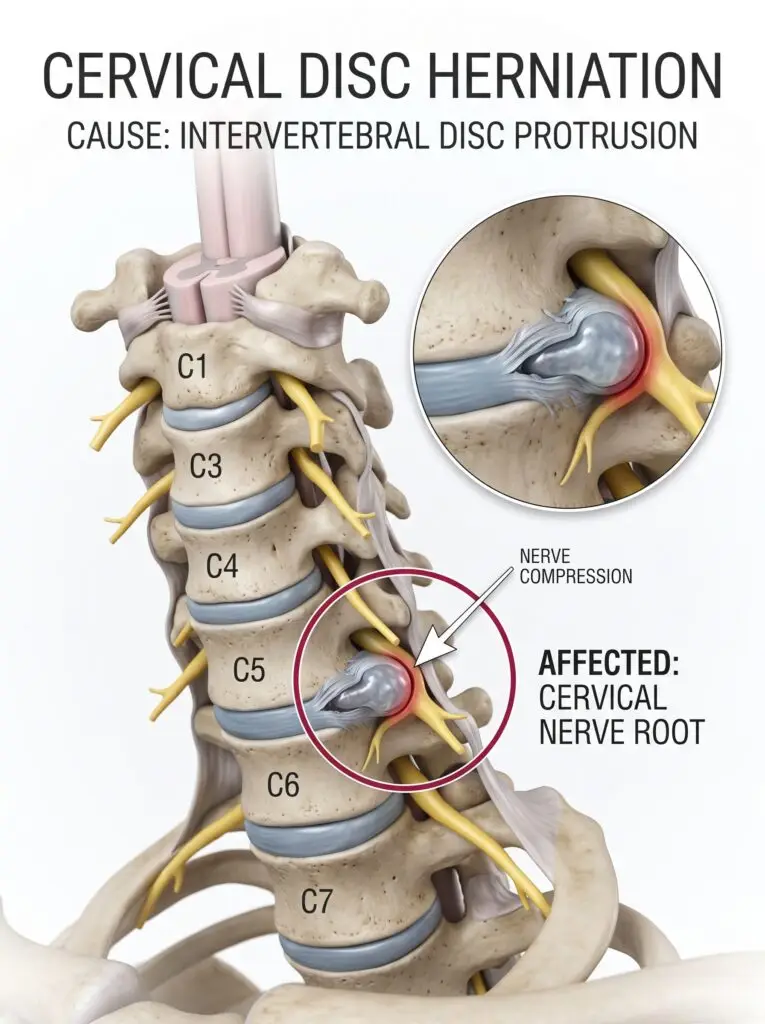
The cervical spine consists of vertebrae separated by intervertebral discs.
Each disc contains two principal components:
- Annulus fibrosus, the tougher outer portion
- Nucleus pulposus, the softer central material
Intervertebral discs help accommodate movement while absorbing and distributing loads placed upon the spine.
When the disc is damaged, its shape or structural integrity may change. Disc material may displace toward the spinal canal or neural foramen, where it can potentially affect a nearby nerve root or, in more serious cases, the spinal cord.
A herniated cervical disc can cause nerve-root compression or irritation and resulting radiculopathy.
Disc Bulge vs. Disc Protrusion vs. Disc Herniation
These terms are frequently used in MRI reports, medical records, and workers’ compensation disputes.
They should not automatically be treated as identical.
Cervical Disc Bulge
A disc bulge generally describes extension of disc tissue beyond its normal boundary over a broader portion of the disc.
A bulge may or may not:
- Produce symptoms
- Narrow the spinal canal
- Narrow a neural foramen
- Contact a nerve root
The existence of a disc bulge on MRI therefore does not, standing alone, establish either disability or traumatic causation.
That does not mean it should automatically be dismissed as “degenerative,” either.
The MRI finding must be evaluated together with the accident mechanism, prior condition, symptoms, physical examination, and other objective evidence.
Cervical Disc Protrusion
A disc protrusion describes a more focal displacement of disc material.
Depending upon its location and size, a protrusion can potentially:
- Narrow a neural foramen
- Affect a cervical nerve root
- Narrow the spinal canal
- Contribute to neurologic symptoms
Cervical disc herniation can occur when degenerative changes, with or without trauma, result in protrusion or rupture of disc material through the annulus.
Cervical Disc Herniation
Disc herniation is the broader clinical concept involving displacement of disc material beyond its normal confines.
Disc material that compresses or irritates a nerve root may produce cervical radiculopathy.
That can create symptoms extending well beyond the neck.
Workplace Accidents That Can Cause Cervical Herniated Discs In Texas Workers' Compensation Cases
Potential mechanisms include:
- Motor vehicle collisions
- Truck accidents
- Forklift accidents
- Falls from ladders or scaffolds
- Slips and falls
- Heavy lifting incidents
- Falling objects
- Sudden pulling injuries
- Machinery accidents
- Direct impacts involving the head or upper body
- Sudden twisting while carrying a load
The fact that a particular mechanism is capable of injuring a disc does not prove causation in an individual worker. The physician should analyze the actual forces generated by the accident and determine whether they are medically consistent with the particular cervical pathology being claimed.
How Workplace Forces Can Damage Cervical Discs
This is where a strong workers’ compensation causation analysis separates itself from simply repeating an MRI report.
The physician should connect force to anatomy.
Flexion Forces
Flexion occurs when the neck moves forward.
A sudden forward movement can occur during:
- Motor vehicle collisions
- Falls
- Sudden deceleration
- Impact from behind
- Accidents while handling heavy materials
Rapid flexion changes loading across the cervical motion segments.
In an appropriate case, the causation analysis should determine whether the force was sufficient to produce new disc injury or additional damage to a previously abnormal disc.
Extension Forces
Extension occurs when the head moves backward.
This can occur when:
- A worker falls backward
- An impact forces the head backward
- A collision rapidly moves the torso beneath the head
Cervical trauma frequently involves combinations of motion rather than a perfectly isolated movement.
For example, an acceleration-deceleration accident may rapidly move the cervical spine through extension followed by flexion.
Rotational Forces
Workplace accidents frequently occur when the neck is not in a neutral position.
A worker may be:
- Looking sideways when a vehicle is struck
- Twisting while carrying material
- Turning when struck by equipment
- Rotating during a fall
The physician should consider whether rotation accompanied flexion, extension, compression, or another loading force.
That analysis is generally more persuasive than simply writing:
“The patient hurt his neck at work.”
Compression and Axial Loading
Certain falls, impacts, and high-energy accidents can transmit compressive forces through the cervical spine.
When a worker’s claim involves a significant traumatic mechanism, the medical evaluation should consider whether more than a simple soft-tissue cervical strain occurred.
Combined Loading
Real workplace accidents rarely produce one perfectly isolated force.
A worker who falls while carrying a heavy object may simultaneously experience:
- Flexion
- Rotation
- Compression
- Muscle contraction
- Sudden deceleration
The causation analysis should therefore examine what actually happened to the worker’s body rather than forcing every accident into one simplified biomechanical category.
Symptoms of a Cervical Herniated Disc
Symptoms depend upon the location of the disc abnormality and whether neural structures are affected.
Workers may report:
- Neck pain
- Neck stiffness
- Shoulder pain
- Pain radiating into an arm
- Numbness
- Tingling
- Burning sensations
- Arm or hand weakness
- Reduced grip strength
Cervical herniated discs in Texas workers’ compensation claims can produce upper-extremity pain, numbness, paresthesias, and weakness when a nerve root is affected.
Cervical Radiculopathy
One of the most important consequences of a cervical disc herniation is cervical radiculopathy.
Radiculopathy occurs when a cervical nerve root becomes compressed or irritated.
A worker may experience:
- Radiating arm pain
- Numbness
- Tingling
- Weakness
- Reflex abnormalities
- Other neurologic findings
See Cervical Radiculopathy.
Cervical Myelopathy and Spinal Cord Compression
Some cervical disc conditions raise a more serious concern: compression of the spinal cord rather than an individual nerve root.
Cervical myelopathy can produce symptoms that include:
- Hand numbness
- Hand or arm weakness
- Difficulty with fine motor tasks
- Balance problems
- Difficulty walking
A herniated disc is one potential cause of cervical spinal cord compression.
Neurologic findings of this type require appropriate medical evaluation and should not simply be treated as symptoms of an ordinary cervical strain.
Diagnosing Cervical Disc Herniations
Diagnosis typically combines several pieces of evidence.
Medical History
Important questions include:
- What happened during the accident?
- When did symptoms begin?
- Where does the pain travel?
- Were similar symptoms present before the accident?
Physical Examination
The physician may evaluate:
- Cervical motion
- Strength
- Sensation
- Reflexes
- Upper-extremity neurologic function
MRI
MRI is commonly used to identify cervical disc pathology and evaluate its relationship to neural structures. Cervical disc herniation is generally confirmed with MRI or CT in conjunction with the clinical picture.
CT
CT may provide additional information in appropriate cases.
Electrodiagnostic Testing
When radiculopathy is disputed, electrodiagnostic testing may become relevant to the overall neurologic evaluation and, importantly, to impairment issues under the Texas system as discussed in MLF Legal’s cervical impairment-rating guide.
An MRI Finding Alone Does Not Prove Causation
This issue deserves its own section.
An MRI tells the doctor what the cervical spine looks like.
It does not, by itself, determine:
When did this disc condition develop, and what caused it?
That requires medical analysis.
The physician should consider:
- Pre-injury symptoms
- Prior medical treatment
- Prior imaging, if available
- Mechanism of injury
- Symptom onset
- Neurologic findings
- Current MRI findings
- Clinical correlation
This is particularly important because cervical herniation can arise in association with degeneration, with or without trauma.
What If the MRI Says “Degenerative”?
This is often the point where the workers’ compensation dispute begins.
A carrier may argue:
“The MRI shows degeneration, so the disc condition was not caused by work.”
That reasoning is incomplete.
The existence of degeneration establishes that degeneration exists. It does not, standing alone, establish whether a workplace accident caused additional damage or harm to that disc or another cervical structure.
The proper analysis should ask:
What changed because of the work accident?
Aggravation of a Preexisting Cervical Disc
The standard we have used throughout this series is particularly important here:
An aggravation is additional damage or harm that was not there before the work injury.
It is not enough to say:
“The accident aggravated his neck.”
The physician should identify the claimed additional harm.
Depending upon the actual medical evidence in a particular case, that might involve a newly developed or measurably worsened structural or neurologic condition.
The opinion should then explain how the evidence demonstrates that this additional condition resulted from the workplace accident.
That analysis is much stronger than merely pointing out that the employee became symptomatic after an accident.
See Aggravation Injuries.
Why Comparing Prior and Current MRIs Can Be Powerful
When pre-injury cervical imaging exists, comparison can become extremely important.
The medical analysis may be able to determine whether a disc abnormality:
- Was already present
- Appeared after the accident
- Changed in morphology or extent
- Is accompanied by different neural involvement
This type of comparison can help the physician answer the critical question:
Is there additional damage or harm that was not present before?
But imaging should still be interpreted by the appropriate physician in the context of the worker’s complete clinical history.
Medical Treatment for Cervical Disc Herniations
Treatment depends on the actual diagnosis, neurologic findings, severity, and response to conservative care.
Mild cervical herniation may be treated with measures that include medication, activity modification, and physical therapy.
More significant cases may require treatment directed at persistent nerve compression.
When Cervical Disc Surgery May Be Required
When cervical radiculopathy persists or worsens despite nonsurgical treatment, surgery may be considered. The goal is generally to decompress the affected nerve.
Procedures described by Surgical Treatment for Cervical Radiculopathy – OrthoInfo – AAOS include:
- Anterior cervical discectomy and fusion (ACDF)
- Artificial disc replacement
- Posterior cervical laminoforaminotomy
The appropriate procedure depends on the worker’s actual condition and the location and nature of the pathology.
For workers in physically demanding jobs, cervical surgery may also create substantial return-to-work issues that need individualized medical evaluation.
Reasons Insurance Companies Dispute Cervical Herniated Disc Claims
Common carrier arguments include:
- The disc abnormality is degenerative
- The disc bulge existed before the accident
- The mechanism was insufficient
- The accepted injury is only a cervical strain
- Arm symptoms are unrelated
- There is no radiculopathy
- Surgery is unrelated to the compensable injury
- Current disability results from preexisting disease
These cases often become major extent-of-injury disputes.
The quality of the causation evidence can therefore determine whether the worker receives treatment for the actual disc condition or only for the carrier’s narrower accepted diagnosis.
Why Insurance Companies Dispute Cervical Herniated Disc Claims
Cervical disc injuries can create significant impairment-rating issues in Texas workers’ compensation cases, particularly when radiculopathy, structural abnormalities, or surgery are involved.
Rather than duplicate that detailed analysis here, see MLF Legal’s Impairment Ratings for Lumbar and Cervical Spine Injuries in Texas Workers’ Compensation. That guide discusses the cervical DRE categories, objective findings, radiculopathy, EMG/NCS evidence, surgery, MMI, and disputes over spinal impairment ratings.
One strategic point is particularly important:
The compensable extent of the cervical injury should be correctly established before the impairment rating is evaluated.
A dispute over whether the compensable injury includes only a cervical strain or also includes a cervical disc condition can materially affect the issues evaluated at MMI and impairment.
Building a Strong Cervical Disc Causation Case
A persuasive case should connect the accident, anatomy, objective findings, and clinical progression in a causation analysis.
Important evidence may include:
Mechanism of Injury
What physically happened?
Forces
Did the accident involve flexion, extension, rotation, compression, acceleration-deceleration, or combined loading?
Pre-Injury Condition
Did the worker have prior neck complaints, restrictions, treatment, or imaging?
Symptom Onset
When did neck and upper-extremity symptoms begin?
Neurologic Findings
Are there objective findings that correspond with an affected nerve root?
Imaging
Does MRI demonstrate a disc abnormality that correlates anatomically with the worker’s symptoms?
Comparison Studies
If prior imaging exists, has the treating physician actually compared it with the post-injury MRI?
Medical Explanation
Most importantly, can the physician explain why the workplace forces caused the claimed disc injury or additional damage to a preexisting condition?
How MLF Legal Handles Cervical Disc Injury Claims
We focus on developing the complete injury rather than allowing the case to stop at a generic “neck strain” diagnosis.
That may include:
- Establishing the exact accident mechanism
- Developing evidence concerning cervical biomechanics
- Identifying disc herniations, protrusions, and bulges
- Separating preexisting degeneration from additional injury
- Comparing prior and post-accident medical evidence
- Establishing cervical radiculopathy when supported
- Developing medical evidence of aggravation
- Fighting for appropriate treatment and surgery
- Preparing injured workers for designated doctor examinations
- Challenging premature MMI and incorrect impairment ratings
- Litigating extent-of-injury disputes at BRCs and CCHs
A cervical disc case becomes much stronger when the medical evidence explains what changed, why it changed, and how the workplace accident caused that change.
The Bottom Line
Cervical disc injuries are more complicated than simply reading the words“bulge,” “protrusion,” or “herniation” from an MRI report.
The real workers’ compensation analysis asks:
What condition does the worker actually have?
Does that condition correlate with the worker’s symptoms and objective findings?
What forces acted upon the cervical spine during the workplace accident?
Did those forces cause new injury or additional damage or harm to a preexisting cervical condition?
And does the medical evidence explain that relationship in a medically defensible way?
Those questions are often the difference between a claim that remains limited to a “cervical strain” and one that accurately recognizes the full extent of a worker’s cervical spine injury.
Call to Action
If you suffered a cervical herniated disc, disc protrusion, or disc bulge after a workplace accident and the insurance carrier is disputing the extent of your neck injury, call the workers’ compensation lawyers at MLF Legal today.
We fight for injured workers — not insurance companies.
FAQs: Cervical Herniated Discs in Texas Workers’ Compensation Claims
Trauma can be associated with disc herniation, although cervical disc abnormalities may also result from degenerative changes. Determining whether a particular worker’s herniation was traumatically caused requires analysis of the mechanism, medical history, symptoms, examination, and imaging. [merckmanuals.com]
Not necessarily. Disc terminology describes different patterns of disc displacement. The precise MRI terminology should be interpreted together with the worker’s symptoms, neurologic findings, and other medical evidence rather than used alone to determine causation.
Yes. When a cervical herniation compresses or irritates a nerve root, it can produce radiculopathy with radiating pain, numbness, paresthesias, and sometimes weakness. [merckmanuals.com]
Degeneration does not, by itself, answer whether the workplace accident produced additional damage or harm. If aggravation is alleged, the medical opinion should identify what additional condition or damage occurred because of the accident.
No. Mild cases may be treated nonsurgically. Surgery may be considered when cervical radiculopathy persists or worsens despite nonsurgical treatment or when other significant neurologic circumstances are present. [orthoinfo.org], [merckmanuals.com]
Cervical impairment involves specific DRE categories and can be affected by findings such as radiculopathy and other structural or neurologic abnormalities. See MLF Legal’s Impairment Ratings for Lumbar and Cervical Spine Injuries in Texas Workers’ Compensation for the detailed analysis. [mlflegal.com]
That may create an extent-of-injury dispute if subsequent medical evidence supports a cervical disc condition. The critical evidence includes the accident mechanism, clinical progression, imaging, neurologic findings, and a physician’s reasoned causation opinion connecting the additional condition to the workplace injury.
Injured at work in Texas and your employer doesn’t have workers’ comp?
You may have the right to sue and recover full compensation.
Contact MLF Legal today for a free consultation. You pay nothing unless we win your case.
Next Steps:
1st
Sign up For a Free One-on-One Work Comp Case Evaluation
NEXT LEGAL STEP
Get a Legal Opinion
Contact us today to schedule your personalized one-on-one free phone consultation with one of our dedicated legal professionals. Our experienced Worker’s Comp Lawyers are here to provide the expert legal guidance and support you need throughout the entire process of your case.
We understand the complexities involved in Worker’s Compensation claims and are committed to helping you achieve the best possible outcome. Don’t hesitate to reach out and take the first step toward securing the justice you deserve.
2nd
Download Free E-Books
NEXT LEGAL STEP
Workers' Compensation

Applying for workers compensation can be a challenging process. It involves filing a claim, providing medical documentation, and navigating the approval process. Seeking guidance from a workers’ compensation attorney can help ensure your rights are protected and your claim is handled properly.
LET’S GET STARTED
Call MLF Legal today
214-357-1782
Fill out our online form
for a free consultation.
We only get paid if we win your case.