
Cervical Radiculopathy in Texas Workers’ Compensation Claims
FREE CONSULTATION
Contact Us About Your Case
FREE Consultation Today.
Cervical Radiculopathy in Texas Workers’ Compensation Claims
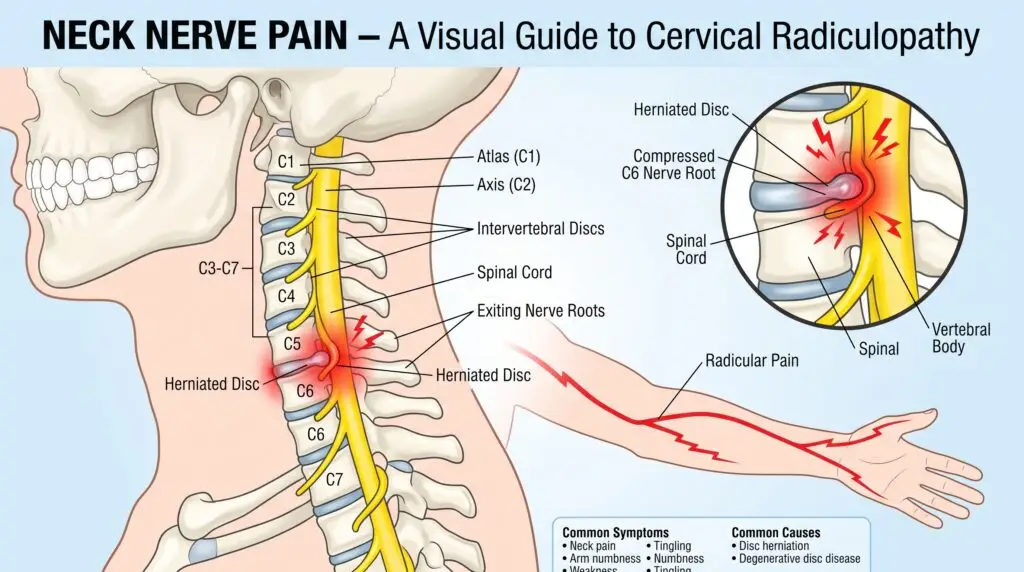
Cervical radiculopathy is one of the most significant neck conditions seen in Texas workers’ compensation claims. Unlike a simple neck strain, cervical radiculopathy occurs when a cervical nerve root becomes compressed, irritated, inflamed, or otherwise affected, causing symptoms that extend beyond the neck and into the shoulder, arm, hand, or fingers.
Workers often describe:
- Neck pain
- Shoulder pain
- Arm pain
- Numbness
- Tingling
- Burning sensations
- Weakness
- Loss of grip strength
Because radiculopathy involves nerve-root dysfunction, it often becomes a major issue in treatment disputes, extent-of-injury disputes, surgery requests, disability determinations, and impairment ratings.
Insurance carriers frequently argue that arm symptoms are unrelated to the workplace injury, that MRI findings are degenerative, or that objective evidence of radiculopathy does not exist.
This article explains cervical radiculopathy, how workplace injuries cause it, how it is diagnosed and treated, and how these claims are litigated in Texas workers’ compensation cases.
What Is Cervical Radiculopathy?
The cervical spine contains nerve roots that exit through openings called neural foramina.
These nerve roots:
- Provide sensation to the upper extremities
- Control muscle function
- Participate in reflex pathways
- Transmit pain signals
Cervical radiculopathy occurs when a cervical nerve root becomes:
- Compressed
- Irritated
- Inflamed
- Mechanically compromised
The result is pain and neurologic symptoms that often extend beyond the neck.
See Cervical Herniated Discs, Disc Protrusions & Disc Bulges.
Common Workplace Causes of Cervical Radiculopathy
Radiculopathy is not a mechanism of injury. It is a consequence of another cervical condition.
Workplace injuries that may result in cervical radiculopathy include:
- Cervical disc herniations
- Disc protrusions
- Foraminal stenosis
- Cervical fractures
- Cervical instability
- Traumatic aggravation of preexisting cervical disease
- High-force whiplash injuries
- Significant lifting injuries
- Falls from height
- Motor vehicle collisions
The key medical question is identifying what structure is affecting the nerve root.
How Workplace Forces Can Lead to Radiculopathy
A strong causation analysis does more than identify symptoms.
It explains how the workplace accident affected the anatomy.
Disc Herniation with Nerve Root Compression
This is one of the most common causes.
During a workplace accident, forces such as:
- Flexion
- Extension
- Rotation
- Compression
- Combined loading
may damage the disc.
The damaged disc can then:
- Narrow the neural foramen
- Contact a nerve root
- Compress a nerve root
- Produce inflammation around the nerve
The worker may develop neck pain followed by radiating upper-extremity symptoms.
Foraminal Narrowing
The neural foramen is the opening through which the cervical nerve root exits the spine.
Trauma may contribute to:
- Disc displacement
- Local inflammation
- Structural changes
that reduce the available space surrounding the nerve root.
Aggravation of Preexisting Cervical Disease
Some workers have preexisting degeneration without symptoms.
When a workplace injury causes:
- Additional disc damage
- New nerve compression
- Increased narrowing
- Additional neurologic dysfunction
the injury may produce cervical radiculopathy that did not previously exist.
See Aggravation Injuries.
Which Nerve Root Is Involved?
Symptoms often depend on which cervical nerve root is affected.
C5 Radiculopathy
May produce:
- Shoulder pain
- Deltoid weakness
- Limited arm elevation
Often mistaken for a shoulder injury.
C6 Radiculopathy
May produce:
- Pain into the thumb
- Numbness of the thumb
- Biceps weakness
- Reduced brachioradialis reflex
C7 Radiculopathy
The most commonly encountered pattern.
May produce:
- Pain into the middle finger
- Triceps weakness
- Numbness in the index and middle fingers
Reduced triceps reflex
C8 Radiculopathy
May produce:
- Hand weakness
- Grip-strength reduction
- Symptoms in the ring and small fingers
- Fine motor difficulties
Understanding dermatomal and myotomal patterns often helps connect symptoms to a specific nerve root.
Symptoms of Cervical Radiculopathy
Workers commonly report:
- Neck pain
- Shoulder pain
- Arm pain
- Burning pain
- Electrical sensations
- Numbness
- Tingling
- Weakness
- Hand clumsiness
- Loss of grip strength
Symptoms often worsen during:
- Overhead work
- Lifting
- Carrying
- Reaching
- Neck movement
Unlike a simple cervical strain, cervical radiculopathy extends beyond localized neck discomfort.
Combined Loading
One reason cervical radiculopathy becomes heavily litigated is that Texas workers’ compensation disputes often revolve around objective findings.
Potential objective findings include:
Motor Weakness
Examples include:
- Biceps weakness
- Triceps weakness
- Grip weakness
- Finger weakness
Reflex Changes
Examples include:
- Reduced biceps reflex
- Reduced triceps reflex
- Reduced brachioradialis reflex
Sensory Deficits
Examples include:
- Decreased sensation
- Numbness patterns
- Dermatomal sensory abnormalities
Electrodiagnostic Findings
EMG and nerve conduction studies may provide evidence supporting nerve-root involvement.
These studies often become important in both causation and impairment disputes.
Cervical Radiculopathy vs. Referred Pain
This distinction is critical.
Not every worker with arm pain has radiculopathy.
A worker may have:
- Referred pain
- Muscle pain
- Shoulder pathology
- Cervical strain symptoms
without actual nerve-root involvement.
The medical evaluation should distinguish:
Radiculopathy
- Nerve-root dysfunction
- Neurologic findings
- Objective deficits
from
Referred Pain
- Pain without nerve-root injury
- No objective neurologic abnormality
This distinction frequently becomes the centerpiece of workers’ compensation litigation.
Diagnosing Cervical Radiculopathy
Diagnosis requires more than an MRI report.
A physician should consider:
Mechanism of Injury
How did the accident occur?
Clinical History
When did symptoms start?
Physical Examination
Are objective neurologic findings present?
Imaging
Does MRI identify pathology affecting the corresponding nerve root?
Electrodiagnostic Testing
Do EMG and nerve conduction studies support nerve-root dysfunction?
The strongest cases show agreement among:
- Symptoms
- Physical examination
- MRI findings
- Electrodiagnostic evidence
MRI Findings and Radiculopathy
One of the biggest misconceptions is that an MRI automatically proves radiculopathy.
It does not.
An MRI may identify:
- Disc bulges
- Disc protrusions
- Herniations
- Foraminal narrowing
- Degenerative changes
But the physician must still determine whether those findings correlate with:
- Symptoms
- Examination findings
- Nerve-root dysfunction
An MRI abnormality without clinical correlation may be insufficient.
Medical Treatment for Cervical Radiculopathy
Treatment depends on severity and progression.
Conservative care may include:
Medications
- Anti-inflammatory medications
- Neuropathic pain medications
- Muscle relaxants
Physical Therapy
Focused on:
- Motion
- Strength
- Functional restoration
Epidural Steroid Injections
Used in selected patients to reduce inflammation surrounding affected nerve roots.
– Functional Restoration Programs
When Surgery May Be Necessary
Surgery may be considered when workers develop:
- Persistent radiculopathy
- Progressive weakness
- Significant nerve-root compression
- Failure of conservative treatment
Common procedures include:
- ACDF
- Disc replacement
- Posterior decompression procedures
The specific surgical recommendation depends upon the pathology involved.
Why Insurance Companies Dispute Cervical Radiculopathy
Carriers frequently argue:
- Symptoms are subjective
- Arm symptoms are unrelated
- The problem is degenerative
- There is no objective evidence
- MRI findings existed before the accident
- EMG testing is normal
- Surgery is unnecessary
These disputes commonly involve:
- Extent of injury
- Causation
- Disability
- Impairment
- Medical necessity
Radiculopathy and Impairment Ratings
Cervical radiculopathy is often one of the most significant issues in spinal impairment rating disputes.
Objective findings such as:
- Motor loss
- muscle atrophy
- Reflex changes
- Sensory changes
- EMG abnormalities
may become important during the impairment-rating process.
For a detailed discussion, see:
Impairment Ratings for Lumbar and Cervical Spine Injuries in Texas Workers’ Compensation
The compensable extent of injury should always be established before evaluating impairment.
Aggravation and Cervical Radiculopathy
A common carrier argument is:
“The worker already had degeneration.”
That statement does not resolve the dispute.
The proper question is:
What additional damage or harm did the workplace injury cause?
As we have consistently emphasized:
An aggravation means additional damage or harm that was not present before the compensable injury.
Examples might include:
- New nerve-root compression
- New neurologic deficits
- Additional disc injury
- Increased foraminal narrowing
- Newly developed radicular symptoms supported by objective findings
A persuasive medical opinion should identify the specific additional condition and explain how the workplace accident caused it.
How MLF Legal Handles Cervical Radiculopathy Claims
Our workers’ compensation lawyers focus on developing evidence that connects:
- The accident
- The cervical pathology
- The affected nerve root
- The worker’s objective findings
This may involve:
- Reviewing MRI studies
- Reviewing EMG/NCS testing
- Establishing neurologic deficits
- Challenging carrier-selected diagnoses
- Fighting for surgery approval
- Challenging premature MMI
- Contesting incorrect impairment ratings
- Litigating extent-of-injury disputes
Strong cervical radiculopathy cases are built on objective medical evidence, not simply complaints of pain.
The Bottom Line
Cervical radiculopathy is much more than ordinary neck pain. It represents dysfunction of a cervical nerve root and can significantly affect a worker’s strength, sensation, dexterity, and ability to perform job duties.
The critical questions are:
- Which nerve root is involved?
- What condition is affecting the nerve root?
- What objective findings support the diagnosis?
- What medical evidence connects the condition to the workplace injury?
Answering those questions often determines the outcome of treatment disputes, surgery requests, disability determinations, and impairment-rating issues in Texas workers’ compensation cases.
Call to Action
If you developed arm pain, numbness, tingling, or weakness after a workplace neck injury and the insurance carrier is disputing your diagnosis, call the workers’ compensation lawyers at MLF Legal today.
We fight for injured workers — not insurance companies.
FAQs: Cervical Radiculopathy in Texas Workers’ Compensation Claims
Cervical radiculopathy occurs when a cervical nerve root becomes compressed, irritated, or inflamed and produces neurologic symptoms.
Yes. Workplace trauma can contribute to conditions such as disc herniations and other cervical abnormalities that affect nerve roots.
No. Arm pain can be caused by many conditions. Radiculopathy generally involves nerve-root dysfunction and often includes neurologic findings.
Yes. Compression or irritation of a cervical nerve root may cause measurable muscle weakness.
No. MRI findings should be correlated with symptoms, physical examination findings, and, when appropriate, electrodiagnostic studies.
Yes. Objective neurologic findings often become important in evaluating spinal impairment under the Texas workers’ compensation system.
That may create an extent-of-injury dispute if the medical evidence supports cervical radiculopathy or another cervical condition beyond the accepted diagnosis.
Injured at work in Texas and your employer doesn’t have workers’ comp?
You may have the right to sue and recover full compensation.
Contact MLF Legal today for a free consultation. You pay nothing unless we win your case.
Next Steps:
1st
Sign up For a Free One-on-One Work Comp Case Evaluation
NEXT LEGAL STEP
Get a Legal Opinion
Contact us today to schedule your personalized one-on-one free phone consultation with one of our dedicated legal professionals. Our experienced Worker’s Comp Lawyers are here to provide the expert legal guidance and support you need throughout the entire process of your case.
We understand the complexities involved in Worker’s Compensation claims and are committed to helping you achieve the best possible outcome. Don’t hesitate to reach out and take the first step toward securing the justice you deserve.
2nd
Download Free E-Books
NEXT LEGAL STEP
Workers' Compensation
Applying for workers compensation can be a challenging process. It involves filing a claim, providing medical documentation, and navigating the approval process. Seeking guidance from a workers’ compensation attorney can help ensure your rights are protected and your claim is handled properly.
LET’S GET STARTED
Call MLF Legal today
214-357-1782
Fill out our online form
for a free consultation.
We only get paid if we win your case.