
Huntington’s Disease and Social Security Disability Benefits
TELL US WHAT HAPPENED SO WE CAN HELP. FREE CONSULTATION

Contact Us About Your Case
FREE Consultation Today.
Huntington’s Disease and Social Security Disability Benefits
Huntington’s disease is a progressive neurological disorder that can affect movement, thinking, behavior, mood, speech, swallowing, and the ability to function independently.
Early in the disease, a person may still be able to work. Over time, however, symptoms can make reliable employment increasingly difficult.
Huntington’s disease may affect work through:
- involuntary movements
- poor balance
- falls
- difficulty using the hands
- slowed thinking
- memory problems
- impaired judgment
- personality changes
- depression or irritability
- difficulty communicating
- swallowing problems
- fatigue
- reduced ability to adapt to change
Adult-onset Huntington’s disease is specifically included in Social Security’s Compassionate Allowances program, which is designed to identify serious conditions for expedited disability processing. It is also specifically evaluated under Blue Book Listing 11.17 for neurodegenerative disorders of the central nervous system.
A diagnosis alone, however, is not the entire disability analysis. The medical evidence should still establish the disease and document how symptoms affect functioning.

What Is Huntington’s Disease?
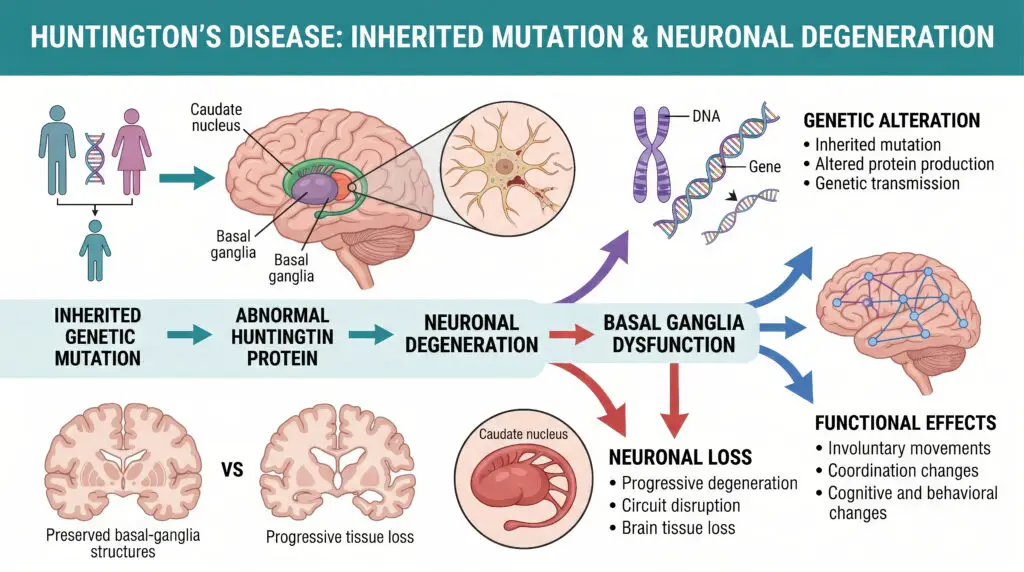
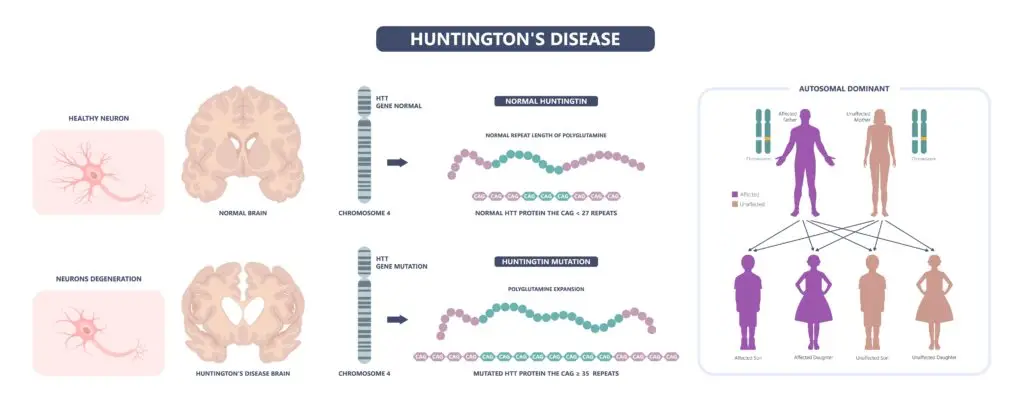
Huntington’s disease is a hereditary neurodegenerative disorder caused by a pathogenic expansion in the HTT gene.
The disease progressively damages neurons in the brain and can affect:
- movement
- coordination
- cognition
- judgment
- personality
- behavior
- mood
- speech
- swallowing
Social Security describes Huntington’s disease as a progressive neurodegenerative disorder affecting motor, cognitive, and psychiatric functioning. Its current guidance notes that there is no treatment that stops, slows, or reverses the progression of adult-onset Huntington’s disease, although medications and supportive treatment may help manage symptoms.
Can Huntington’s Disease Qualify for Social Security Disability?
Yes.
Huntington’s disease can qualify for Social Security Disability when the medical evidence establishes the diagnosis and symptoms satisfy Social Security’s disability standard.
For many adults with symptomatic Huntington’s disease, Social Security may evaluate the claim under:
- Listing 11.17
- another medically equivalent listing
- the mental disorder listings when cognitive or psychiatric effects predominate
- residual functional capacity if the listing requirements are not met
Adult-onset Huntington’s disease is also a Compassionate Allowances condition, which may allow faster processing of the claim.
Social Security Blue Book Listing 11.17 for Huntington’s Disease
Huntington’s disease is specifically identified under Listing 11.17, Neurodegenerative Disorders of the Central Nervous System.
A person may meet Listing 11.17 through one of two general pathways.
Severe Motor Dysfunction
One pathway requires disorganization of motor function in two extremities resulting in an extreme limitation in the ability to:
- stand up from a seated position
- balance while standing or walking
- use the upper extremities
This may apply when chorea, rigidity, weakness, loss of coordination, or other motor problems become severe.
Combined Physical and Mental Limitations
The second pathway requires a marked limitation in physical functioning together with a marked limitation in one area of mental functioning, such as:
- understanding, remembering, or applying information
- interacting with others
- concentrating, persisting, or maintaining pace
- adapting or managing oneself
This structure is especially important in Huntington’s disease because the condition often affects both physical and mental functioning.
Huntington’s Disease and Compassionate Allowances
Adult-onset Huntington’s disease is currently on Social Security’s Compassionate Allowances list.
Compassionate Allowances are designed to help Social Security quickly identify claims involving conditions that are highly likely to satisfy the statutory disability standard.
This does not mean that medical evidence is unnecessary.
A strong Huntington’s disease claim should still include:
- neurologist records
- genetic testing when available
- neurological examination findings
- documentation of progression
- cognitive or neuropsychological testing
- psychiatric records
- speech or swallowing evaluations
- functional evidence
Social Security’s current POMS guidance for adult-onset Huntington’s disease specifically identifies records documenting progression of motor, cognitive, and psychiatric symptoms, genetic testing showing a pathogenic CAG repeat expansion, neurological findings, imaging when relevant, and psychological or neurocognitive testing as useful evidence.
Huntington’s Chorea and Work
Chorea refers to involuntary, irregular movements that may affect the:
- face
- arms
- hands
- legs
- shoulders
- trunk
These movements may interfere with:
- typing
- writing
- gripping
- carrying objects
- using tools
- operating controls
- walking
- standing
- driving
A person may drop objects, make unpredictable movements, or struggle with tasks requiring precise coordination.
Chorea can affect both physical and sedentary work.
Huntington’s Disease and Hand Function
Fine motor control may deteriorate as Huntington’s disease progresses.
A person may have difficulty with:
- typing
- writing
- buttoning clothing
- using utensils
- handling small objects
- gripping tools
- using a computer mouse
- operating workplace equipment
Hand limitations are especially important when Social Security considers whether someone could perform sedentary work.
Many desk jobs require frequent controlled hand use.
Huntington’s Disease and Walking Problems
Motor symptoms may interfere with walking and mobility.
Problems may include:
- abnormal gait
- poor coordination
- stumbling
- unpredictable movements
- difficulty turning
- difficulty climbing stairs
- reduced balance
- falls
These limitations may interfere with jobs requiring even modest movement around the workplace.
Huntington’s Disease and Falls
Falls can become a significant safety concern.
Frequent falls or near-falls may lead to restrictions involving:
- ladders
- heights
- machinery
- uneven surfaces
- carrying objects while walking
- rapid movement
- driving
A person may also need an assistive device or supervision as the disease progresses.
Huntington’s Disease and Cognitive Decline
Huntington’s disease can affect cognition before severe physical disability develops.
Cognitive problems may include:
- slowed thinking
- reduced attention
- poor memory
- difficulty planning
- impaired judgment
- difficulty organizing tasks
- reduced mental flexibility
- difficulty learning new information
These symptoms can have a major effect on employability.
A person may still walk independently but be unable to perform a job reliably because they cannot process information, make appropriate decisions, or complete tasks efficiently.
Huntington’s Disease and Executive Function
Executive function refers to the ability to:
- plan
- organize
- prioritize
- solve problems
- regulate behavior
- initiate tasks
- adapt to changing circumstances
Huntington’s disease may impair these abilities.
At work, that may cause:
- incomplete tasks
- poor decisions
- difficulty prioritizing
- inability to adapt
- repeated mistakes
- need for extra supervision
- difficulty working independently
These limitations can be particularly disabling in professional, administrative, technical, or managerial work.
Huntington’s Disease and Concentration
Difficulty concentrating may affect:
- reading
- computer work
- meetings
- following instructions
- multitasking
- task completion
- maintaining pace
A person may need more time to complete routine tasks or may become overwhelmed by distractions.
Huntington’s Disease and Memory Problems
Memory may become increasingly impaired as the disease progresses.
Work-related problems may include:
- forgotten instructions
- missed appointments
- repeated questions
- forgotten procedures
- incomplete assignments
- difficulty learning new tasks
- mistakes involving details
The person may understand instructions when given but fail to retain and apply them consistently.
Huntington’s Disease and Psychiatric Symptoms
Psychiatric and behavioral symptoms can be a major part of Huntington’s disease.
Possible symptoms include:
- depression
- irritability
- anxiety
- apathy
- impulsivity
- emotional instability
- obsessive or repetitive behavior
- social withdrawal
Some individuals may experience psychiatric symptoms before obvious motor symptoms develop.
These symptoms may affect:
- attendance
- relationships with coworkers
- stress tolerance
- judgment
- motivation
- pace
- ability to accept supervision
Huntington’s Disease and Depression
Depression is common in Huntington’s disease and may compound cognitive and physical limitations.
Depression may cause:
- low motivation
- fatigue
- poor concentration
- social withdrawal
- sleep disturbance
- reduced pace
- difficulty completing tasks
A disability claim should evaluate depression together with the neurological disorder rather than treating it as unrelated.
Huntington’s Disease and Irritability or Behavioral Changes
Changes in personality or behavior may interfere significantly with employment.
Possible problems include:
- irritability
- angry outbursts
- impulsive behavior
- poor frustration tolerance
- inappropriate comments
- inability to accept criticism
- conflict with coworkers
- difficulty following workplace rules
These symptoms may result from neurological changes caused by Huntington’s disease.
Huntington’s Disease and Apathy
Apathy is different from simple laziness.
A person with Huntington’s disease may have difficulty initiating activities even when they understand what needs to be done.
At work, this may appear as:
- failure to start tasks
- reduced productivity
- need for repeated prompting
- failure to follow through
- inability to work independently
This can become an important vocational limitation.
Huntington’s Disease and Speech Problems
Speech may become less clear as the disease progresses.
Problems may include:
- slurred speech
- reduced speech control
- difficulty organizing thoughts
- slowed communication
- difficulty being understood
Speech problems may interfere with:
- telephone work
- customer service
- teaching
- healthcare
- sales
- management
- public-facing duties
Huntington’s Disease and Swallowing Problems
Difficulty swallowing, or dysphagia, may develop as Huntington’s disease progresses.
Social Security’s adult-onset Huntington’s disease guidance specifically recognizes speech-language evaluation and nutritional support as part of disease management as swallowing and communication problems develop.
Swallowing problems may cause:
- choking
- prolonged meal times
- difficulty eating during normal breaks
- weight loss
- aspiration risk
- need for dietary modifications
These limitations may become increasingly significant as the disease advances.
Huntington’s Disease and Weight Loss
Weight loss can occur in Huntington’s disease, particularly as movement, swallowing problems, and nutritional needs become more difficult to manage.
Weight loss may contribute to:
- weakness
- fatigue
- reduced stamina
- difficulty maintaining physical activity
Nutrition records and weight trends may provide useful evidence of progression.
Huntington’s Disease and Fatigue
Fatigue may result from:
- constant involuntary movement
- poor sleep
- depression
- difficulty eating
- effort required to compensate for cognitive problems
- disease progression
Fatigue may interfere with:
- concentration
- pace
- stamina
- attendance
- ability to complete full shifts
A person may be able to function for limited periods but not throughout a normal workday.
Can You Work With Huntington’s Disease?
Some people with early Huntington’s disease continue working for a period of time.
Early manifestations can be subtle, and some individuals remain capable of many daily activities and employment in the early stage.
However, work often becomes increasingly difficult as motor, cognitive, and psychiatric symptoms progress.
A person may initially need:
- reduced responsibilities
- more supervision
- simpler tasks
- written instructions
- less multitasking
- reduced driving
- a predictable schedule
Eventually, these accommodations may no longer be enough to sustain competitive employment.
Can Huntington’s Disease Prevent Sedentary Work?
Yes.
Sedentary work still requires:
- controlled hand use
- concentration
- memory
- judgment
- pace
- communication
- social interaction
- regular attendance
- ability to adapt to workplace demands
A person with Huntington’s disease may be physically capable of sitting while being unable to perform sedentary work because of:
- hand movements
- cognitive decline
- poor judgment
- memory loss
- slowed processing
- speech problems
- psychiatric symptoms
- fatigue
- excessive off-task time
Simply being able to sit does not establish an ability to sustain full-time employment.
Huntington’s Disease and Residual Functional Capacity
Residual Functional Capacity, or RFC, describes what a person can still do despite medical limitations.
A Huntington’s disease RFC may include physical restrictions such as:
- limited standing
- limited walking
- limited balancing
- no ladders or heights
- no hazardous machinery
- limited driving
- limited handling or fingering
Mental restrictions may include:
- simple tasks
- reduced multitasking
- limited decision-making
- predictable duties
- reduced workplace changes
- extra supervision
- limited public interaction
- reduced pace
- additional breaks
- off-task time
- absences
Because Huntington’s disease affects multiple functional systems, both physical and mental RFC limitations may be necessary.
Medical Evidence That Helps Prove Huntington’s Disease
Helpful medical evidence may include:
- neurologist records
- movement-disorder specialist records
- family history
- neurological examinations
- genetic testing
- brain imaging
- neuropsychological testing
- psychiatric evaluations
- speech therapy records
- swallowing studies
- physical therapy records
- occupational therapy records
- assistive device records
- nutrition records
- medication history
Social Security’s current guidance specifically identifies progression of motor, cognitive, and psychiatric findings, Huntington gene testing, neurological examinations, and neurocognitive evidence as useful medical evidence.
Genetic Testing and Huntington’s Disease
Genetic testing can strongly support the diagnosis.
Social Security’s POMS guidance identifies laboratory testing showing a CAG repeat expansion in the Huntington gene as relevant evidence in adult-onset Huntington’s disease claims.
Genetic testing does not by itself describe how well someone can work, however.
The claim should also document actual symptoms and functional decline.
Neuropsychological Testing
Neuropsychological testing may help document:
- memory
- processing speed
- attention
- executive function
- problem-solving
- judgment
- cognitive flexibility
These findings can be particularly valuable when cognitive decline is more disabling than the visible movement disorder.
Family and Caregiver Evidence
Family members often notice functional changes before the person with Huntington’s disease fully recognizes them.
Helpful observations may include:
- personality changes
- poor judgment
- forgetting responsibilities
- unsafe behavior
- difficulty managing money
- problems driving
- inability to organize daily activities
- swallowing problems
- falls
Specific examples may help show progression.
Employer Evidence
Work records may document early functional decline.
Helpful evidence may include:
- increased mistakes
- reduced productivity
- conflicts with coworkers
- difficulty learning tasks
- written warnings
- reduced responsibilities
- accommodations
- attendance problems
- failed attempts to continue working
Evidence showing a decline from prior work performance may be especially useful.
Medications Used in Huntington’s Disease
There is currently no medication that cures or stops the progression of Huntington’s disease. Treatment focuses on managing symptoms.
Medications may be used to address:
- chorea
- depression
- irritability
- anxiety
- psychosis
- sleep problems
For example, medications such as Austedo may be used to treat chorea.
Medication side effects should also be considered if they affect alertness, concentration, balance, or stamina.
Doctor Statements for Huntington’s Disease Work Limitations
A treating provider may be able to address:
- gait
- balance
- hand function
- chorea
- speech
- swallowing
- memory
- concentration
- processing speed
- judgment
- behavior
- stress tolerance
- need for supervision
- expected progression
- ability to complete a full workday
Specific functional opinions are generally more useful than simply stating that a person is “disabled.”
Tracking Huntington’s Disease Symptoms
A symptom log may help document:
- involuntary movements
- falls
- hand problems
- memory problems
- behavioral changes
- mood changes
- speech difficulty
- swallowing problems
- fatigue
- missed work
- medication effects
- need for assistance
A symptom log does not replace medical evidence, but it may help show the pattern of progression.
Signs Huntington’s Disease May Prevent Full-Time Work
Huntington’s disease may prevent sustained work when it causes:
- significant chorea
- poor hand control
- gait and balance problems
- frequent falls
- cognitive decline
- memory loss
- impaired judgment
- executive function problems
- psychiatric symptoms
- behavioral changes
- speech or swallowing problems
- severe fatigue
- excessive off-task time
- need for supervision
- inability to complete full shifts
When these limitations are medically documented, the disability claim may be strong.
Common Mistakes in Huntington’s Disease Disability Claims
Common problems include:
- focusing only on chorea
- failing to document cognitive decline
- ignoring psychiatric symptoms
- not obtaining neuropsychological testing when appropriate
- failing to document speech or swallowing problems
- not gathering caregiver evidence
- failing to document work decline
- assuming independent walking means the person can still work
- failing to identify the Compassionate Allowances status
- failing to evaluate Listing 11.17
A strong claim addresses the disease as a combination of motor, cognitive, psychiatric, and functional decline.
When to Speak With a Social Security Disability Lawyer
Many people seek legal help when:
- Huntington’s disease has begun interfering with work
- cognitive decline causes mistakes
- chorea affects safety or hand use
- psychiatric symptoms interfere with employment
- speech or swallowing problems develop
- work duties have been reduced
- a return-to-work attempt has failed
- the disability claim has been denied
- Social Security has not recognized the claim for expedited processing
Our social security disability attorneys can help evaluate whether the evidence supports Listing 11.17, Compassionate Allowances processing, or disability through residual functional capacity.
FAQs: Huntington’s Disease and Social Security Disability Benefits
Can Huntington’s disease qualify for Social Security Disability?
Yes. Huntington’s disease is a progressive neurodegenerative disorder that may qualify when motor, cognitive, psychiatric, or combined limitations satisfy Social Security’s disability standard.
Is Huntington’s disease in the Social Security Blue Book?
Yes. Huntington’s disease is specifically identified under Listing 11.17 for neurodegenerative disorders of the central nervous system.
Is Huntington’s disease a Compassionate Allowances condition?
Yes. Adult-onset Huntington’s disease is currently included on Social Security’s Compassionate Allowances list.
Does Huntington’s disease have to cause severe chorea to qualify?
No. Huntington’s disease can also cause severe cognitive, psychiatric, behavioral, and functional limitations. Listing 11.17 specifically recognizes a pathway involving marked physical impairment together with marked mental functional limitation.
Can Huntington’s disease prevent sedentary work?
Yes. Sedentary work still requires concentration, memory, judgment, hand use, communication, social interaction, pace, and attendance. Huntington’s disease may impair all of these functions.
Can cognitive symptoms qualify someone before severe physical symptoms develop?
Potentially. Social Security recognizes that neurodegenerative disorders may produce significant cognitive and mental limitations, and purely mental manifestations may be evaluated under the mental disorder listings.
What evidence helps prove a Huntington’s disease disability claim?
Helpful evidence may include neurologist records, genetic testing, neurological examinations, neuropsychological testing, psychiatric records, speech or swallowing evaluations, therapy records, caregiver statements, and employment evidence documenting decline.
Does genetic testing prove disability?
Genetic testing can strongly support the Huntington’s diagnosis, but Social Security also considers actual symptoms and functional limitations. Current SSA guidance identifies Huntington gene CAG repeat testing as useful evidence.
Can Huntington’s disease affect speech and swallowing?
Yes. As the disease progresses, speech and swallowing may become impaired. Social Security’s Huntington’s guidance specifically recognizes speech-language evaluation and nutritional management as relevant treatment.
What should I do if Huntington’s disease is preventing me from working?
You may want to speak with a Social Security Disability attorney to evaluate whether the claim meets Listing 11.17, qualifies for Compassionate Allowances processing, or is supported through residual functional capacity.
Contact MLF Legal for a Free Disability Case Evaluation
If Huntington’s disease, chorea, cognitive decline, behavioral changes, speech problems, swallowing problems, or another neurological condition prevents you from working, you may qualify for Social Security Disability benefits.
MLF Legal represents disability applicants nationwide. Based in Dallas, Texas, we help individuals across the country pursue disability benefits.
Our social security lawyers can review your situation for free and explain your options.
📞 Call MLF Legal at 214-357-1782 to request a free consultation.
Next Steps:
1st Sign up For a Free One-on-One Disability Case Evaluation
Contact us today to schedule your personalized one-on-one free phone consultation with one of our dedicated legal professionals. Our experienced social security lawyers are here to provide the expert legal guidance and support you need throughout the entire process of your case.
We understand the complexities involved in social security disability claims and are committed to helping you achieve the best possible outcome. Don’t hesitate to reach out and take the first step toward securing the justice you deserve.
2nd Download Free E-Books
Social Security Disability

Navigating the Social Security Disability Benefits process can be complex, but understanding the key steps can help. From gathering medical records to completing the application, this process ensures eligible individuals receive the support they need. Seeking guidance from experts can simplify the journey and increase the chances of a successful outcome.
Call MLF Legal today
214-357-1782
Fill out our online form
for a free consultation.
We only get paid if we win your case.