
Gluteus Medius and Gluteus Minimus: Gluteal Tendon Tears in Texas Workers’ Compensation Claims
FREE CONSULTATION
Contact Us About Your Case
FREE Consultation Today.
Gluteus Medius and Gluteus Minimus : Gluteal Tendon Tears in Texas Workers’ Compensation Claims
Gluteus medius and gluteus minimus tendon tears are important causes of lateral hip pain, weakness, and impaired hip function. Yet these injuries can be overlooked in Texas workers’ compensation claims because the worker is initially diagnosed with something much broader, such as a hip strain or trochanteric bursitis.
The gluteus medius and minimus are important hip abductor muscles. When their tendons become significantly injured, workers can have difficulty walking, climbing, standing on the affected leg, and performing physically demanding activities.
Gluteal tendon pathology also overlaps with greater trochanteric pain syndrome (GTPS). Modern medical literature recognizes that GTPS can involve tendinopathy or tearing of the gluteus medius and minimus rather than simply inflammation of the trochanteric bursa.
For workers’ compensation purposes, the challenge is frequently causation.
A worker may already have some degree of gluteal tendinopathy before an accident. A workplace fall, slip, sudden load shift, or other traumatic event then occurs, followed by substantial lateral hip pain and weakness.
The carrier argues:
“The tendon findings are degenerative and preexisting.”
The worker argues:
“My hip was fine until the accident.”
Neither statement, by itself, completely answers the medical question.
The correct analysis asks:
What tendon condition existed before the accident?
What forces acted upon the hip during the workplace event?
Did those forces cause a new tendon tear or additional structural damage?
Does the worker’s weakness and functional loss correlate with that tendon injury?
If a degenerative tendon condition already existed, what additional damage or harm did the workplace accident cause that was not present before?
What Are the Gluteus Medius and Gluteus Minimus?
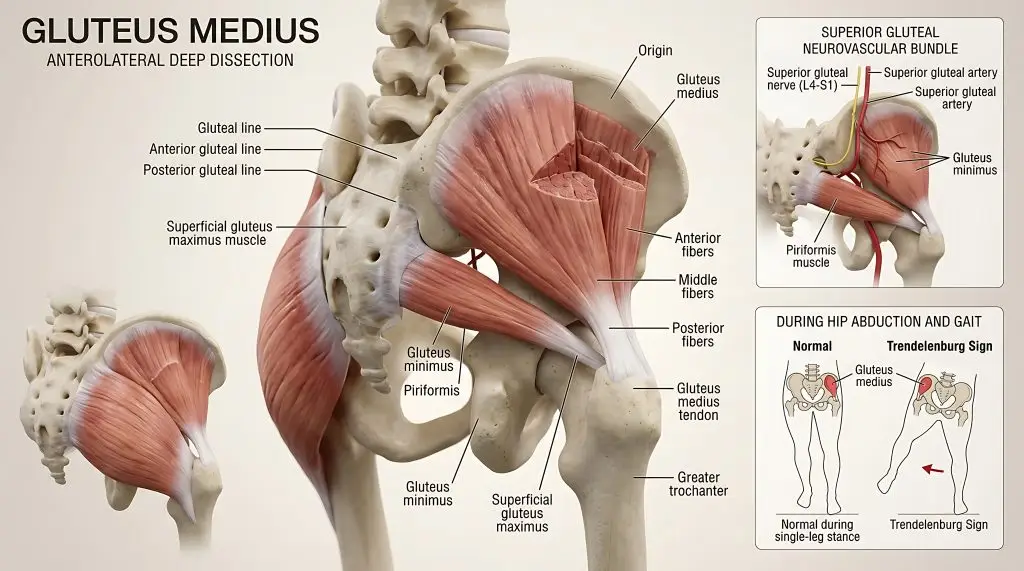
The gluteus medius and gluteus minimus are muscles located along the lateral aspect of the hip.
Their tendons attach around the greater trochanter of the femur.
These muscles play important roles in:
- Hip abduction
- Pelvic stabilization
- Walking
- Standing on one leg
- Climbing
- Maintaining balance during movement
That makes these structures particularly important for workers who spend substantial portions of the day:
- Walking
- Standing
- Climbing
- Carrying
- Working on uneven surfaces
- Moving heavy materials
When the tendons are significantly damaged, the worker may lose strength and pelvic control during weight-bearing activity.
What Is a Gluteal Tendon Tear?
The tendon connects the muscle to bone.
A gluteus medius or minimus tendon can develop several types of pathology, including:
- Tendinopathy
- Partial-thickness tearing
- Full-thickness tearing
- Tendon retraction
- Chronic degenerative change
This distinction matters.
Tendinopathy is not automatically the same thing as a structural tendon tear.
And a partial tear presents a different medical issue from a complete rupture.
The physician should identify precisely what condition is actually present before addressing work causation.
Gluteal Tendinopathy vs. Tendon Tear
A major workers’ compensation problem arises when all gluteal tendon pathology is treated as though it were one condition.
Gluteal Tendinopathy
Generally refers to disease or degeneration affecting the tendon.
Gluteal Tendon Tear
Involves structural disruption of tendon fibers.
A worker may have preexisting tendinopathy and then suffer a subsequent partial or full-thickness tear.
That is exactly the kind of case where aggravation analysis becomes important.
Greater Trochanteric Pain Syndrome
Gluteal tendon tears exist within a larger spectrum of lateral hip disorders frequently grouped under the term greater trochanteric pain syndrome.
GTPS may involve:
- Gluteus medius tendinopathy
- Gluteus minimus tendinopathy
- Gluteal tendon tears
- Trochanteric bursitis
A recent review describes GTPS as involving tendinopathy or tears of the gluteus medius and minimus and notes that the condition can be misdiagnosed as trochanteric bursitis.
This is important for workers’ compensation because an early diagnosis of:
“Hip bursitis”
may not fully identify the worker’s actual structural condition.
Common Workplace Mechanisms
Potential workplace mechanisms include:
- Slips and falls
- Falls directly onto the hip
- Sudden loss of balance
- Stepping unexpectedly from a height
- Carrying heavy material
- Sudden changes in direction
- Twisting while the leg is planted
- Climbing
- Machinery accidents
- Work-related vehicle accidents
The existence of an accident does not automatically prove a gluteal tendon tear.
The physician still needs to explain how the forces generated by the event acted upon the tendon.
Sudden Hip Adduction During a Slip
Consider a worker whose foot unexpectedly slides.
The worker attempts to prevent a fall while the pelvis moves relative to the planted or loaded leg.
The hip abductors may contract vigorously to control the pelvis and maintain balance.
If symptoms begin during that event, the physician should evaluate whether the mechanism is consistent with injury to the lateral hip structures.
The stronger causation analysis explains the actual movement rather than simply stating:
“The employee slipped and tore the gluteus medius.”
Eccentric Loading
The gluteal muscles may also undergo eccentric loading, meaning the muscle contracts while the musculotendinous unit is being lengthened.
This type of loading can occur when a worker suddenly attempts to:
- Stop a fall
- Restore balance
- Control the pelvis
- Decelerate the body
- Resist unexpected movement
The physician should determine whether the worker’s specific accident imposed a meaningful load on the gluteal tendon.
Direct Falls Onto the Hip
A fall directly onto the lateral hip creates a different mechanism.
That impact may injure:
- Soft tissues
- Bursa
- Tendons
- Bone
- Other hip structures
Persistent lateral hip pain after direct trauma should therefore be evaluated rather than automatically labeled“bursitis” or“hip contusion.”
Repetitive Occupational Loading
Not all gluteal tendon problems arise from one dramatic accident.
Workers who repeatedly:
- Climb
- Walk
- Carry loads
- Work on uneven ground
- Perform prolonged weight-bearing activity
may expose the hip abductors to repeated physical demands.
However, an occupational-disease claim requires its own individualized analysis. The existence of a physically demanding job does not automatically establish that work caused degenerative tendinopathy.
Symptoms of Gluteus Medius and Minimus Tears
Symptoms can include:
- Lateral hip pain
- Tenderness near the greater trochanter
- Weakness
- Pain while walking
- Difficulty standing on the affected leg
- Difficulty climbing
- Reduced walking endurance
- Functional limitations
Associated GTPS can become chronic, making accurate diagnosis particularly important.
Hip Abductor Weakness
Weakness may be one of the most important clues that the condition involves more than uncomplicated bursitis.
The gluteus medius and minimus help stabilize the pelvis during walking and single-leg stance.
When abductor function becomes impaired, a worker may experience difficulty:
- Walking efficiently
- Maintaining pelvic stability
- Climbing stairs or ladders
- Standing on one leg
- Carrying material while walking
For a construction, warehouse, oilfield, healthcare, or industrial worker, that weakness can substantially alter work capacity.
Altered Gait
A worker with substantial abductor dysfunction may develop an altered walking pattern.
The significance of gait abnormality should be evaluated by the physician together with:
- Strength testing
- Pain
- Tendon integrity
- Imaging
- Other potential causes
An altered gait does not independently prove a gluteal tendon tear, but it can become an important part of the overall clinical picture.
Gluteal Tendon Tear vs. Hip Strain
This distinction is central to our cluster.
A hip strain may involve a muscle or tendon, but it is a broad diagnosis.
A worker with persistent lateral hip symptoms may later be diagnosed more specifically with a:
- Gluteus medius tear
- Gluteus minimus tear
See Hip Sprains and Strains in Texas Workers’ Compensation Claims.
The question then becomes:
Was the initial strain diagnosis the entire injury, or did the workplace event produce a more specific structural tendon injury?
Gluteal Tendon Tear vs. Trochanteric Bursitis
This distinction is just as important.
The trochanteric bursa lies in the lateral hip region.
Inflammation of a bursa and tearing of a tendon are not the same structural diagnosis.
Yet gluteal tendon disease and bursitis can occur within the same broader lateral hip pain syndrome.
This is why calling every lateral hip condition:
“Bursitis”
can oversimplify the medical problem.
Gluteal Tendon Tears vs. Hip Labral Tears
These also involve completely different structures.
Gluteal Tendon Tear
Primarily affects lateral extra-articular hip structures.
Labral Tear
Involves fibrocartilage around the acetabulum within the joint.
A worker’s description of:
- Pain location
- Mechanical symptoms
- Weakness
- Examination findings
may help the physician determine which area needs further evaluation.
Gluteal Tendon Tears vs. Femoroacetabular Impingement
FAI involves abnormal contact within the ball-and-socket hip joint.
Gluteal tendon tears involve structures outside the joint.
See Femoroacetabular Impingement (FAI) in Texas Workers’ Compensation Claims.
A worker can potentially have both conditions, which makes accurate diagnosis and causation analysis important.
Diagnosing Gluteal Tendon Tears In Texas Workers' Compensation Claims
A complete evaluation generally combines history, examination, and imaging.
Medical History
The physician should determine:
- Where the pain is located
- Whether there was a specific workplace accident
- How the worker moved during the event
- Whether symptoms existed previously
- Whether weakness developed
- Whether walking changed
Physical Examination
The examination may evaluate:
- Hip abductor strength
- Tenderness
- Gait
- Functional movement
- Other potential sources of hip pain
Imaging
Both ultrasound and MRI are used in the diagnostic evaluation of gluteal tendon pathology and GTPS.
Imaging becomes particularly important when distinguishing tendinopathy from significant structural tendon tearing.
MRI Shows Structure, Not Work Causation
This principle continues throughout our injury clusters.
An MRI may demonstrate:
Partial-thickness gluteus medius tendon tear
But the MRI does not independently tell us:
- When the tear developed
- Whether the tendon was degenerative beforehand
- Whether the work accident caused additional tearing
- Whether the imaging finding explains the worker’s symptoms
Those are medical causation questions.
Preexisting Gluteal Tendinopathy
This is where many carrier disputes will arise.
A worker may already have degenerative tendon changes before a workplace accident.
The carrier may therefore argue:
“The tear is degenerative.”
The physician should address that possibility honestly.
The stronger claimant-side argument, when medically supported, is frequently not:
“There was absolutely no degeneration.”
Instead:
“What additional damage did this workplace accident cause to the preexisting tendon?”
Aggravation of Preexisting Gluteal Tendon Disease
We apply the same standard we have established elsewhere:
A true aggravation requires additional damage or harm that was not present before the workplace injury.
Therefore:
“The tendon became more painful”
is not necessarily the entire aggravation analysis.
The physician should identify the actual additional condition.
Depending upon the evidence, the question may be whether a workplace accident caused:
- New partial tearing
- Progression of an existing tear
- A complete tear
- Another objectively supportable structural injury
The specific answer must come from the medical evidence.
Why Pre-Injury Function Still Matters
Suppose a worker had degenerative gluteal tendinopathy but:
- Worked full duty
- Had no meaningful lateral hip pain
- Had no documented hip weakness
- Walked normally
- Required no treatment
After a workplace fall, the worker develops:
- Persistent lateral hip pain
- Abductor weakness
- Altered gait
- MRI evidence of tearing
That clinical change matters.
But it does not automatically prove the tear was traumatic.
Instead, it establishes a before-and-after clinical picture that the physician should medically explain.
Why Prior Imaging Can Be Valuable
When earlier imaging exists, comparison may help establish whether:
- Tendon abnormality already existed
- A partial tear was previously present
- The tear has progressed
- Retraction or other structural changes developed
The physician should interpret those changes in the complete clinical context.
Different wording on two radiology reports does not automatically establish a traumatic progression.
What If There Is No Prior Hip MRI?
That will usually be the case.
Workers who had no substantial pre-injury hip problems generally had no reason to obtain MRI imaging.
The physician can still consider:
- Prior medical history
- Pre-injury symptoms
- Pre-injury work function
- Mechanism of injury
- Symptom onset
- Examination findings
- Current imaging
- Clinical progression
The absence of prior MRI does not prove either side’s causation theory.
Medical Treatment for Gluteal Tendon Tears
Treatment depends upon:
- Tear severity
- Amount of weakness
- Functional limitations
- Chronicity
- Associated hip pathology
GTPS treatment literature describes nonsurgical approaches including physical therapy and other interventions, although treatment results vary depending upon the underlying pathology.
A worker with tendinopathy presents a different treatment question from someone with a significant structural tendon tear.
When Surgery Becomes an Issue
Persistent structural tears associated with substantial weakness and failed conservative treatment may eventually lead to surgical evaluation.
At that point, the workers’ compensation dispute often becomes:
“Does the worker medically need tendon repair?”
versus:
“Is the tendon tear part of the compensable injury?”
Those are different questions.
The surgeon’s causation opinion may therefore become critical.
The Surgery Causation Problem
If the tendon was degenerative before the workplace injury, the physician should identify:
- What degeneration existed.
- What workplace event occurred.
- What additional tendon damage resulted.
- How the imaging and clinical findings support that opinion.
- Whether the proposed surgery treats the additional compensable damage.
That is considerably more persuasive than simply saying:
“The patient’s gluteal tear is work-related.”
Why Insurance Companies Dispute Gluteal Tendon Tears
Common arguments may include:
- The tendon tear is degenerative
- The condition is chronic
- The worker has ordinary GTPS
- The worker merely has bursitis
- The accident caused only a hip strain
- MRI findings predate the work event
- Surgery treats preexisting tendon disease
- No true aggravation occurred
Some of these may be legitimate possibilities.
The medical evidence should address them rather than assuming that every MRI tear is traumatic.
What a Strong Gluteal Tendon Causation Opinion Should Address
A well-developed medical opinion on causation of gluteal tendon tears in Texas workers’ compensation cases should answer:
- What structure is injured?
Gluteus medius? Gluteus minimus? Both?
- What type of injury exists?
Tendinopathy? Partial tear? Full-thickness tear?
- Was degeneration present?
Address it honestly.
- What happened during the workplace accident?
Describe the mechanics.
- How was the gluteal tendon loaded?
Direct impact? Sudden balance correction? Eccentric loading? Another mechanism?
- What happened clinically afterward?
Pain? Weakness? Gait change?
- What does imaging show?
Correlate it with the examination.
- What additional damage or harm occurred?
If aggravation is claimed, identify it.
- Why did the workplace event cause that additional injury?
Explain the medical reasoning.
That’s the level of causation analysis we want throughout the hip cluster.
Gluteal Tendon Tears and Impairment Ratings
No gluteal tendon tear should automatically be assigned a particular impairment percentage simply because an MRI demonstrates structural damage.
The eventual Texas workers’ compensation impairment analysis depends upon:
- The extent of the compensable injury
- Residual objective findings
- Surgical outcome where relevant
- The legally applicable rating methodology
- Loss of range of motion
The important strategic issue remains:
Establish the complete compensable hip injury before MMI and impairment are finally determined.
How MLF Legal Handles Gluteal Tendon Tear Claims
We focus on separating:
preexisting tendon degeneration
from
additional structural injury caused by the workplace accident.
That may involve:
- Establishing the precise accident mechanism
- Determining the worker’s hip position during the event
- Reviewing prior hip treatment
- Establishing pre-injury strength and walking ability
- Obtaining or reviewing MRI and ultrasound findings
- Distinguishing tendinopathy from tendon tearing
- Distinguishing tendon pathology from bursitis
- Evaluating competing intra-articular hip diagnoses
- Developing medical evidence of additional damage or harm
- Challenging an artificially narrow hip-strain diagnosis
- Fighting for appropriate treatment or surgery
- Preparing workers for designated doctor examinations
- Addressing MMI and impairment
- Litigating extent-of-injury and disability disputes at BRCs and CCHs
The point is not to pretend degeneration did not exist.
It is to determine:
What did the workplace accident actually do to the tendon?
The Bottom Line
Gluteus medius and minimus tendon tears are important structural causes of lateral hip pain and weakness. They can occur within the broader spectrum of greater trochanteric pain syndrome and may be mistaken for uncomplicated trochanteric bursitis.
For Texas workers’ compensation purposes, the difficult cases often involve a combination of preexisting tendon degeneration and a subsequent workplace accident.
The correct analysis asks:
What tendon condition existed before the accident?
Was the worker symptomatic or functionally limited?
What forces acted upon the hip during the workplace event?
Did the tendon sustain new tearing or other additional damage?
Do weakness, gait abnormalities, examination findings, and imaging fit together?
And, if aggravation is claimed, what additional damage or harm exists after the workplace accident that was not present before?
That analysis is far stronger than either automatically calling every tear “degenerative” or automatically calling every tear found after an accident “traumatic.”
Call For Help Today
If you developed persistent lateral hip pain or weakness after a workplace accident and the insurance carrier is calling your gluteal tendon tear degenerative, bursitis, or merely a hip strain, call the workers’ compensation lawyers at MLF Legal today.
We fight for injured workers — not insurance companies.
FAQs: Gluteus Medius and Gluteus Minimus : Gluteal Tendon Tears in Texas Workers’ Compensation Claims
They are tendons associated with important hip abductor muscles that help stabilize the pelvis during walking and weight-bearing activities.
No. Tendon tearing and bursal inflammation involve different tissues, although both may occur within the broader condition known as greater trochanteric pain syndrome.
Yes. Gluteus medius and minimus tendinopathy and tears are recognized components of GTPS, an important cause of lateral hip pain.
Diagnosis combines the medical history and examination with appropriate imaging. MRI and ultrasound are used to evaluate gluteal tendon pathology.
Potentially. A broad strain diagnosis may be made early, while persistent pain or weakness later leads to more specific tendon evaluation.
Yes. Gluteal tendon disease may develop as tendinopathy and can include partial or full-thickness tearing. When a work accident occurs in a tendon with preexisting disease, causation requires individualized analysis.
Potentially. But the medical evidence should establish additional damage or harm that was not present before the workplace injury, rather than relying solely on increased pain.
No. Treatment depends upon severity, weakness, functional limitations, associated pathology, and response to nonsurgical management.
Injured at work in Texas and your employer doesn’t have workers’ comp?
You may have the right to sue and recover full compensation.
Contact MLF Legal today for a free consultation. You pay nothing unless we win your case.
Next Steps:
1st
Sign up For a Free One-on-One Work Comp Case Evaluation
NEXT LEGAL STEP
Get a Legal Opinion
Contact us today to schedule your personalized one-on-one free phone consultation with one of our dedicated legal professionals. Our experienced Worker’s Comp Lawyers are here to provide the expert legal guidance and support you need throughout the entire process of your case.
We understand the complexities involved in Worker’s Compensation claims and are committed to helping you achieve the best possible outcome. Don’t hesitate to reach out and take the first step toward securing the justice you deserve.
2nd
Download Free E-Books
NEXT LEGAL STEP
Workers' Compensation
Applying for workers compensation can be a challenging process. It involves filing a claim, providing medical documentation, and navigating the approval process. Seeking guidance from a workers’ compensation attorney can help ensure your rights are protected and your claim is handled properly.
LET’S GET STARTED
Call MLF Legal today
214-357-1782
Fill out our online form
for a free consultation.
We only get paid if we win your case.