
Femoroacetabular Impingement (FAI) in Texas Workers’ Compensation Claims
FREE CONSULTATION
Contact Us About Your Case
FREE Consultation Today.
Femoroacetabular Impingement (FAI) in Texas Workers’ Compensation Claims
Femoroacetabular impingement, commonly called FAI or hip impingement, is an important condition in Texas workers’ compensation claims involving hip and groin pain. It occurs when the shape of the femoral head and neck, the acetabulum, or both creates abnormal contact within the hip during movement. Over time, that contact can damage the hip’s labrum and articular cartilage.
FAI creates a particularly important workers’ compensation causation problem because the underlying cam or pincer morphology usually predates the workplace accident. According to AAOS, the abnormal shape associated with FAI develops during the growing years, and some people can remain active with FAI anatomy without ever developing problems.
Then a worker suffers a workplace fall, twisting injury, lifting event, or other hip trauma and develops significant symptoms. Imaging identifies:
- Cam morphology
- Pincer morphology
- Mixed impingement
- Labral damage
- Cartilage abnormalities
The carrier responds:
“The FAI was preexisting. The accident did not cause it.”
That may be correct as to the underlying bone shape.
But it does not necessarily answer the entire causation question.
The more important inquiry may be:
Did the worker have preexisting FAI anatomy, but sustain additional damage or harm to the hip during the workplace accident?
That distinction can determine whether a case involving preexisting hip morphology also includes a compensable traumatic or aggravation injury.
What Is Femoroacetabular Impingement?
The hip is a ball-and-socket joint.
The ball is the:
- Femoral head
The socket is the:
- Acetabulum
Articular cartilage covers the joint surfaces, while the labrum surrounds the acetabular rim and contributes to the function and stability of the hip joint.
Normally, the femoral head and neck move within the acetabulum with adequate clearance.
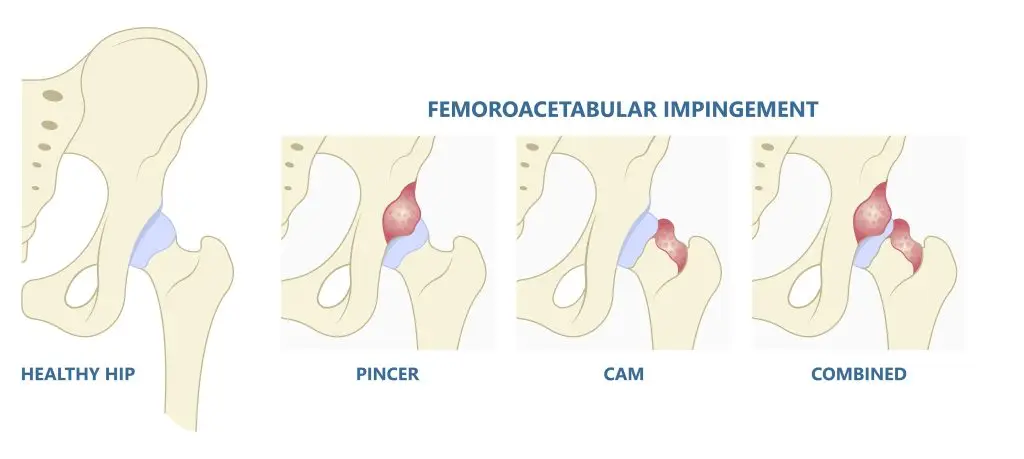
With FAI, the shape of the femur, acetabulum, or both creates abnormal contact during movement. That repeated contact can damage the labrum and articular cartilage.
The Three Types of FAI
FAI is generally divided into three categories.
Cam Impingement
With cam-type FAI, the femoral head is not perfectly round or there is excess bone around the femoral head-neck junction.
As the hip moves, that prominence can make abnormal contact with the acetabulum and damage the cartilage within the socket.
Cam morphology is particularly important in workplace causation cases because the bony shape generally existed before the accident.
The legal and medical question may therefore be about what happened to the hip because of the accident, not whether the accident manufactured the cam morphology.
Pincer Impingement
With pincer-type FAI, additional acetabular coverage creates abnormal contact between the acetabular rim and the femoral head-neck region.
The labrum can become compressed during that abnormal contact.
Pincer morphology may likewise exist before a work injury becomes symptomatic.
Combined FAI
Some individuals have both:
- Cam morphology
- Pincer morphology
This is often referred to as combined or mixed FAI.
The presence of both abnormalities can make interpretation of a post-injury hip MRI more complicated because there may already have been mechanics capable of placing stress on the labrum or cartilage before the work accident.
FAI Morphology Does Not Automatically Mean Symptomatic FAI
This distinction is important.
A person may have underlying FAI morphology and live an active life without experiencing symptoms. AAOS specifically notes that some people with FAI may remain highly active without problems.
That means:
The presence of cam or pincer morphology on imaging does not establish that the worker had a disabling hip condition before the workplace accident.
But the reverse also matters:
Being asymptomatic before the accident does not automatically prove that the accident structurally aggravated the FAI.
Those are two separate questions.
The physician should determine what actually changed.
Is FAI a Work Injury?
This requires careful wording.
The underlying cam or pincer shape generally should not automatically be attributed to a specific workplace accident. AAOS attributes the characteristic FAI morphology to abnormal hip development during the growing years and expressly states that exercise does not cause FAI.
Therefore, a causation opinion that says:
“The workplace accident caused the worker’s cam-type FAI.”
may be difficult to defend unless there is unusual evidence supporting a genuinely post-traumatic deformity.
More commonly, the better question is:
Did a worker with preexisting FAI morphology sustain an additional traumatic hip injury during the workplace event?
That is a much different causation theory.
The Aggravation Issue
This is where our established framework becomes particularly valuable.
Suppose a worker had preexisting cam morphology but:
- No meaningful hip treatment
- No work restrictions
- No disabling groin pain
- No known labral tear
- Full ability to perform physical work
Then a workplace accident occurs.
Afterward, the worker develops significant groin pain, mechanical symptoms, and imaging identifies both:
- Cam morphology
- Labral injury
The carrier points to the cam morphology.
But the correct question is not merely:
“Was the cam morphology preexisting?”
It may have been.
The next question is:
“What additional damage or harm did the workplace accident cause?”
A True Aggravation Requires Additional Damage or Harm
As throughout our injury clusters:
An aggravation requires additional damage or harm that was not present before the workplace injury.
It is therefore not enough for a doctor simply to state:
“The accident made the FAI symptomatic.”
That describes timing.
A stronger opinion identifies the additional hip injury, if supported by the medical evidence.
Depending upon the individual case, the doctor might determine that the accident caused:
- Labral damage
- Additional cartilage injury
- Another traumatic intra-articular condition
The evidence needs to establish what actually happened.
FAI and Hip Labral Tears
This is the most important internal link in this article.
The acetabular labrum surrounds the hip socket and plays an important role in joint function.
Abnormal contact associated with FAI can damage or tear the labrum over time.
That creates a particularly important workers’ compensation causation problem.
A worker may have:
preexisting FAI morphology
and then sustain:
a traumatic labral injury
during a workplace accident.
See Hip Labral Tears in Texas Workers’ Compensation Claims.
The existence of the first condition does not automatically establish the cause of the second.
How a Workplace Accident Can Affect a Hip With FAI
A workplace incident can subject the hip to combinations of:
- Flexion
- Rotation
- Axial loading
- Twisting
- Sudden directional change
- Impact
The medical analysis should determine how those forces interacted with the worker’s particular hip anatomy.
Hip Flexion
Hip flexion occurs when the thigh moves toward the torso.
Workers may repeatedly or suddenly enter deep hip flexion while:
- Squatting
- Kneeling
- Climbing
- Working in confined areas
- Lifting from the floor
a hip with limited clearance because of FAI morphology, certain movements can bring the femoral head-neck region into abnormal contact with the acetabular rim. FAI is defined by this abnormal contact within the hip joint.
That does not mean ordinary hip flexion at work automatically causes a compensable injury.
The physician must analyze the particular mechanism and additional pathology.
Flexion Combined With Rotation
This is an especially important workplace scenario.
A worker may:
- Squat or bend,
- Plant the foot,
- Rotate the body,
- Move or lift a load.
The femur and pelvis are therefore moving relative to one another while the hip is loaded.
If acute pain or mechanical symptoms develop during such an event, the physician should determine whether an intra-articular injury occurred.
The analysis becomes much stronger when it identifies the specific injured structure rather than merely saying:
“The worker aggravated his FAI.”
Falls
Falls may expose the hip to:
- Direct impact
- Axial loading
- Rotation
- Sudden flexion or extension
Depending upon the landing, the worker may injure structures within or around the hip.
Again, the important question is not whether a fall created cam morphology.
The better question is whether the fall caused additional traumatic damage in a hip that already had FAI anatomy.
FAI and Articular Cartilage Damage
The joint surfaces of the femoral head and acetabulum are covered by articular cartilage.
Repeated abnormal contact associated with FAI can damage cartilage, and FAI is associated with the development of secondary osteoarthritis.
In a workers’ compensation case, however, the physician should distinguish:
- Longstanding cartilage degeneration
- Preexisting FAI
- New traumatic chondral damage
- Aggravation involving additional damage
That distinction may become important where the worker ultimately develops post-traumatic or accelerated arthritic changes.
FAI and Hip Osteoarthritis
FAI can contribute to progressive joint degeneration and osteoarthritis.
But that does not mean every worker with FAI and arthritis has a compensable occupational condition.
The causation analysis should determine:
What pathology existed before the accident, what additional injury occurred, and what role did the workplace event play in the worker’s current condition?
This will link naturally to our future pages on:
- Post-Traumatic Hip Arthritis
- Aggravation of Preexisting Hip Osteoarthritis
Symptoms of Symptomatic FAI
Workers with symptomatic FAI may experience:
- Hip pain
- Groin pain
- Pain with hip movement
- Reduced range of motion
- Difficulty with physical activity
FAI can cause hip or groin pain and reduced hip motion.
Associated labral or cartilage pathology may contribute additional symptoms.
Mechanical Hip Symptoms Matter
When a worker develops:
- Clicking
- Catching
- Locking
- Pain with rotation
- Deep groin pain
after trauma, treating physicians may evaluate whether an intra-articular hip condition is present.
But symptoms alone still do not prove a labral tear or traumatic aggravation.
They help define the clinical picture.
Diagnosing Femoroacetabular Impingement
Evaluation generally combines several forms of evidence.
Medical History
The physician should determine:
- Where the pain occurs
- What movements reproduce it
- Whether there was a specific accident
- Whether symptoms existed before the accident
- What changed afterward
Physical Examination
The examination may evaluate:
- Hip range of motion
- Pain with provocative movements
- Strength
- Gait
- Functional limitations
X-Rays
Radiographs may help identify the underlying bone morphology associated with cam or pincer impingement.
MRI
MRI may provide information about associated soft-tissue or cartilage pathology.
If a labral injury is suspected, the treating physician may determine whether additional imaging is appropriate.
Imaging Shows Anatomy, Not Work Causation
This principle should remain consistent throughout our clusters.
An X-ray may show:
Cam morphology
An MRI may show:
Labral pathology
But those findings do not independently tell us:
- When the labral damage developed
- Whether it was symptomatic before
- Whether trauma caused additional damage
- Whether the current symptoms arise from the FAI, labrum, cartilage, or another structure
The physician still needs to perform the causation analysis.
Why Prior Hip Imaging Can Be Valuable
Pre-injury imaging can sometimes clarify what was already present.
A physician might compare:
Before the accident
- Cam or pincer morphology
- Labral condition
- Cartilage condition
- Other degenerative findings
with:
After the accident
- Same FAI morphology
- New structural abnormality
- Labral damage
- Chondral injury
If the bone shape did not change but another structure did, that may significantly refine the causation analysis.
The relevant question becomes:
What additional damage occurred in the already impinging hip?
What If There Is No Prior MRI?
That is far more common.
A worker who had no significant hip complaints may never have needed advanced imaging before the accident.
without prior imaging, a physician can still consider:
- Prior medical records
- Prior hip symptoms
- Pre-injury work capacity
- Accident mechanism
- Symptom onset
- Physical examination
- Post-injury imaging
- Clinical progression
The absence of prior imaging does not prove either side’s causation theory.
FAI vs. Hip Strain
This distinction will become important as we build the cluster.
A carrier may accept:
Hip strain
while disputing:
FAI with associated labral injury
These involve different structures and different medical questions.
A worker may genuinely have sustained a muscle strain while also suffering an intra-articular injury.
Greater Trochanteric Pain vs. FAI
Not all hip pain comes from inside the joint.
Pain on the outside of the hip may arise from conditions within the spectrum of greater trochanteric pain syndrome, including gluteal tendon pathology and bursitis.
FAI is an intra-articular mechanical hip problem.
This distinction matters because the worker’s pain location and examination findings may point toward different anatomical structures.
See the future Greater Trochanteric Pain Syndrome and Trochanteric Bursitis page.
Medical Treatment for Symptomatic FAI
Treatment should depend upon the worker’s:
- Symptoms
- Functional limitations
- Physical examination
- Associated labral or cartilage pathology
- Response to conservative treatment
Conservative management may include rehabilitation directed at hip function and movement.
When symptoms and structural damage remain significant, surgical treatment may be considered.
Hip Arthroscopy and FAI
Surgery for FAI may involve arthroscopic treatment of the underlying morphology and associated joint damage. Surgical treatment is directed at reducing the abnormal contact while addressing associated pathology.
Depending upon the actual case, treatment may involve:
- Addressing cam morphology
- Addressing pincer morphology
- Labral treatment
- Treatment of associated cartilage injury
The specific procedure is a medical decision for the treating orthopedic surgeon.
The Surgery Causation Problem
This can become one of the highest-stakes disputes.
The surgeon may recommend treatment for:
FAI with a labral tear
The carrier responds:
“FAI was preexisting, so the surgery is unrelated to the workplace accident.”
But that may collapse several issues into one.
The correct analysis should separate:
- Was the bone morphology preexisting?
- Was the labral or cartilage injury preexisting?
- Did the workplace accident cause additional damage?
- What portion of the proposed surgery addresses the work-related condition?
- Is treatment of the underlying morphology medically necessary to adequately treat the additional injury?
Those are much more precise questions.
Why Insurance Companies Dispute FAI Claims
Common arguments include:
- Cam morphology is developmental
- Pincer morphology is preexisting
- FAI existed before the accident
- The underlying anatomy is unrelated to work
- The labral tear resulted from FAI rather than trauma
- The accident caused only a hip strain
- Surgery treats preexisting anatomy
- No true aggravation occurred
The important point is that some of these propositions may actually be medically correct.
The claimant’s case should not depend upon proving every carrier statement false.
Instead:
Acknowledge the preexisting anatomy and identify what the workplace accident added.
What a Strong FAI Causation Opinion Should Address
A good medical opinion should answer:
- What type of FAI morphology exists?
Cam? Pincer? Combined?
- Was the underlying bone morphology preexisting?
Usually, acknowledge this honestly when supported.
- Was the worker symptomatic beforehand?
Establish the clinical baseline.
- What happened during the work accident?
Describe the mechanism precisely.
- How was the hip loaded?
Flexion? Rotation? Axial loading? Direct impact?
- What additional pathology is present?
Labral injury? Cartilage injury? Another traumatic condition?
- Does the clinical presentation correlate?
Symptoms, examination, and imaging should form a coherent picture.
- What additional damage or harm occurred?
If aggravation is claimed:
Identify what exists after the accident that was not present before.
- Why did the workplace accident cause that additional harm?
Connect the biomechanics to the anatomy and objective evidence.
That is a medical causation opinion that can support a femoroacetabular impingement in Texas workers’ compensation claim.
Example of the Better Aggravation Analysis
A weak opinion says:
“The work injury aggravated the patient’s FAI.”
A stronger analysis might explain:
The worker had preexisting cam morphology. That bony morphology was not created by the workplace event. However, the physician concludes that the workplace mechanism caused an additional intra-articular injury, supported by the post-accident examination and imaging. The compensable aggravation is therefore based on the additional damage or harm, not merely the existence of the preexisting cam anatomy.
The exact additional condition must, of course, come from the actual worker’s medical evidence.
FAI and Impairment Ratings
FAI morphology alone should not automatically produce a particular impairment rating.
The Texas impairment analysis depends upon:
- The full compensable injury
- Residual objective findings
- Surgical history where applicable
- The methodology required by the Texas workers’ compensation system
As we have said many times now, the extent of the compensable hip injury should be properly established before MMI and impairment are finally determined.
How MLF Legal Handles FAI Claims
The strongest femoroacetabular impingement and Texas workers’ compensation case is rarely built by arguing that the worker had perfectly normal hip anatomy before the workplace accident when imaging plainly shows otherwise.
Instead, we separate:
the anatomy the worker brought to work
from
the additional injury the worker suffered at work.
That may involve:
- Reviewing pre-injury hip history
- Obtaining earlier imaging when available
- Establishing pre-injury work capacity
- Developing the precise accident mechanism
- Analyzing hip position and loading
- Reviewing MRI findings
- Identifying labral or cartilage injury
- Separating developmental morphology from traumatic pathology
- Developing medical evidence of additional damage or harm
- Challenging an artificially narrow hip-strain diagnosis
- Fighting for appropriate treatment or surgery
- Preparing workers for designated doctor examinations
- Addressing MMI and impairment
- Litigating extent-of-injury disputes at BRCs and CCHs
The carrier may be right that:
“The cam lesion was already there.”
That does not necessarily answer:
“What happened to the hip during the workplace accident?”
The Bottom Line
Femoroacetabular impingement is a mechanical hip condition associated with abnormal contact between the femoral head-neck region and the acetabulum. Cam, pincer, and combined morphology can damage the labrum and articular cartilage over time.
The underlying morphology commonly predates any particular workplace accident, and some people remain active with FAI anatomy without symptoms.
That makes these claims ideal examples of why preexisting condition and work-related injury are not always opposite concepts.
The correct analysis asks:
What FAI anatomy existed before the accident?
How was the worker functioning before the injury?
What forces acted upon the hip during the workplace event?
Did the accident cause a labral tear, cartilage injury, or other additional pathology?
Does the post-injury clinical picture correlate with that structural damage?
And, if aggravation is claimed, what additional damage or harm exists after the accident that was not there before?
That is a far stronger causation framework than either pretending the preexisting FAI anatomy did not exist or allowing that anatomy to automatically defeat the entire workers’ compensation claim.
Call For Help Today
If you developed significant hip or groin pain after a workplace accident and the insurance carrier is blaming your condition entirely on preexisting femoroacetabular impingement, call the workers’ compensation lawyers at MLF Legal today.
We fight for injured workers — not insurance companies.
FAQs: Femoroacetabular Impingement (FAI) in Texas Workers’ Compensation Claims
FAI occurs when abnormal bone shape around the femoral head-neck region, acetabulum, or both creates abnormal contact during hip movement. That contact can damage the labrum and articular cartilage.
Cam impingement involves abnormal shape around the femoral head-neck region. Pincer impingement involves excessive acetabular coverage or prominence at the socket rim. Combined FAI includes features of both. not establish the diagnosis.
AAOS explains that FAI morphology develops during the growing years and that exercise does not cause FAI. Accordingly, a workplace causation analysis often focuses instead on whether the accident caused additional injury to a hip with preexisting FAI anatomy.
Yes. Some people with FAI remain active without developing problems.
Abnormal contact associated with FAI can damage the acetabular labrum over time. Femoroacetabular impingement in Texas workers’ compensation claims are very complex. If FAI causes a labral tear, litigation will require an expert medical opinion, called a causation letter, to support it.
Potentially. But the aggravation analysis should identify additional damage or harm that was not present before the workplace injury, such as an additional labral, cartilage, or other hip injury supported by the evidence. Merely becoming symptomatic is not the whole analysis.
No. The imaging identifies anatomy. The physician still needs to correlate that anatomy with the worker’s symptoms, examination, associated structural pathology, and other potential sources of hip pain.
FAI can contribute to articular-cartilage damage and secondary osteoarthritis.
No. Conservative management may be appropriate for some patients, while surgery may be considered when symptoms and structural pathology warrant it.
That may create an extent-of-injury dispute if medical evidence supports additional intra-articular injury. The disputed condition should be evaluated through the accident mechanism, examination, imaging, prior medical history, and a reasoned medical causation opinion. It is common to have to litigate insurance company liability for something more than a sprain, like femoroacetabular impingement in Texas workers’ compensation claims.
Injured at work in Texas and your employer doesn’t have workers’ comp?
You may have the right to sue and recover full compensation.
Contact MLF Legal today for a free consultation. You pay nothing unless we win your case.
Next Steps:
1st
Sign up For a Free One-on-One Work Comp Case Evaluation
NEXT LEGAL STEP
Get a Legal Opinion
Contact us today to schedule your personalized one-on-one free phone consultation with one of our dedicated legal professionals. Our experienced Worker’s Comp Lawyers are here to provide the expert legal guidance and support you need throughout the entire process of your case.
We understand the complexities involved in Worker’s Compensation claims and are committed to helping you achieve the best possible outcome. Don’t hesitate to reach out and take the first step toward securing the justice you deserve.
2nd
Download Free E-Books
NEXT LEGAL STEP
Workers' Compensation
Applying for workers compensation can be a challenging process. It involves filing a claim, providing medical documentation, and navigating the approval process. Seeking guidance from a workers’ compensation attorney can help ensure your rights are protected and your claim is handled properly.
LET’S GET STARTED
Call MLF Legal today
214-357-1782
Fill out our online form
for a free consultation.
We only get paid if we win your case.