
What Does “Open and Obvious” Danger Mean in Texas Premises Liability Cases?
FREE CONSULTATION
Contact Us About Your Case
FREE Consultation Today.
What Does “Open and Obvious” Danger Mean in Texas Premises Liability Cases?
A store, apartment complex, hotel, or other property owner may respond to an injury claim by arguing that the dangerous condition was an “open and obvious” danger. The owner may contend that because a reasonable visitor should have noticed the hazard, the owner had no duty to provide another warning or make the condition safe.
That argument can be important under Texas premises liability law, but it does not automatically defeat every claim. Courts examine the particular condition, what the injured person knew, whether the hazard was reasonably apparent, and whether a limited exception applies.
If you were injured on unsafe property in Dallas–Fort Worth or elsewhere in Texas, the premises liability attorneys at MLF Legal, PLLC can investigate the condition, evaluate the available evidence, and determine how the open-and-obvious rule may affect your claim.
What Is an Open and Obvious Danger?
An open and obvious danger is generally a condition that an ordinary person exercising reasonable care would recognize and appreciate under the circumstances. A condition may also be treated as known when the injured visitor actually understood both its existence and the danger it presented.
Possible examples might include:
- A large opening that is plainly visible in a well-lit walkway
- A clearly marked area of active construction
- Water covering a substantial portion of a floor where the condition can readily be seen
- A staircase the visitor knows is dark, damaged, or uneven
- Ice, debris, or another condition the visitor observed before proceeding
These examples are not automatic rules. Visibility, lighting, contrast, distractions, placement, prior knowledge, and the visitor’s reason for using the area may change the analysis.
For a broader explanation of property-injury claims, read Texas Premises Liability Laws: What Injured Visitors Need to Prove.
Why Does the Rule Matter in a Texas Injury Claim?
In a typical claim involving an invitee, such as a customer, the owner or occupier must use reasonable care concerning certain unreasonably dangerous property conditions.
The injured person ordinarily must prove that:
- The defendant had actual or constructive knowledge of the condition.
- The condition created an unreasonable risk of harm.
- The defendant failed to use reasonable care to reduce or eliminate the risk.
- That failure proximately caused the injury.
The Texas Supreme Court explained in Austin v. Kroger Texas, L.P. that a landowner generally has no duty to warn or protect an invitee from a dangerous premises condition that is open and obvious or already known to the invitee.
The reasoning is that a warning ordinarily adds nothing when the visitor already recognizes the danger and can take reasonable precautions or avoid it.
This is more than an argument that the injured person was careless. In many cases, it concerns whether the property owner owed a duty regarding that particular condition. If the defendant establishes that the hazard was open and obvious and no exception applies, the court may resolve the claim without a jury trial.
Is a Hazard Open and Obvious Just Because It Was Visible?
Not necessarily. The legal question is not simply whether some part of the condition could be seen in a photograph after the accident. The inquiry may include whether a reasonable visitor in the claimant’s position would have recognized and appreciated the danger before being injured.
Relevant circumstances may include:
- The size, color, and location of the condition
- Lighting and shadows
- Whether the hazard blended into the surrounding surface
- Whether merchandise, doors, people, or fixtures blocked the visitor’s view
- Whether the visitor approached from a different direction
- Whether the condition was temporary or changing
- Whether the danger was apparent, even if the object itself was visible
- Whether the property’s design directed visitors toward the condition
- Whether the visitor had encountered the condition previously
A clear photograph taken from above, with ideal lighting and no surrounding activity, may not accurately show what the injured person could perceive while walking through the property.
Does Seeing a Condition Mean You Understood the Risk?
No. Seeing an object or condition is not always the same as appreciating its danger.
For example, a customer may see a floor that appears slightly discolored without realizing that it is covered by a transparent, slippery substance. A person may see a stair but not recognize that its height differs from the surrounding steps. A tenant may know that a common stairwell is poorly lit without knowing that a tread is loose.
The evidence should therefore identify the precise hazard. A defendant should not be able to describe the condition so generally that an unseen danger becomes obvious merely because the surrounding area was visible.
What Is the Necessary-Use Exception?
Texas recognizes a limited necessary-use exception. It may apply when an invitee must use the dangerous portion of the property and, despite knowing about the danger, cannot take precautions that adequately reduce the risk.
The Texas Supreme Court discussed this exception in Austin v. Kroger by examining an earlier case involving a woman who had to descend an improperly lighted apartment stairway to leave the property. She knew the stairway was dark and attempted to protect herself by using a flashlight, proceeding carefully, and holding the handrail. Those precautions were not enough to eliminate the danger.
The necessary-use exception is narrow. Merely choosing a convenient route may not be sufficient. Important questions include:
- Was there a reasonably safe alternative route?
- Did the property’s layout require the claimant to encounter the condition?
- Could the claimant decline to proceed without surrendering access to the property or a necessary service?
- Could reasonable precautions adequately reduce the risk?
- Should the owner have anticipated that visitors would encounter the danger despite knowing about it?
Apartment residents, employees, delivery workers, and customers may encounter necessary-use issues, but the result depends on the specific facts.
What Is the Criminal-Activity Exception?
The Texas Supreme Court has also recognized a limited exception involving foreseeable criminal conduct by third parties. When a property owner should anticipate that criminal harm may occur despite an invitee’s awareness of the risk, knowledge of the danger does not necessarily eliminate the owner’s duty to take reasonable safety measures.
These cases may involve allegations such as:
- Broken access gates or door locks
- Repeated assaults or robberies at the property
- Inadequate lighting in parking areas
- A known pattern of violent conduct
- Failure to intervene as a confrontation escalates
- Ignored security complaints
The exception does not make a property owner the insurer of every visitor’s safety. Foreseeability, prior incidents, control, available precautions, and the connection between the alleged security failure and the injury remain critical.
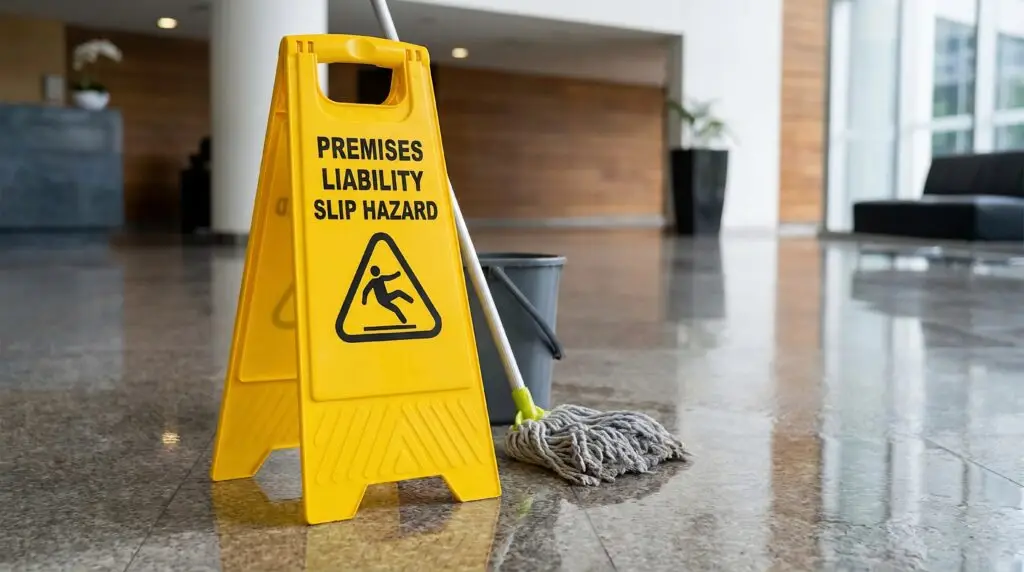
Does a Warning Sign Make a Danger Open and Obvious?
A warning sign may help a property owner argue that a visitor knew about the danger, but the presence of a sign does not automatically end the claim. The warning must be evaluated in context.
Questions may include:
- Was the sign visible before the visitor encountered the hazard?
- Was it placed close enough to identify the dangerous area?
- Did it describe or reasonably communicate the actual risk?
- Was the sign blocked, turned away, or lost among merchandise?
- Could the visitor understand the warning?
- Did the dangerous condition extend beyond the marked area?
- Did the property owner create a route that still required visitors to cross the hazard?
A generic warning may be inadequate when it does not allow a visitor to identify and avoid the actual danger. Conversely, a clearly positioned and adequate warning may satisfy the owner’s duty.
What if the Property Owner Says You Should Have Been Watching Where You Were Going?
Insurance companies frequently argue that the injured person was distracted, looking at a phone, wearing unsuitable shoes, moving too quickly, or failing to observe an obvious condition.
Those allegations do not establish the facts. Surveillance video, witness testimony, scene photographs, incident reports, and the property’s layout may show where the claimant was looking, what could be seen, and how the accident happened.
When Texas proportionate-responsibility rules apply, a claimant generally cannot recover damages if the claimant’s percentage of responsibility is greater than 50%. If the claimant is 50% or less responsible, recoverable damages are generally reduced by that percentage.
The governing provisions appear in Chapter 33 of the Texas Civil Practice and Remedies Code.
The open-and-obvious issue and comparative responsibility are related but distinct. One may concern whether the defendant owed a duty; the other concerns how responsibility for the occurrence should be allocated.
What Evidence Can Challenge an Open-and-Obvious Danger Defense?
Evidence should be preserved quickly because the condition may be repaired, cleaned, moved, or altered after the accident. Surveillance recordings may also be overwritten.
Potentially useful evidence includes:
- Photographs and videos taken from the claimant’s direction of travel
- Measurements of the condition and surrounding area
- Surveillance footage from before, during, and after the accident
- Lighting measurements and inspection records
- Witness statements
- Incident reports
- Prior complaints and earlier accidents
- Repair requests and maintenance records
- Store layouts and floor plans
- Leases and property-management agreements
- Warning-sign placement and inspection records
- The shoes and clothing worn during the incident
- Medical records documenting the mechanism and timing of the injury
- Expert analysis concerning visibility, engineering, human factors, or property safety
Evidence showing that the defendant recognized the condition as difficult to detect can also matter. For example, internal communications about the need for cones, barriers, lighting, repairs, or a different walking route may contradict a later assertion that every visitor should have appreciated the risk.
What Should You Do After an Injury Involving an Allegedly Obvious Hazard?
Obtain Medical Care
Seek appropriate medical attention and accurately describe how the injury occurred. Delayed treatment may harm your health and give the insurance company another issue to dispute.
Photograph the Scene From Multiple Angles
If it is safe, document the condition from the direction you approached it. Include wide views showing lighting, displays, doorways, signs, and obstructions—not only a close-up of the hazard.
Report the Accident
Notify the owner, manager, or person controlling the property. Request a copy of the incident report, but avoid guessing about fault or minimizing your injuries.
Identify Witnesses
Obtain names and contact information for anyone who saw the dangerous condition, witnessed the accident, or observed the property owner’s response.
Preserve Your Evidence
Save photographs, videos, receipts, damaged personal items, footwear, medical paperwork, and communications with the property owner or insurance company.
Request Legal Review Promptly
An attorney can identify the correct parties, send evidence-preservation notices, investigate available insurance, and evaluate whether the danger was truly open and obvious or whether an exception may apply.
Contact a Texas Premises Liability Attorney
An insurance company may use the phrase “open and obvious” as though it ends the discussion. Texas law requires a closer examination of the precise condition, the visitor’s knowledge, the available alternatives, any warnings, and the limited exceptions recognized by the courts.
MLF Legal, PLLC represents people injured because of unsafe property conditions in Dallas–Fort Worth and throughout Texas. Our personal injury attorneys can investigate what happened, preserve time-sensitive evidence, evaluate the property owner’s defenses, and explain your legal options.
Contact MLF Legal or call the personal injury lawyers at 214-357-1782 for a free consultation.
FAQs: What Does “Open and Obvious” Danger Mean in Texas Premises Liability Cases?
Possibly. Actual knowledge may support an open-and-obvious defense, but the result depends on whether you appreciated the danger, whether you had to use the area, whether reasonable precautions could protect you, and whether another exception applies.
No. A visible object may contain a danger that is not reasonably apparent. Courts consider the specific hazard and the surrounding circumstances rather than visibility in isolation.
No. The sign’s placement, visibility, wording, timing, and relationship to the actual hazard matter. An adequate warning may satisfy the property owner’s duty, but merely having a sign somewhere on the premises is not necessarily enough.
The necessary-use exception may be relevant when the visitor had to use the dangerous area and could not take precautions that adequately reduced the risk. The exception is limited and requires a fact-specific analysis.
Yes. Depending on the claim, a defendant may argue that no duty existed regarding an open and obvious condition and may alternatively seek to assign the claimant a percentage of responsibility.
Many Texas personal injury claims are subject to a two-year limitations period, but exceptions and shorter notice requirements may apply, particularly for governmental property. An attorney should calculate the deadline from the specific facts.
Injured at work in Texas and your employer doesn’t have workers’ comp?
You may have the right to sue and recover full compensation.
Contact MLF Legal today for a free consultation. You pay nothing unless we win your case.
Call MLF Legal today
214-357-1782
Fill out our online form
for a free consultation.
We only get paid if we win your case.