
Does a Wet-Floor Sign Prevent a Texas Slip and Fall Claim?
FREE CONSULTATION
Contact Us About Your Case
FREE Consultation Today.
Does a Wet-Floor Sign Prevent a Texas Slip and Fall Claim?
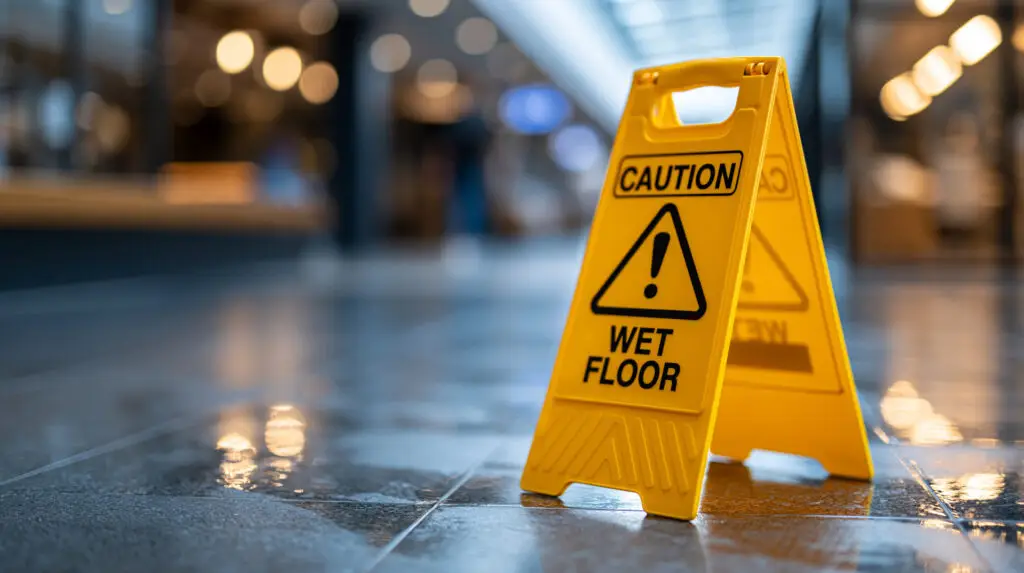
A wet-floor sign can defeat a Texas premises liability claim when it provides a legally adequate warning of the condition involved. But the mere presence of a sign somewhere on the property does not resolve every case.
The question is whether the warning adequately communicated the relevant danger in the circumstances. Evidence about its location, visibility, timing, and relationship to the hazard can matter.
MLF Legal, PLLC’s personal injury attorneys can review a fall in Dallas–Fort Worth or elsewhere in Texas and explain how a warning may affect your options.
What Does Texas Law Say About Warnings?
For a typical invitee claim, Texas law generally allows a property owner to satisfy the applicable premises duty by adequately warning about the condition or taking reasonable steps to make it reasonably safe.
In Henkel v. Norman, 441 S.W.3d 249 (Tex. 2014), the Texas Supreme Court explained that warning adequacy depends on the surrounding circumstances and whether a reasonable person would perceive and understand the condition being communicated.
An adequate warning can negate a required element of the claim. It is not merely evidence that the injured person shares fault.
Does a Business Always Have to Remove the Water?
Not necessarily. For an ordinary invitee premises claim, an adequate warning can satisfy the applicable duty even when the condition remains.
The Texas Supreme Court discusses this principle in Austin v. Kroger Texas, L.P..
Other duties or limited exceptions may require separate review. Do not assume either that leaving water on the floor always creates liability or that placing any sign always eliminates it.
What Questions Should an Investigation Address?
The following questions can help organize evidence. They are not a mechanical checklist that decides every warning dispute.
Was the Sign Present Before the Fall?
A sign visible in a photograph taken afterward does not necessarily establish when it was placed.
Surveillance footage, witness accounts, and staff testimony may help resolve timing. Preserve your own recollection without guessing about events you did not observe.
Could the Warning Be Seen From Your Approach?
Document the route you took and the surrounding layout. Displays, doors, shelving, and other objects may help explain what was visible.
Your statement that you did not notice the sign is relevant to the factual investigation, but it does not by itself establish that the warning was legally inadequate.
Did It Communicate the Relevant Condition?
A warning must be evaluated in relation to the condition involved. A wet-floor sign relates to a slippery surface; it does not necessarily communicate an unrelated defect such as a broken step.
The investigation should identify precisely what caused the fall rather than assume that every hazard in the area was covered by the same warning.
What Other Warnings or Circumstances Existed?
An employee’s verbal warning, barriers, visible mopping, or other circumstances may also be relevant.
For example, in Brooks v. PRH Investments, Inc., 303 S.W.3d 920 (Tex. App.—Texarkana 2010, no pet.), the court considered a wet-floor sign, a verbal warning, and the customer’s observation of mopping in finding the warning adequate.
The full context matters; no single sentence about a sign should replace review of the actual evidence.
Does the Sign Have to Identify the Exact Substance?
Not always. In Henkel, the court explained that a warning can adequately communicate a slippery condition without naming the particular material causing it.
A claim therefore should not rest solely on the argument that the sign said “wet floor” instead of identifying water, cleaner, or another substance.
What if I Saw the Sign but Had to Use the Area?
Tell your attorney why you used the route, whether alternatives existed, and what precautions were available.
Austin recognizes a limited necessary-use exception involving circumstances in which use of dangerous premises is necessary and the owner should anticipate the invitee cannot avoid the risk. Merely preferring a route does not automatically establish the exception.
A known or open and obvious danger can raise duty questions separate from whether a warning was sufficient.
What if There Was No Wet-Floor Sign?
The absence of a sign does not automatically prove liability.
A typical invitee claim still requires proof of actual or constructive knowledge, an unreasonable risk, failure to use reasonable care, and an injury proximately caused by that failure.
Investigators should examine when the condition appeared, what the defendant knew, and whether another adequate warning or reasonable corrective action existed.
Does a Sign Mean I Was More Than 50% at Fault?
No automatic percentage follows from a sign’s presence.
In cases governed by Texas Civil Practice and Remedies Code Chapter 33, a claimant’s responsibility greater than 50% bars recovery. At 50% or less, damages are reduced by that percentage.
However, warning adequacy may resolve a claim before percentage allocation becomes relevant. Both issues require careful legal analysis.
What Evidence Should You Preserve?
When safe, collect information that shows both the warning and the condition:
- Wide photographs of the area and your approach.
- Close-up photographs of the hazard and sign.
- Any objects affecting visibility.
- Witness names and contact details.
- The exact location and approximate time.
- Statements made by staff.
- Incident reports and relevant communications.
Ask an attorney about preserving footage from before and during the accident. Do not move a sign, recreate the scene, or return to an unsafe area solely to take pictures.
Seek medical care first and accurately describe how the incident happened.
How Long Do You Have to Bring a Claim?
Many Texas personal injury lawsuits must be filed within two years after the claim accrues, often the injury date, under Section 16.003. Exceptions may affect the deadline.
An accident report or insurance discussion does not automatically extend the filing period. Prompt investigation also helps address evidence that may be lost or overwritten.
Contact MLF Legal About a Wet-Floor Injury
A wet-floor sign can have significant legal consequences. A useful investigation examines the warning, the condition, and the surrounding circumstances rather than assuming the sign either ends the case or has no effect.
Contact the slip and fall lawyers at MLF Legal, PLLC to discuss a slip and fall injury in Dallas–Fort Worth or elsewhere in Texas.
FAQs: Does a Wet-Floor Sign Prevent a Texas Slip and Fall Claim?
Possibly, but an adequate warning can defeat an ordinary invitee premises claim. The sign and the surrounding circumstances require review.
No. Investigators should examine what was visible and communicated from the relevant approach, along with the other evidence.
Do not assume there is a universal distance rule deciding warning adequacy. Applicable standards and the actual circumstances require review.
A verbal warning can matter and may be adequate. Record what was said, when it was said, and whether you heard it before encountering the condition.
That raises a timing issue. Preserve witness information and discuss obtaining relevant footage with your attorney.
Injured at work in Texas and your employer doesn’t have workers’ comp?
You may have the right to sue and recover full compensation.
Contact MLF Legal today for a free consultation. You pay nothing unless we win your case.
Call MLF Legal today
214-357-1782
Fill out our online form
for a free consultation.
We only get paid if we win your case.