
Causation Letters for Rotator Cuff Tears in Texas Workers’ Compensation Claims
FREE CONSULTATION
Contact Us About Your Case
FREE Consultation Today.
Causation Letters for Rotator Cuff Tears in Texas Workers’ Compensation Claims
Rotator cuff tears are among the most heavily litigated injuries in Texas workers’ compensation claims. Insurance carriers routinely argue that a tear is merely the product of aging, degeneration, or a preexisting condition rather than a workplace injury. As a result, a well-written causation letter is often the difference between an approved surgery and a denied claim.
However, many causation letters fail because they simply state a conclusion without explaining the biomechanics of injury. The strongest opinions explain not only what happened, but how the forces generated by the workplace accident damaged the rotator cuff.
An effective causation letter should analyze the mechanism of injury, the anatomy involved, the forces applied to the shoulder, the timing of symptoms, imaging findings, and the distinction between degeneration and true aggravation.
Why Causation Matters in Rotator Cuff Cases
For many workers, the existence of a rotator cuff tear is not disputed.
The real dispute is:
Insurance carriers often argue:
- The tear is degenerative.
- MRI findings are age-related.
- The worker had preexisting disease.
- The work event was insufficient to cause a tear.
- Surgery is unrelated to the compensable injury.
A properly supported causation letter can establish:
- Extent of injury
- Medical necessity
- Surgical entitlement
- Disability
- Impairment
- Ongoing treatment rights
Understanding Rotator Cuff Anatomy
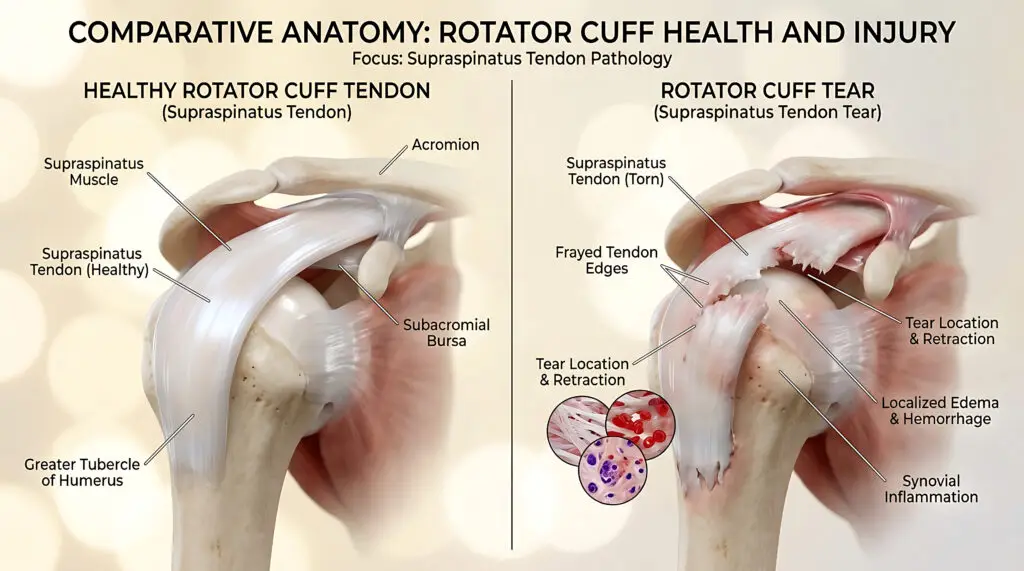
The rotator cuff consists of four muscles and tendons:
- Supraspinatus
- Infraspinatus
- Teres Minor
- Subscapularis
Together they function as dynamic stabilizers of the shoulder.
Their job is to:
- Keep the humeral head centered in the joint
- Resist traction forces
- Resist rotational forces
- Stabilize lifting motions
- Control overhead movement
Rotator cuff tears occur when forces exceed the structural capacity of these tendons.
The Most Common Mechanisms of Rotator Cuff Tears
A persuasive causation opinion should explain the specific forces involved in the injury.
Falls Onto an Outstretched Arm (FOOSH Injuries)
One of the most common workplace mechanisms is a fall where a worker reaches out to stop the fall.
Examples include:
- Falls from ladders
- Slips on wet surfaces
- Falls in warehouses
- Construction site falls
The Biomechanics
When the worker falls, body weight travels through the arm into the shoulder.
This creates:
- Sudden traction forces
- Compression forces
- Rotational forces
As the arm attempts to absorb the impact, the rotator cuff is forced to contract violently to stabilize the shoulder.
The tendon may fail because:
- The load exceeds tensile limits
- The tendon is forcibly stretched
- The humeral head abruptly shifts within the socket
The supraspinatus is particularly vulnerable during these events.
Heavy Lifting Injuries
Another common mechanism involves lifting heavy objects.
Examples include:
- Carrying equipment
- Lifting construction materials
- Moving inventory
- Pulling industrial components
The Biomechanics
When lifting a heavy load away from the body, a large lever arm develops.
This dramatically increases the load placed upon the rotator cuff.
As the load increases:
- Tensile stress rises within the tendons
- The cuff attempts to stabilize the shoulder
- Tendon fibers may fail
This is especially true when:
- The load suddenly shifts
- The worker loses balance
- The worker catches a falling object
Many acute rotator cuff tears occur during these events.
Sudden Traction Injuries
Traction injuries occur when the arm is suddenly pulled.
Examples include:
- Equipment jerking the arm
- A falling object pulling on the worker
- Machinery entanglement
- A worker grabbing an object that suddenly drops
The Biomechanics
Traction forces place the rotator cuff under extreme tension.
The tendons must resist:
- Sudden distraction forces
- External rotation forces
- Shear forces across the tendon insertion
These forces can:
- Tear tendon fibers
- Cause partial-thickness tears
- Create full-thickness ruptures
- Aggravate preexisting pathology
Catching a Falling Object
This mechanism appears frequently in workers’ compensation cases.
The Biomechanics
When a worker attempts to catch a falling object:
- The shoulder rapidly transitions from motion to resistance
- The rotator cuff contracts eccentrically
- Extreme tensile forces develop within the tendon
Eccentric loading is one of the most damaging forces in orthopedics.
Many traumatic cuff tears occur because the tendon is attempting to control an unexpectedly heavy load while simultaneously decelerating the arm.
Shoulder Dislocations
Shoulder dislocations frequently cause both:
- Labral tears
- Rotator cuff tears
The Biomechanics
As the humeral head leaves the socket:
- Rotator cuff tendons are stretched
- Tendons may be pinched
- Tendons may be partially or completely torn
Workers over age forty are particularly susceptible to rotator cuff tearing during shoulder dislocations.
What Is an Aggravation?
One of the most misunderstood concepts in workers’ compensation medicine is aggravation.
Many carriers argue:
“The worker already had degeneration.”
That statement alone does not answer the causation question.
The proper question is:
Did the work injury cause additional harm that did not exist before?
A true aggravation means:
- Additional tearing occurred
- Additional tendon damage occurred
- Symptoms increased because of new injury
- Functional loss increased
- The need for treatment increased
A medical aggravation is not simply making an MRI finding visible.
A medical aggravation means the workplace injury produced new structural damage, additional pathology, additional dysfunction, or increased impairment that was not present beforehand.
In practical terms:
If a worker had an asymptomatic partial-thickness tear and then suffers a workplace injury that causes a larger tear, greater tendon retraction, increased weakness, loss of function, or the need for surgery, the worker has sustained additional harm.
That is an aggravation.
Factors That Strengthen a Causation Opinion
No Prior Shoulder Problems
A history showing:
- No prior treatment
- No prior restrictions
- No prior surgery
- No prior complaints
strongly supports causation.
Immediate Symptoms
Particularly important findings include:
- Immediate pain
- Immediate weakness
- Immediate loss of motion
- Immediate difficulty lifting
Temporal proximity strengthens causal analysis.
Objective MRI Findings
Important findings may include:
- Full-thickness tears
- Acute tendon retraction
- Muscle edema
- Hemorrhage
- Bursal fluid
- Associated traumatic pathology
The existence of degeneration does not exclude traumatic injury.
Mechanism Consistent With Orthopedic Principles
The mechanism should be medically consistent with known injury biomechanics.
For example:
- A ladder fall
- Catching a falling object
- A shoulder dislocation
- A traction injury
- A heavy overhead lift
These mechanisms are entirely consistent with traumatic rotator cuff failure.
Common Mistakes in Rotator Cuff Causation Letters
Merely stating a conclusion
A doctor should explain why the injury is related.
Ignoring degenerative findings
A strong opinion addresses degeneration directly.
Failing to discuss biomechanics
The mechanism must be connected to the pathology.
Failing to explain aggravation
Many successful cases involve aggravation rather than entirely new injury.
Example Strong Causation Language
Based upon the patient’s history, mechanism of injury, physical examination findings, diagnostic imaging, and my orthopedic training and experience, it is my medical opinion that the workplace accident caused (or substantially aggravated, if applicable) the patient’s rotator cuff tear. The described mechanism generated forces that are medically recognized as capable of producing rotator cuff failure, including traction, eccentric loading, and compressive forces across the shoulder. Although imaging demonstrates some underlying degenerative change, the patient experienced immediate onset of pain, weakness, and loss of function following the accident. In my opinion, the work injury caused additional structural damage and functional impairment beyond any preexisting condition. The inflammation noted on the MRI supports this conclusion. Therefore, the workplace injury remains a substantial contributing factor to the patient’s current rotator cuff condition and need for treatment, including surgery.
How MLF Legal Uses Rotator Cuff Causation Letters
Our Workers’ Compensation Lawyers work with treating physicians to ensure causation opinions address:
- Mechanism of injury
- Shoulder biomechanics
- MRI findings
- Surgical findings
- Aggravation principles
- Extent of injury disputes
- Disability issues
- Future medical needs
Strong causation evidence frequently becomes the cornerstone of successful:
The Bottom Line
The best rotator cuff causation letters do more than identify a tear. They explain how the forces generated during the workplace accident damaged the rotator cuff and why the resulting condition is medically connected to the work injury.
They also recognize a critical principle often overlooked by insurance carriers: an aggravation means additional damage or harm that was not present before the accident. When a work injury causes new tendon failure, additional tearing, greater dysfunction, or increased need for treatment, the resulting condition may be compensable even when some preexisting degeneration existed beforehand.
Call to Action
If you suffered a rotator cuff tear at work, call the workers’ compensation lawyers at MLF Legal today.
We fight for injured workers — not insurance companies.
FAQs: Causation Letters for Rotator Cuff Tears in Texas Workers’ Compensation Claims
Yes. Falls generate traction, compression, and rotational forces that can exceed the structural limits of the rotator cuff tendons.
No. The key question is whether the workplace injury caused additional damage, dysfunction, or need for treatment.
An aggravation is additional harm, structural damage, or impairment that was not present before the work injury.
Explaining the forces applied to the shoulder helps demonstrate how the accident medically caused the injury.
Yes. A workplace injury may aggravate, accelerate, worsen, or cause additional damage to a preexisting condition.
Injured at work in Texas and your employer doesn’t have workers’ comp?
You may have the right to sue and recover full compensation.
Contact MLF Legal today for a free consultation. You pay nothing unless we win your case.
Next Steps:
1st
Sign up For a Free One-on-One Work Comp Case Evaluation
NEXT LEGAL STEP
Get a Legal Opinion
Contact us today to schedule your personalized one-on-one free phone consultation with one of our dedicated legal professionals. Our experienced Worker’s Comp Lawyers are here to provide the expert legal guidance and support you need throughout the entire process of your case.
We understand the complexities involved in Worker’s Compensation claims and are committed to helping you achieve the best possible outcome. Don’t hesitate to reach out and take the first step toward securing the justice you deserve.
2nd
Download Free E-Books
NEXT LEGAL STEP
Workers' Compensation
Applying for workers compensation can be a challenging process. It involves filing a claim, providing medical documentation, and navigating the approval process. Seeking guidance from a workers’ compensation attorney can help ensure your rights are protected and your claim is handled properly.
LET’S GET STARTED
Call MLF Legal today
214-357-1782
Fill out our online form
for a free consultation.
We only get paid if we win your case.