
Labral Tears in Texas Workers’ Compensation Claims
FREE CONSULTATION
Contact Us About Your Case
FREE Consultation Today.
Labral Tears in Texas Workers’ Compensation Claims
Shoulder labral tears are among the most frequently missed and disputed shoulder injuries in Texas workers’ compensation claims. The labrum is a ring of cartilage that surrounds the shoulder socket and helps stabilize the shoulder joint. When torn, workers often experience pain, weakness, instability, clicking, and difficulty performing overhead work, lifting, pushing, pulling, and other essential job duties.
Labral tears commonly occur alongside rotator cuff injuries, shoulder dislocations, biceps tendon injuries, and traumatic falls. Because MRI findings can sometimes show age-related changes, insurance carriers frequently argue that a labral tear is “degenerative” rather than work-related.
This post explains how shoulder labral tears occur, how they are diagnosed, what treatment may be required, and how injured workers can protect their claims.
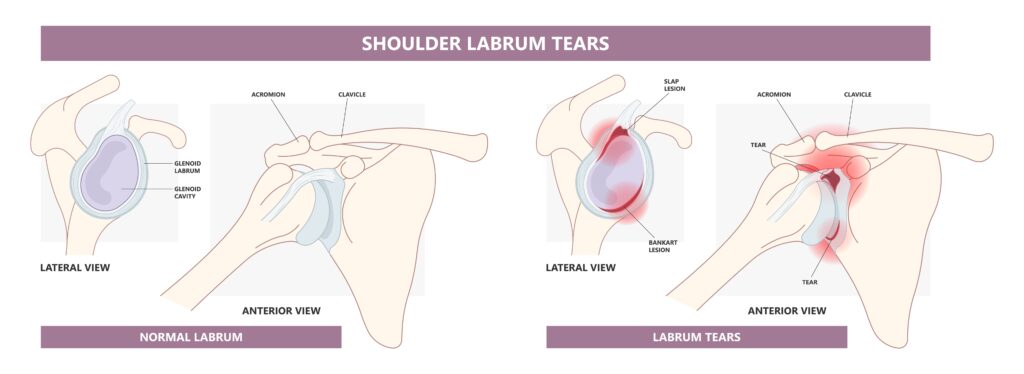
What Is the Shoulder Labrum?
The shoulder is a ball-and-socket joint consisting of:
- Humeral head (the ball)
- Glenoid (the socket)
- Rotator cuff muscles and tendons
- Labrum
The labrum is a ring of fibrocartilage that:
- Deepens the shoulder socket
- Improves shoulder stability
- Helps keep the shoulder centered during movement
- Serves as an attachment point for ligaments and the biceps tendon
When the labrum tears, the shoulder may become unstable and painful.
See Rotator Cuff Tears.
Common Work-Related Causes of Labral Tears
Labral tears are strongly associated with:
- Falls onto an outstretched arm
- Falls from ladders
- Heavy lifting
- Repetitive overhead work
- Pulling heavy objects
- Sudden traction injuries
- Machinery accidents
- Vehicle collisions
- Shoulder dislocations
- Repetitive forceful reaching
These mechanisms are fully consistent with compensable injuries under Texas workers’ compensation.
Types of Labral Tears
Several different types of labral tears may occur.
SLAP Tears (Superior Labrum Anterior to Posterior)
A SLAP tear occurs at the top of the shoulder socket where the biceps tendon attaches.
Common symptoms include:
- Deep shoulder pain
- Pain with lifting
- Clicking and popping
- Weakness
SLAP tears are particularly common in workers who perform repetitive overhead activities.
Bankart Tears
A Bankart tear involves the lower front portion of the labrum.
These tears commonly occur after:
- Shoulder dislocations
- Falls
- Traumatic shoulder injuries
Bankart lesions often cause chronic shoulder instability.
Posterior Labral Tears
These tears occur in the back portion of the shoulder socket and may result from:
- Repetitive pushing
- Heavy lifting
- Direct trauma
Degenerative Labral Tears
Labral tissue may wear over time, but significant workplace trauma can aggravate or accelerate underlying degeneration.
See Aggravation Injuries.
Symptoms of a Labral Tear
Workers often report:
- Deep shoulder pain
- Clicking or popping
- Catching sensations
- Shoulder weakness
- Pain with lifting
- Pain overhead
- Loss of throwing strength
- Night pain
- Instability
- Reduced range of motion
Symptoms often worsen with repetitive work activities.
How Labral Tears Affect Work Activities
Labral tears frequently interfere with:
- Overhead work
- Climbing
- Carrying materials
- Tool use
- Pushing
- Pulling
- Reaching
- Lifting
Workers often notice reduced endurance and weakness during repetitive tasks.
Labral Tears Often Occur With Other Shoulder Injuries
Labral injuries frequently accompany:
- Rotator cuff tears
- Shoulder impingement
- Biceps tendon injuries
- Shoulder instability
- Shoulder dislocations
- AC joint injuries
- Post-traumatic arthritis
Multiple shoulder conditions are often part of the same workers’ compensation claim.
Diagnosis of Labral Tears
Workers may be entitled to:
Physical Examination
A physician may evaluate:
- Shoulder stability
- Range of motion
- Strength
- Pain-provoking maneuvers
- Mechanical symptoms
X-Ray
Often used to:
- Rule out fractures
- Evaluate joint alignment
- Assess arthritis
MRI
MRI is commonly used to evaluate:
- Labral damage
- Rotator cuff injuries
- Biceps pathology
MR Arthrogram
Often considered the gold standard for diagnosing labral tears.
Contrast dye helps identify:
- SLAP tears
- Bankart lesions
- Capsular injuries
- Labral instability
Accurate diagnosis is critical because labral tears are frequently missed on routine imaging.
– Functional Restoration Programs
Medical Treatment for Labral Tears
Workers may be entitled to:
Conservative Treatment
Many workers initially receive:
- Anti-inflammatory medications
- Physical therapy
- Activity modification
- Work restrictions
- Home exercise programs
Injections
Treatment may include:
- Corticosteroid injections
- Diagnostic injections
Surgery
More significant injuries may require:
- Arthroscopic labral repair
- SLAP repair
- Bankart repair
- Shoulder stabilization procedures
- Biceps tenodesis
- Debridement
Rehabilitation
Following surgery:
- Physical therapy
- Range-of-motion exercises
- Strengthening programs
- Functional retraining
– Functional Restoration Programs
Recovery Timeline
Recovery depends on severity.
Typical timelines include:
- Mild tears: 6–12 weeks
- Conservative treatment: 2–4 months
- Arthroscopic repair: 4–6 months
- Complex stabilization procedures: 6–12 months
Workers performing heavy labor often require extended restrictions.
Complications of Labral Tears
If untreated or undertreated, labral tears can lead to:
- Chronic pain
- Shoulder instability
- Recurrent dislocations
- Loss of strength
- Loss of range of motion
- Rotator cuff dysfunction
- Post-traumatic arthritis
- Permanent impairment
These complications often increase impairment ratings.
Post-Traumatic Shoulder Arthritis
Workers who develop chronic instability following a labral tear may later develop:
- Glenohumeral arthritis
- Shoulder stiffness
- Chronic pain
- Permanent functional loss
Significant traumatic labral injuries can accelerate arthritic changes within the shoulder joint.
Impairment Ratings for Labral Tears
Impairment ratings may be based on:
- Loss of range of motion
- Strength deficits
- Shoulder instability
- Surgical outcomes
- Chronic pain
- Functional limitations
Workers with persistent symptoms frequently qualify for measurable permanent impairment.
Why Insurance Companies Dispute Labral Tear Claims
Carriers often argue:
- The tear is degenerative
- The MRI findings are age-related
- Surgery is unnecessary
- The worker fully recovered
- Symptoms are caused by a preexisting condition
- Ongoing treatment is unrelated to the work injury
These disputes can be challenged through:
How MLF Legal Proves Labral Tears Are Work-Related
Our Workers’ Compensation Lawyers assist clients by:
- Proving the tear resulted from workplace trauma
- Establishing a clear mechanism of injury
- Securing orthopedic specialist evaluations
- Obtaining MRI and MR arthrogram evidence
- Fighting for surgery approvals
- Preparing workers for designated doctor examinations
- Challenging low impairment ratings
- Winning disputes at BRCs and CCHs
Labral tear claims are highly winnable when supported by proper medical evidence.
The Bottom Line
Labral tears are serious shoulder injuries that can cause chronic pain, instability, weakness, and permanent functional limitations. If you suffered a labral tear at work, you need a lawyer who understands the medical issues, legal standards, and workers’ compensation system necessary to maximize your recovery.
Call to Action
If you suffered a shoulder labral tear at work, call the workers’ compensation lawyers at MLF Legal today.
We fight for injured workers — not insurance companies.
FAQs: Labral Tears in Texas Workers’ Compensation Claims
Yes. Labral tears are compensable when caused or aggravated by workplace trauma or repetitive work activities.
A SLAP tear is a tear of the superior labrum where the biceps tendon attaches to the shoulder socket.
Some improve with therapy and injections, but significant tears often require arthroscopic repair or stabilization procedures.
An MR arthrogram is often considered the most sensitive imaging study for identifying labral tears.
Yes. Chronic pain, instability, reduced motion, weakness, and surgical outcomes can all result in permanent impairment ratings.
Injured at work in Texas and your employer doesn’t have workers’ comp?
You may have the right to sue and recover full compensation.
Contact MLF Legal today for a free consultation. You pay nothing unless we win your case.
Next Steps:
1st
Sign up For a Free One-on-One Work Comp Case Evaluation
NEXT LEGAL STEP
Get a Legal Opinion
Contact us today to schedule your personalized one-on-one free phone consultation with one of our dedicated legal professionals. Our experienced Worker’s Comp Lawyers are here to provide the expert legal guidance and support you need throughout the entire process of your case.
We understand the complexities involved in Worker’s Compensation claims and are committed to helping you achieve the best possible outcome. Don’t hesitate to reach out and take the first step toward securing the justice you deserve.
2nd
Download Free E-Books
NEXT LEGAL STEP
Workers' Compensation
Applying for workers compensation can be a challenging process. It involves filing a claim, providing medical documentation, and navigating the approval process. Seeking guidance from a workers’ compensation attorney can help ensure your rights are protected and your claim is handled properly.
LET’S GET STARTED
Call MLF Legal today
214-357-1782
Fill out our online form
for a free consultation.
We only get paid if we win your case.