
Causation Letters For Lumbar Disc Herniations
FREE CONSULTATION
Contact Us About Your Case
FREE Consultation Today.
Causation Letters For Lumbar Disc Herniations
A lumbar disc herniation is one of the most common injuries disputed in Texas workers’ compensation claims. Insurance companies frequently argue that a herniated disc is the result of aging, degeneration, or a pre-existing condition rather than a workplace accident. That’s why a causation letter for lumbar disc herniations in Texas workers’ compensation claims is so important.
The difference between a denied claim and a successful extent-of-injury claim often comes down to one thing: the quality of the causation letter.
This article explains how doctors evaluate whether a lumbar disc herniation was caused by a work accident, what findings support causation, and what treating physicians should include in a causation letter.
Why Lumbar Disc Herniation Cases Are Frequently Disputed
Unlike a broken bone, a lumbar disc herniation cannot usually be seen immediately after an accident.
Instead, doctors rely on a combination of:
- Mechanism of injury
- Symptom onset
- Physical examination findings
- MRI findings
- Prior medical history
- Biomechanics
Insurance carriers often point to MRI findings showing:
- Degenerative disc disease
- Disc desiccation
- Facet arthropathy
- Osteophytes
- Prior disc bulges
They then argue that the injured worker’s symptoms are simply the result of natural aging.
A treating doctor’s causation opinion must explain why the lumbar disc herniation is related to the work injury despite any pre-existing degeneration.
Understanding Lumbar Disc Anatomy
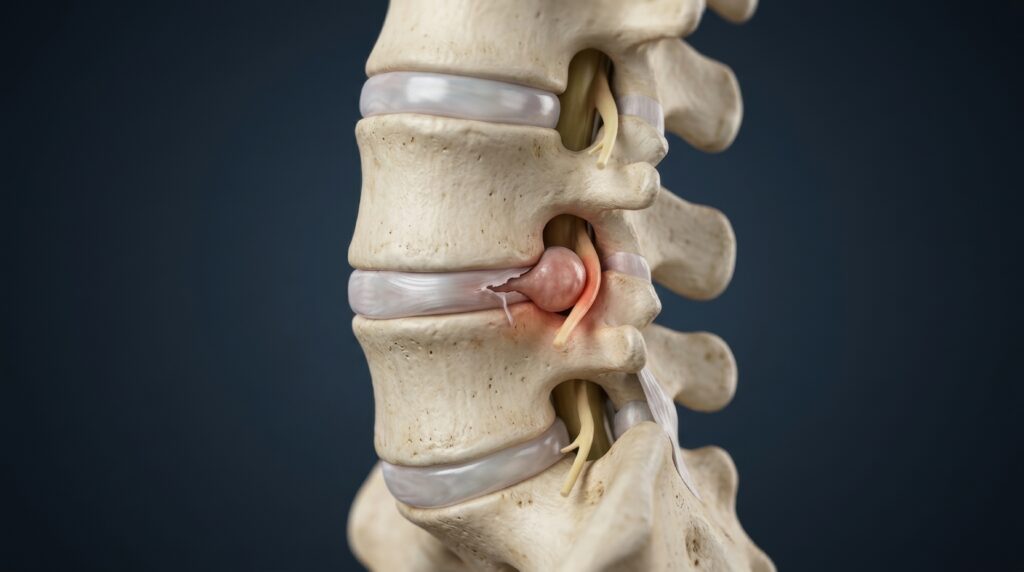
The lumbar spine contains intervertebral discs that act as shock absorbers between the vertebral bodies.
Each disc consists of:
Annulus Fibrosus
The tough outer ring of the disc.
Nucleus Pulposus
The softer center portion of the disc.
When excessive forces are placed on the spine, the annulus can fail, allowing disc material to protrude or herniate outward.
The herniated disc may then:
- Compress a nerve root
- Cause inflammation
- Produce radicular symptoms
- Create weakness, numbness, or reflex changes
The Most Important Part of the Letter: Mechanism of Injury
Before discussing MRI findings, a doctor must explain the accident itself.
A causation letter should answer:
What Happened?
Examples:
- Lifting a 125-pound motor
- Carrying concrete forms
- Lifting and twisting while unloading freight
- Falling from a ladder
- Being struck by equipment
What Forces Were Created?
Different mechanisms generate different biomechanical forces.
Examples include:
Axial Loading
A vertical compressive force traveling through the spine.
Examples:
- Fall onto feet
- Heavy lifting
- Sudden impact
Rotational Forces
Twisting movements that increase stress on the annulus.
Examples:
- Lifting while turning
- Carrying uneven loads
Shear Forces
One vertebral segment sliding against another.
Examples:
- Slip-and-fall incidents
- Sudden directional changes
Combined Loading
Many lumbar injuries occur when compression and rotation occur simultaneously.
Research has consistently shown that combined compression and rotational loading significantly increases the risk of annular failure and disc herniation.
What Doctors Must Explain About Biomechanics
One of the most common weaknesses in causation letters is failing to explain how the forces from the accident produced the injury.
A strong causation letter should include language similar to:
“The lifting and twisting motion subjected the lumbar spine to combined axial compression and rotational forces. These forces increased intradiscal pressure and created stress within the annulus fibrosus. Within reasonable medical probability, those forces caused the annular disruption and resulting disc herniation at L5-S1.”
This is what turns a conclusion into an explanation.
Timing Matters
Doctors often evaluate causation by examining when symptoms started.
Strong evidence includes:
- Immediate low back pain
- Pain beginning during the work activity
- Symptoms developing later the same day
- Symptoms developing within a few days
Weaker evidence includes:
- No reported symptoms for weeks
- Significant gaps in treatment
- Delayed onset without explanation
The more closely symptoms follow the accident, the stronger the causal connection becomes.
Physical Examination Findings That Support Causation
MRI findings alone do not establish causation.
The MRI must match the clinical presentation.
Doctors look for objective findings such as:
Positive Straight-Leg Raise
May indicate nerve root irritation.
Dermatomal Sensory Loss
Numbness following a specific nerve root distribution.
Motor Weakness
Examples:
- Foot drop
- Dorsiflexion weakness
- Great toe weakness
Reflex Changes
Changes involving:
- Patellar reflex
- Achilles reflex
Muscle Guarding
Protective muscle spasm frequently seen after acute injury.
A strong causation letter should explain how these findings correlate with the MRI findings.
MRI Findings That Suggest an Acute Disc Injury
Certain MRI findings may be more consistent with a recent injury.
These can include:
- Annular fissures
- High-intensity zones within the annulus
- Bone marrow edema
- Nerve root impingement matching symptom patterns
- New herniations not present on prior imaging
When these findings appear shortly after a work injury, they strengthen the causal relationship.
MRI Findings That Suggest Degenerative Disease
Not every abnormal MRI finding represents a compensable injury.
Doctors frequently see:
- Disc desiccation
- Broad-based bulges
- Osteophyte formation
- Facet arthropathy
- Multilevel degenerative changes
These findings often develop over many years.
The presence of degeneration does not automatically defeat a workers’ compensation claim.
Instead, the physician must determine whether the accident caused:
- A new injury, or
- An aggravation of the degenerative condition.
Aggravation Versus Exacerbation
This distinction is critical.
Aggravation
An aggravation involves new structural damage or measurable worsening.
Examples:
- New nerve compression
- New weakness
- Increased herniation size
- New neurological deficits
Aggravations may be compensable.
Exacerbation
An exacerbation is merely a temporary increase in symptoms.
Examples:
- Increased pain without objective findings
- Temporary flare-up of arthritis
- No structural change
Exacerbations are not considered compensable injuries under Texas workers’ compensation law. There has to be new damage or harm to the body to qualify as a compensable injury.
What Doctors Should Include in a Lumbar Disc Herniation Causation Letter
1. Detailed Mechanism of Injury
Explain exactly what happened.
2. Biomechanical Analysis
Identify the forces:
- Axial load
- Rotation
- Compression
- Shear
Explain how those forces produced the disc injury.
3. Specific Diagnosis
Examples:
- L5-S1 disc herniation
- L4-L5 disc extrusion
- Left-sided lumbar radiculopathy
Avoid vague diagnoses such as “back pain.”
4. Objective Findings
Document:
- Strength deficits
- Sensory loss
- Reflex changes
- Positive orthopedic tests
5. MRI Correlation
Explain how imaging findings match the symptoms and examination.
6. Acute Injury Versus Aggravation
Choose one and explain why.
7. Alternative Causes
Address pre-existing degeneration and explain why it does or does not account for current symptoms.
8. Statement of Causation
The physician should clearly state:
“Within reasonable medical probability, the patient’s lumbar disc herniation was caused by the work-related incident of [date].”
Why Strong Causation Letters Win Cases
Many doctors stop after identifying a lumbar disc herniation.
The best causation letters go much further.
They explain:
- What happened
- What forces were generated
- How those forces acted on the spine
- What objective findings support the diagnosis
- Why alternative explanations are less likely
- How the MRI findings correlate with the patient’s symptoms
That level of analysis gives judges and insurers a clear medical basis for accepting the claim.
Need Help Proving Your Lumbar Disc Herniation Was Caused by a Work Injury?
At MLF Legal, our workers’ compensation lawyers help injured workers throughout Texas develop the medical evidence necessary to win extent-of-injury disputes. We routinely work with treating physicians to strengthen causation opinions, identify objective evidence, and address insurance company arguments involving pre-existing degeneration and disc disease.
If your lumbar disc herniation has been denied, disputed, or blamed on degeneration, contact MLF Legal to discuss your options.
We fight for injured workers — not insurance companies.
FAQs: Causation Letters For Lumbar Disc Herniations
Yes, if your doctor doesn’t explain the difference between the pre-existing condition and the new injury or aggravation. Many injured workers have degenerative findings on MRI. The key question is whether the work accident caused a new injury or aggravated the pre-existing condition.
A doctor may suspect a disc injury based on symptoms and examination, but MRI testing is usually the most important study for confirming a lumbar disc herniation.
Biomechanics explains how the forces generated by the accident acted upon the body to create the injury. This helps establish a logical medical connection between the work event and the diagnosis.
Many doctors provide a conclusion without explaining their reasoning. A strong causation letter explains the mechanism of injury, biomechanics, objective findings, MRI correlation, and why the accident caused the condition.
Yes. A workplace accident can aggravate an asymptomatic or mildly symptomatic degenerative condition if it causes measurable worsening or new structural damage.
Injured at work in Texas and your employer doesn’t have workers’ comp?
You may have the right to sue and recover full compensation.
Contact MLF Legal today for a free consultation. You pay nothing unless we win your case.
Next Steps:
1st
Sign up For a Free One-on-One Work Comp Case Evaluation
NEXT LEGAL STEP
Get a Legal Opinion
Contact us today to schedule your personalized one-on-one free phone consultation with one of our dedicated legal professionals. Our experienced Worker’s Comp Lawyers are here to provide the expert legal guidance and support you need throughout the entire process of your case.
We understand the complexities involved in Worker’s Compensation claims and are committed to helping you achieve the best possible outcome. Don’t hesitate to reach out and take the first step toward securing the justice you deserve.
2nd
Download Free E-Books
NEXT LEGAL STEP
Workers' Compensation
Applying for workers compensation can be a challenging process. It involves filing a claim, providing medical documentation, and navigating the approval process. Seeking guidance from a workers’ compensation attorney can help ensure your rights are protected and your claim is handled properly.
LET’S GET STARTED
Call MLF Legal today
214-357-1782
Fill out our online form
for a free consultation.
We only get paid if we win your case.