
Shoulder Impingement Syndrome in Texas Workers’ Compensation Claims
FREE CONSULTATION
Contact Us About Your Case
FREE Consultation Today.
Shoulder Impingement Syndrome in Texas Workers’ Compensation Claims
Shoulder impingement syndrome is a common source of shoulder pain in Texas workers’ compensation claims, particularly for employees whose jobs require repetitive overhead reaching, lifting, carrying, pushing, pulling, or working with the arms away from the body.
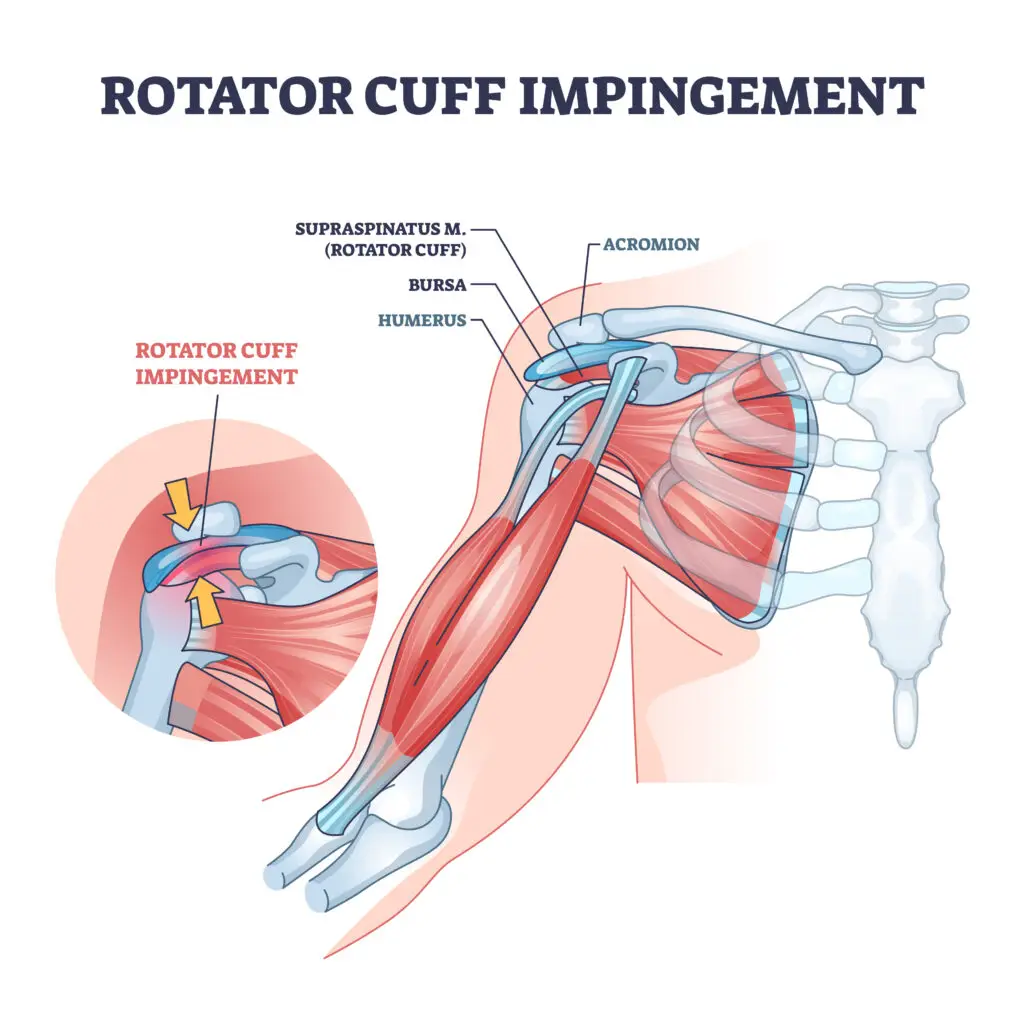
Often, shoulder impingement occurs when the space available for the rotator cuff tendons and subacromial bursa becomes restricted as the arm is raised. This can cause the rotator cuff and bursa to rub against or become compressed beneath the acromion, resulting in pain and irritation.
For injured workers, the condition can make routine tasks such as lifting materials, reaching overhead, carrying equipment, or using tools extremely difficult.
Insurance carriers may dispute shoulder impingement by arguing that the condition is degenerative, caused by the worker’s anatomy, unrelated to a specific accident, or simply part of the normal aging process. But repetitive overhead activity and repetitive lifting are recognized risk factors for rotator cuff-related shoulder pain and impingement.
This post explains shoulder impingement, how workplace activities can contribute to it, how doctors diagnose and treat the condition, and why these injuries become disputed in Texas workers’ compensation claims.
What Is Shoulder Impingement Syndrome?
The shoulder contains several structures that have to move within a relatively confined anatomical space.
Important structures include:
- The humerus
- The scapula
- The acromion
- The rotator cuff
- The subacromial bursa
The rotator cuff tendons attach to the upper humerus. Above those tendons sits the acromion, a bony portion of the shoulder blade. A lubricating bursa helps the rotator cuff glide underneath the acromion.
As the arm is raised, the space between the acromion and rotator cuff becomes smaller. In shoulder impingement, the tendon or underlying bursa becomes irritated as these structures rub against or become compressed beneath the acromion.
That process can be associated with:
- Rotator cuff tendinitis
- Subacromial bursitis
- Pain with overhead motion
- Reduced shoulder function
Shoulder impingement should not automatically be treated as synonymous with a rotator cuff tear. A worker may have impingement without a tear, or impingement may coexist with other rotator cuff pathology.
See Rotator Cuff Tears.
Why Shoulder Impingement Develops in Workers
Shoulder impingement is particularly important in jobs involving repeated lifting or overhead use of the arm. The American Academy of Orthopaedic Surgeons specifically identifies people performing repetitive lifting or overhead activities, including construction and painting, as being at risk for rotator cuff pain and impingement.
Work activities that may be relevant include:
- Repetitive overhead reaching
- Repetitive lifting
- Carrying materials
- Working above shoulder height
- Painting
- Construction work
- Repeated tool use
- Pushing and pulling
- Forceful shoulder activity
The important question in a workers’ compensation case is not simply whether the worker has impingement. The medical evidence must connect the diagnosed condition to the worker’s particular accident or occupational exposure.
How Workplace Forces Can Affect the Shoulder
Understanding the mechanics of the worker’s job can be critical when the insurance carrier disputes causation.
Repetitive Overhead Work
Overhead work repeatedly positions the rotator cuff beneath the acromion.
Examples may include:
- Electrical work
- Painting
- Overhead construction
- Installation work
- Warehouse stocking
- Repeated overhead tool use
As the arm repeatedly rises, the available subacromial space becomes smaller and the rotator cuff and bursa may become irritated.
The clinical question becomes whether the frequency, duration, force, and positioning involved in that particular worker’s duties medically contributed to the diagnosed condition.
Repetitive Lifting
Workers do not necessarily have to perform completely overhead work.
Repeated lifting can require the rotator cuff to stabilize the shoulder while the arm moves under load. The American Academy of Orthopaedic Surgeons identifies repetitive lifting as a risk activity for this type of shoulder problem.
For causation purposes, important details may include:
- Weight of the objects
- Distance from the body
- Height of the lift
- Number of lifts performed
- Whether the worker was reaching while lifting
- Whether the load unexpectedly shifted
A generic statement that an employee “lifted at work” is much less persuasive than an accurate description of the actual physical demands.
Acute Shoulder Trauma
Shoulder pain and inflammation may also develop following an injury.
In a workers’ compensation claim, the physician should evaluate whether a traumatic event caused new shoulder pathology or inflammation rather than assuming that every impingement presentation represents longstanding degeneration.
See Aggravation Injuries.
Shoulder Impingement, Rotator Cuff Tendinitis, and Bursitis
These conditions frequently overlap.
Rotator Cuff Tendinitis
Tendinitis involves inflammation or irritation affecting a tendon.
Subacromial Bursitis
The subacromial bursa sits between the rotator cuff and acromion. When irritated or inflamed, it can cause pain and reduced motion.
Shoulder Impingement
Impingement describes the painful rubbing or compression that occurs when the space between the acromion and rotator cuff becomes restricted during shoulder elevation.
A worker may therefore have more than one diagnosis at the same time.
Symptoms of Shoulder Impingement
Workers commonly experience:
- Pain in the front or side of the shoulder
- Pain when raising the arm
- Pain reaching overhead
- Shoulder tenderness
- Stiffness
- Difficulty reaching
- Night pain
The American Academy of Orthopaedic Surgeons notes that pain and stiffness may occur when lifting the arm or reaching overhead and that pain may also occur as the arm is lowered. Night pain is also common.
For a laborer, these symptoms can directly interfere with essential job functions.
How Shoulder Impingement Can Affect Work
A worker with shoulder impingement may struggle with:
- Lifting materials
- Reaching overhead
- Carrying equipment
- Pushing or pulling
- Operating tools
- Stocking shelves
- Working from ladders
- Repetitive shoulder-level work
The limitations can become especially significant when the job requires repeated shoulder use throughout an entire shift.
Diagnosing Shoulder Impingement
A physician generally begins by evaluating the worker’s symptoms, medical history, mechanism of injury, shoulder motion, strength, and provocative findings.
Imaging may also be used to evaluate the shoulder and determine whether additional pathology is present.
An important goal is determining whether the worker has associated conditions such as:
- Rotator cuff pathology
- Subacromial bursitis
- Arthritis
- Other structural causes of shoulder pain
This distinction matters in workers’ compensation cases because the carrier may accept a very limited diagnosis while disputing the other conditions identified during treatment.
Medical Treatment for Shoulder Impingement
Treatment depends on the worker’s individual condition and any associated shoulder pathology. The American Academy of Orthopaedic Surgeons notes that patient care should be individualized rather than treated according to a fixed protocol.
Treatment may include:
Activity Modification
Temporarily reducing activities that provoke symptoms may allow irritated tissues to recover.
Anti-Inflammatory Treatment
Treatment may be directed toward reducing inflammation and pain.
Physical Therapy
Rehabilitation may focus on restoring shoulder function and movement.
Corticosteroid Injection
Injection treatment may be considered in appropriate cases when inflammation and pain persist.
Treatment of Associated Conditions
A worker with impingement may also require treatment for associated rotator cuff or bursal pathology.
See Rotator Cuff Tears and Subacromial Bursitis.
What If Conservative Treatment Fails?
Persistent shoulder symptoms deserve further evaluation, particularly when the worker continues to have:
- Pain with overhead activity
- Weakness
- Loss of motion
- Night symptoms
- Difficulty performing work duties
One of the critical issues is determining whether the worker has additional structural pathology that explains why the symptoms have not resolved.
This can be particularly important where a carrier accepted only a “shoulder strain” even though subsequent medical evidence identifies more significant pathology.
Shoulder Impingement and Rotator Cuff Tears
Shoulder impingement and rotator cuff tears are related but distinct diagnoses.
A worker with ongoing impingement symptoms may also be diagnosed with a rotator cuff tendon problem. Rotator cuff pathology encompasses inflammation as well as tendon tearing.
That distinction can become extremely important in Texas workers’ compensation litigation.
An insurance carrier may accept:
“Right shoulder strain.”
while disputing:
“Rotator cuff tear, tendinitis, bursitis, and shoulder impingement.”
When that happens, the dispute is not merely about terminology. The accepted extent of injury may affect the treatment being requested and the medical issues litigated in the claim.
What About Preexisting Degeneration?
The presence of preexisting degenerative pathology does not answer the separate question of whether a workplace injury caused additional damage or harm.
This distinction is particularly important with shoulder claims.
An aggravation means additional damage or harm that was not there before the work injury.
That may involve evidence of:
- New structural pathology
- Additional tissue damage
- A materially worsened condition
- New functional loss
- Other objective evidence showing the condition changed because of the accident
The medical opinion should identify what changed rather than merely state that the worker’s preexisting condition became symptomatic.
See Aggravation Injuries.
Why Insurance Companies Dispute Shoulder Impingement Claims
Common carrier arguments include:
- The condition is degenerative
- The worker has age-related shoulder changes
- The job duties were insufficient to cause the condition
- There was no traumatic injury
- The worker only sustained a shoulder strain
- Ongoing symptoms are unrelated
- Additional treatment is unnecessary
These cases frequently turn on the quality of the medical evidence explaining why the worker’s specific job duties or accident caused the diagnosed condition.
How MLF Legal Develops Shoulder Impingement Claims
In disputed cases, the evidence may need to address:
- The exact mechanism of injury
- The worker’s physical job demands
- The onset of symptoms
- The worker’s previous shoulder condition
- Physical examination findings
- Diagnostic imaging
- Associated rotator cuff or bursal pathology
- Whether additional damage or harm occurred
That evidence can become critical in disputes involving:
The Bottom Line
Shoulder impingement can significantly affect a worker’s ability to lift, reach, carry, push, pull, and perform overhead work. It should not automatically be dismissed as a minor shoulder strain.
A strong Texas workers’ compensation claim identifies what structure is injured, what workplace forces acted on the shoulder, what objective findings support the diagnosis, and whether the accident caused new damage or an aggravation of a preexisting condition.
When those issues are explained clearly, the medical evidence tells a much stronger causation story.
Call to Action
If your shoulder impingement or related shoulder injury has been denied or disputed by the workers’ compensation carrier, call the workers’ compensation lawyers at MLF Legal today.
We fight for injured workers — not insurance companies.
FAQs: Shoulder Impingement Syndrome in Texas Workers’ Compensation Claims
Repetitive lifting and overhead activities are recognized risk factors for rotator cuff-related shoulder pain and impingement. Whether a particular worker’s condition is work-related requires an individualized medical causation analysis. [orthoinfo.org]
No. Impingement describes compression or rubbing involving structures beneath the acromion. A rotator cuff tear involves actual disruption of tendon tissue. The conditions can coexist. [orthoinfo.org]
Yes. The subacromial bursa lies between the rotator cuff and acromion, and inflammation of the bursa commonly occurs with rotator cuff-related shoulder conditions. [orthoinfo.org], [orthoinfo.org]
Yes. Post-traumatic AC joint arthritis is a common long-term complication.
Because a carrier may accept one condition while disputing additional shoulder pathology. Clearly identifying the conditions at issue and obtaining medical evidence connecting them to the workplace accident can therefore be critical to an extent-of-injury dispute.
Injured at work in Texas and your employer doesn’t have workers’ comp?
You may have the right to sue and recover full compensation.
Contact MLF Legal today for a free consultation. You pay nothing unless we win your case.
Next Steps:
1st
Sign up For a Free One-on-One Work Comp Case Evaluation
NEXT LEGAL STEP
Get a Legal Opinion
Contact us today to schedule your personalized one-on-one free phone consultation with one of our dedicated legal professionals. Our experienced Worker’s Comp Lawyers are here to provide the expert legal guidance and support you need throughout the entire process of your case.
We understand the complexities involved in Worker’s Compensation claims and are committed to helping you achieve the best possible outcome. Don’t hesitate to reach out and take the first step toward securing the justice you deserve.
2nd
Download Free E-Books
NEXT LEGAL STEP
Workers' Compensation
Applying for workers compensation can be a challenging process. It involves filing a claim, providing medical documentation, and navigating the approval process. Seeking guidance from a workers’ compensation attorney can help ensure your rights are protected and your claim is handled properly.
LET’S GET STARTED
Call MLF Legal today
214-357-1782
Fill out our online form
for a free consultation.
We only get paid if we win your case.