
Frozen Shoulder (Adhesive Capsulitis) in Texas Workers’ Compensation Claims
FREE CONSULTATION
Contact Us About Your Case
FREE Consultation Today.
Frozen Shoulder (Adhesive Capsulitis) in Texas Workers’ Compensation Claims
Frozen shoulder, medically known as adhesive capsulitis, can become a serious complication of a workplace shoulder injury. The condition causes progressive pain and stiffness until movement of the shoulder becomes severely restricted. Unlike many shoulder injuries that primarily cause pain with certain movements, frozen shoulder can restrict both the worker’s ability to move the shoulder voluntarily and the amount the shoulder can be moved by someone else.
That loss of motion can be devastating for workers whose jobs require lifting, reaching, carrying, pushing, pulling, climbing, driving, operating machinery, or working overhead.
Frozen shoulder presents an additional problem in Texas workers’ compensation claims because it may develop after the original workplace injury rather than being diagnosed immediately. Immobilization following an injury or surgery is a recognized risk factor for adhesive capsulitis.
That creates a predictable insurance dispute: the carrier accepts the initial shoulder injury but contests frozen shoulder as a separate condition.
Understanding how and why the condition developed can therefore become critical to proving the extent of the compensable injury.
What Is Frozen Shoulder?
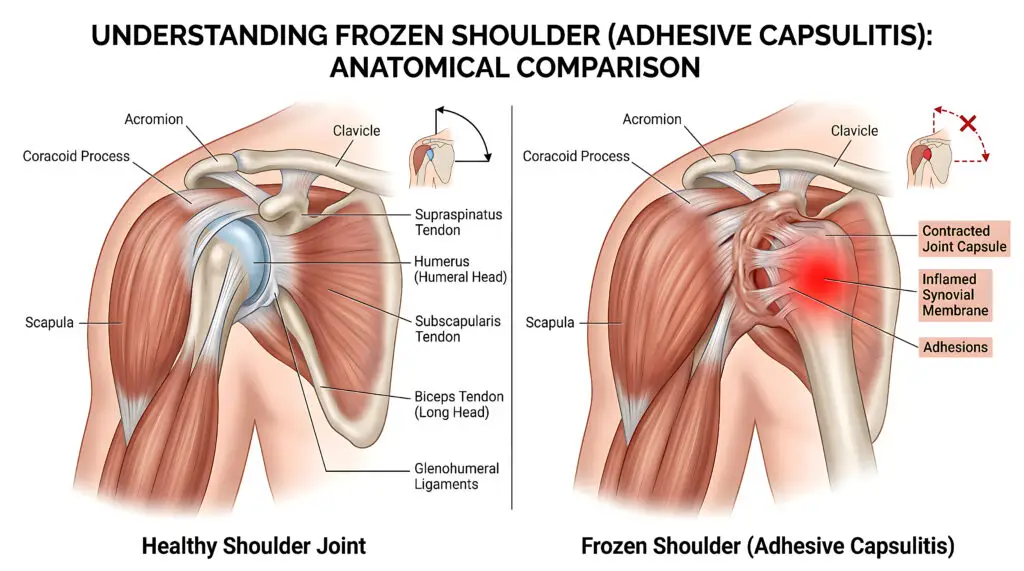
The shoulder is surrounded by strong connective tissue known as the joint capsule.
Normally, this capsule permits the extensive movement necessary for the shoulder’s exceptional range of motion.
With adhesive capsulitis, the capsule becomes:
- Thickened
- Stiff
- Tight
- Inflamed
Adhesions can also develop within the capsule, further restricting movement. The result is the characteristic combination of shoulder pain and progressive loss of motion.
Why Frozen Shoulder Can Develop After a Workplace Injury
This distinction is especially important in workers’ compensation cases.
Frozen shoulder does not necessarily have to be present on the date of the accident.
Instead, it may develop as a consequence of another shoulder injury or its treatment.
The American Academy of Orthopaedic Surgeons explains that frozen shoulder sometimes occurs following injury or surgery and identifies immobilization following injury or surgery as a risk factor.
Mayo Clinic likewise identifies prolonged restriction of shoulder movement as a risk factor and specifically lists rotator cuff injury, arm fracture, and recovery from surgery among situations associated with restricted mobility.
That secondary pathway can be extremely important in a Texas workers’ compensation claim. It is the most common context that we see frozen shoulder in Texas workers’ compensation claims.
The Injury-to-Frozen-Shoulder Progression
Consider a worker who suffers a significant shoulder injury.
The worker develops pain and begins protecting the shoulder. Depending upon the underlying injury and prescribed treatment, shoulder movement may become significantly restricted.
The medical sequence might therefore look like:
Work accident → shoulder injury → pain/restricted movement or immobilization → progressive capsular stiffness → adhesive capsulitis
That sequence is fundamentally different from claiming that the workplace accident instantly created adhesive capsulitis.
In the appropriate case, the causation question may instead be whether the compensable shoulder injury and resulting period of restricted motion contributed to the later development of adhesive capsulitis.
That distinction can make the medical opinion considerably more precise.
Shoulder Injuries That May Precede Frozen Shoulder
Frozen shoulder can develop during recovery from other shoulder conditions, particularly when movement becomes restricted.
Relevant workplace injuries may include:
Rotator Cuff Injuries
Pain and restricted movement associated with a rotator cuff injury can create circumstances in which shoulder mobility becomes substantially reduced. Mayo Clinic specifically lists rotator cuff injury among conditions associated with immobility or reduced mobility that can increase frozen shoulder risk.
Shoulder Fractures
A worker recovering from a significant shoulder fracture may experience a prolonged period of restricted shoulder movement. Immobilization after injury is a recognized risk factor for frozen shoulder.
Shoulder Surgery
Frozen shoulder may develop after surgery, particularly when postoperative protection limits shoulder movement.
Other Significant Shoulder Injuries
When another compensable injury produces severe pain and restricted shoulder movement, the medical question becomes whether that restriction contributed to the subsequent capsular condition.
That determination should be made by the treating physician based upon the actual history and clinical evidence rather than assumed.
Primary vs. Secondary Frozen Shoulder
This is an important distinction for workers’ compensation claims.
Primary Frozen Shoulder
In some people, adhesive capsulitis develops without a clearly identifiable precipitating injury.
The precise cause of frozen shoulder remains incompletely understood, and AAOS notes that there is no clear connection between frozen shoulder generally and occupation.
That is why it would be inaccurate to simply say that frozen shoulder is generally “caused by work.”
Secondary Frozen Shoulder
In other cases, frozen shoulder develops following another event or condition, including injury, surgery, or immobilization.
For Texas workers’ compensation purposes, secondary adhesive capsulitis is often the more important causation scenario.
The analysis must connect the original compensable injury and its consequences to the later development of adhesive capsulitis.
Symptoms of Frozen Shoulder
The hallmark problem is restricted motion.
Workers may experience:
- Deep shoulder pain
- Progressive stiffness
- Difficulty lifting the arm
- Difficulty reaching overhead
- Difficulty reaching behind the back
- Night pain
- Limited shoulder rotation
- Difficulty dressing
- Difficulty performing work activities
One particularly significant diagnostic feature is limitation of both active and passive shoulder motion. In other words, not only does the worker have difficulty moving the shoulder independently, but the shoulder also remains restricted when an examiner attempts to move it.
The Three Stages of Frozen Shoulder
Adhesive capsulitis commonly progresses through three clinical stages.
Freezing Stage
Pain progressively increases while shoulder motion becomes increasingly restricted.
A worker may notice increasing difficulty with:
- Reaching
- Lifting
- Sleeping
- Dressing
- Overhead activities
Frozen Stage
Pain may begin improving, but substantial stiffness remains.
For a worker, this can be particularly disabling because improvement in pain does not necessarily mean restoration of function.
Thawing Stage
Shoulder movement gradually begins improving.
Recovery can be slow. AAOS notes that complete recovery may take considerable time and, in some cases, up to three years.
How Frozen Shoulder Affects Work
Adhesive capsulitis can interfere with seemingly simple activities such as:
- Reaching above shoulder level
- Lifting materials
- Operating tools
- Driving
- Climbing ladders
- Carrying equipment
- Reaching behind the body
- Pushing
- Pulling
- Repetitive arm use
For construction workers, mechanics, warehouse employees, electricians, painters, healthcare workers, drivers, and industrial employees, substantial loss of shoulder motion can make normal job duties impossible.
Diagnosing Frozen Shoulder
Frozen shoulder is primarily a clinical diagnosis characterized by significant restriction of shoulder movement.
An orthopedic evaluation may examine:
- Active range of motion
- Passive range of motion
- Shoulder rotation
- Pain
- Functional limitations
Imaging may also be used to evaluate other potential sources of shoulder dysfunction.
This distinction matters because other conditions may produce shoulder pain without causing the characteristic global restriction of both active and passive motion associated with adhesive capsulitis.
Medical Treatment for Frozen Shoulder
Treatment focuses heavily on restoring motion and controlling pain.
The American Academy of Orthopaedic Surgeons identifies physical therapy focused on shoulder flexibility as a primary treatment recommendation.
Depending upon the individual case, treatment may include:
Physical Therapy
Therapy generally focuses on improving shoulder mobility and function.
Anti-Inflammatory Medication
Medication may be used to manage pain and inflammation.
Corticosteroid Injection
Injection treatment may be used in appropriate patients to address pain and inflammation.
Manipulation Under Anesthesia
For persistent cases that fail conservative management, manipulation under anesthesia may be considered.
Arthroscopic Capsular Release
Surgical release may be considered when significant loss of motion continues despite prolonged conservative treatment.
Frozen Shoulder After Surgery
This deserves special attention in workers’ compensation cases.
Suppose a worker sustains a compensable rotator cuff tear and undergoes surgery. The worker subsequently develops significant capsular stiffness and is diagnosed with adhesive capsulitis.
The carrier may argue:
“Frozen shoulder wasn’t part of the original injury.”
But that does not resolve the causation question.
If the condition developed during recovery from the compensable injury or surgery, the relevant medical question becomes whether the original injury, treatment, postoperative restriction, or resulting reduced shoulder mobility contributed to the development of the adhesive capsulitis.
That analysis should be clearly explained by the treating physician.
Aggravation and Frozen Shoulder
The same principle we have established throughout this series applies here:
An aggravation requires additional damage or harm that was not present before the compensable injury.
Merely experiencing more symptoms does not, by itself, explain what additional damage or harm occurred.
A persuasive medical opinion should identify the actual change.
Depending upon the particular case, that analysis might focus on objective development of:
- New capsular restriction
- Measurable loss of shoulder motion
- Additional dysfunction
- A newly diagnosed adhesive capsulitis condition
The physician should explain what changed following the workplace injury and why that change is medically attributable to the compensable event or its consequences.
See Aggravation Injuries.
Risk Factors Do Not Automatically Decide Causation
Certain medical conditions increase the risk of adhesive capsulitis.
Established risk factors include:
- Diabetes
- Thyroid disorders
- Prolonged shoulder immobilization
Frozen shoulder also occurs more commonly in people between 40 and 60 years old.
The existence of a risk factor, however, does not itself determine the cause of an individual worker’s condition.
For example, saying:
“The worker has diabetes.”
identifies a risk factor.
It does not, standing alone, answer the separate medical question of why adhesive capsulitis developed following a particular shoulder injury and period of restricted movement.
A strong causation opinion should address both possibilities rather than ignoring the worker’s underlying risk factors.
Why Insurance Companies Dispute Frozen Shoulder
Common carrier arguments include:
- The condition is unrelated to the original injury
- Adhesive capsulitis developed later
- The original injury was only a strain
- The worker has diabetes or thyroid disease
- The condition developed spontaneously
- The worker should already have recovered
- Additional treatment is unnecessary
- Current disability is unrelated to the compensable injury
These disputes frequently become extent-of-injury and disability disputes.
Building the Medical Causation Evidence
A persuasive frozen shoulder case should establish the medical sequence rather than merely rely on timing.
Important evidence may include:
- The original mechanism of injury
- Initial shoulder diagnosis
- Pre-injury shoulder function
- Treatment after the accident
- Periods of immobilization or restricted movement
- Progressive loss of range of motion
- Objective range-of-motion measurements
- Orthopedic examinations
- Surgical history
- Physical therapy records
- The treating physician’s causation analysis
The strongest opinion explains why adhesive capsulitis developed in this particular worker following this particular compensable injury.
Impairment Ratings and Frozen Shoulder
Frozen shoulder can leave a worker with persistent loss of shoulder motion even after substantial treatment.
In Texas workers’ compensation claims, the impairment analysis must follow the applicable statutory and regulatory requirements and the required impairment-rating methodology. Therefore, it is better not to assume that the diagnosis itself automatically produces a particular impairment rating.
What matters clinically is whether the worker has persistent, measurable functional loss when the appropriate impairment evaluation occurs.
How MLF Legal Handles Frozen Shoulder Claims
When adhesive capsulitis becomes disputed, our Texas workers’ compensation lawyers focus on developing evidence showing the entire progression of the injury.
That may include:
- Establishing the original compensable shoulder injury
- Documenting the treatment timeline
- Identifying periods of reduced mobility
- Obtaining orthopedic opinions addressing secondary adhesive capsulitis
- Establishing what additional condition developed
- Challenging carrier attempts to isolate the original accident from its medical consequences
- Preparing workers for designated doctor examinations
- Litigating extent of injury and disability disputes at BRCs and CCHs
The goal is to tell the complete medical story rather than allowing the carrier to look at each diagnosis in isolation.
The Bottom Line
Frozen shoulder is different from many workplace shoulder injuries because the condition may develop during the recovery process rather than at the precise moment of the accident.
That makes causation especially important.
When a worker sustains a shoulder injury, experiences significant restriction or immobilization, and subsequently develops objective adhesive capsulitis, the medical evidence should address the entire chain of events.
The right question is not simply:
“Was frozen shoulder diagnosed on the date of injury?”
The better question is:
“Did the compensable injury and its resulting medical consequences cause or contribute to the subsequent development of adhesive capsulitis?”
That is the causation issue that needs to be developed.
Call to Action
If you developed frozen shoulder after a workplace shoulder injury or surgery and the insurance carrier is disputing your condition, call the workers’ compensation lawyers at MLF Legal today.
We fight for injured workers — not insurance companies.
FAQs: Frozen Shoulder (Adhesive Capsulitis) in Texas Workers’ Compensation Claims
Yes. Frozen shoulder can develop after injury, and prolonged shoulder immobilization is a recognized risk factor. [orthoinfo.org]
Yes. Adhesive capsulitis may occur following surgery, particularly when shoulder movement has been restricted during recovery. [orthoinfo.org], [orthobullets.com]
No. A rotator cuff tear involves damage to one or more rotator cuff tendons. Frozen shoulder primarily involves thickening and stiffness of the shoulder capsule. They are distinct conditions, although frozen shoulder may develop during recovery from rotator cuff pathology. [orthoinfo.org], [mayoclinic.org]
A hallmark feature is substantial restriction in shoulder motion, including limitation when the patient moves the arm and when the examiner moves it passively. [orthoinfo.org], [orthobullets.com]
Diabetes is a recognized risk factor for adhesive capsulitis. However, determining causation in a workers’ compensation claim requires an individualized medical analysis of the worker’s injury, prior condition, treatment history, restricted motion, and subsequent development of adhesive capsulitis. [orthoinfo.org]
Frozen shoulder can be prolonged. AAOS reports that full recovery may take up to three years in some patients. [orthoinfo.org]
That may create an extent-of-injury dispute. Medical evidence explaining how the compensable shoulder injury, surgery, or resulting restricted movement relates to the subsequent adhesive capsulitis can be particularly important.
Injured at work in Texas and your employer doesn’t have workers’ comp?
You may have the right to sue and recover full compensation.
Contact MLF Legal today for a free consultation. You pay nothing unless we win your case.
Next Steps:
1st
Sign up For a Free One-on-One Work Comp Case Evaluation
NEXT LEGAL STEP
Get a Legal Opinion
Contact us today to schedule your personalized one-on-one free phone consultation with one of our dedicated legal professionals. Our experienced Worker’s Comp Lawyers are here to provide the expert legal guidance and support you need throughout the entire process of your case.
We understand the complexities involved in Worker’s Compensation claims and are committed to helping you achieve the best possible outcome. Don’t hesitate to reach out and take the first step toward securing the justice you deserve.
2nd
Download Free E-Books
NEXT LEGAL STEP
Workers' Compensation
Applying for workers compensation can be a challenging process. It involves filing a claim, providing medical documentation, and navigating the approval process. Seeking guidance from a workers’ compensation attorney can help ensure your rights are protected and your claim is handled properly.
LET’S GET STARTED
Call MLF Legal today
214-357-1782
Fill out our online form
for a free consultation.
We only get paid if we win your case.