
Ulnar Collateral Ligament Sprains and Tears in Texas Workers’ Compensation Claims
FREE CONSULTATION
Contact Us About Your Case
FREE Consultation Today.
Ulnar Collateral Ligament Sprains and Tears in Texas Workers’ Compensation Claims
Ulnar Collateral Ligament (UCL) injuries — sprains, partial tears, and complete ruptures — are serious elbow injuries that significantly impact a worker’s ability to lift, grip, push, pull, or use tools. Although UCL injuries are often associated with throwing athletes, they are extremely common in Texas workers’ compensation cases, especially in construction, warehousing, manufacturing, oilfield work, and jobs requiring repetitive forceful arm movements.
Because UCL injuries often require surgery and result in measurable impairment, insurance companies frequently dispute them, claiming the injury is “degenerative,” “minor,” or “not caused by work.” This post explains how UCL injuries happen, how they’re diagnosed, what treatment is available, and how injured workers can protect their claims.
Understanding the Ulnar Collateral Ligament (UCL)
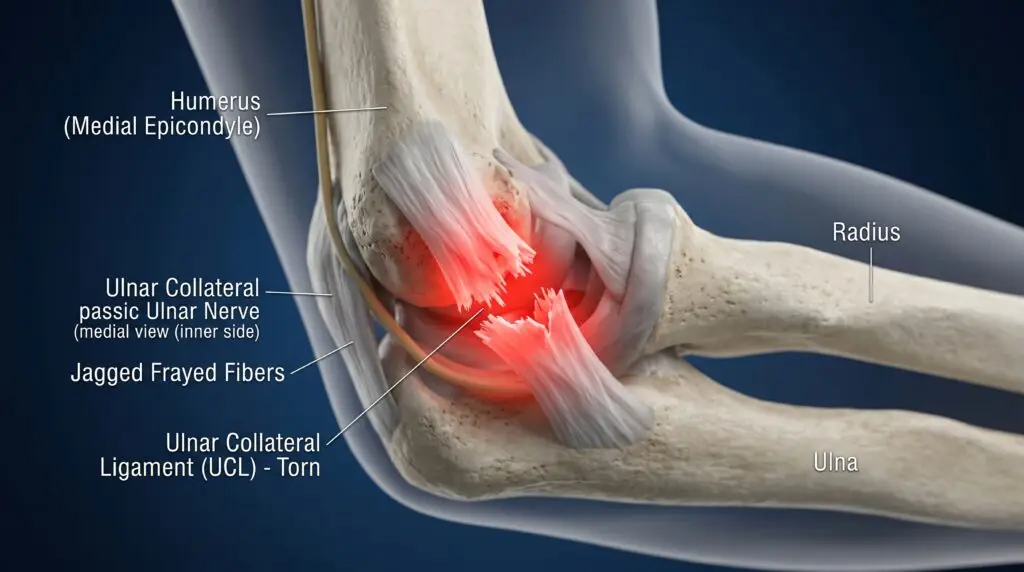
The UCL is the primary stabilizing ligament on the inner (medial) side of the elbow. It prevents the elbow from bending inward under stress (valgus force).
The UCL is essential for:
- Lifting
- Carrying
- Pushing and pulling
- Tool use
- Overhead work
- Stabilizing the elbow during forceful tasks
When the UCL is sprained or torn, workers lose stability and strength, making many job tasks painful or impossible.
How UCL Sprains and Tears Happen at Work
UCL injuries occur when the elbow is exposed to valgus stress — an inward‑bending force. Common work‑related mechanisms include:
- Lifting heavy objects with the elbow slightly bent
- Forceful pulling or jerking motions
- Using torque‑producing tools (wrenches, drills, pipe tools)
- Falls onto an outstretched hand
- Sudden twisting injuries
- Direct blows to the inner elbow
- Repetitive overhead work
- Catching falling objects
These mechanisms are fully consistent with compensable injuries under Texas workers’ compensation law.
Symptoms of UCL Sprains and Tears
Workers often report:
- Pain on the inner elbow
- Weakness when gripping or lifting
- Instability or “giving way”
- Pain during twisting or torqueing motions
- Swelling or tenderness
- Difficulty using tools
- Loss of throwing or overhead strength
- A popping sensation at the moment of injury
Symptoms may appear immediately or worsen over time with continued use.
Types of UCL Injuries
Grade I – Mild Sprain
Ligament stretched but not torn. Pain with valgus stress.
Grade II – Partial Tear
Some fibers torn. Weakness and instability.
Grade III – Complete Tear
Ligament fully ruptured. Significant instability; often requires surgery.
Diagnosis of UCL Sprains and Tears
Diagnosis may include:
Physical Examination
- Valgus stress test
- Moving valgus stress test
- Tenderness over the medial elbow
- Grip strength testing
MRI
The gold standard for confirming partial or complete tears.
Ultrasound
Useful for dynamic evaluation of ligament laxity.
X‑ray
Rules out fractures or avulsion injuries.
Accurate diagnosis is essential for proving causation and securing treatment.
Medical Treatment for UCL Sprains and Tears
Workers may be entitled to:
Conservative Care
- Anti‑inflammatory medications
- Bracing
- Physical therapy
- Activity modification
Injections
Platelet‑rich plasma (PRP) may be used in some cases (approval varies).
Surgery
For moderate to severe tears:
- UCL repair
- UCL reconstruction (“Tommy John” surgery)
- Internal brace augmentation
Post‑Operative Rehabilitation
- Strengthening
- Range‑of‑motion work
- Gradual return to lifting and tool use
Work Hardening
To rebuild job‑specific strength and endurance.
Functional Restoration Programs
For chronic pain, weakness, or psychosocial barriers.
Recovery Timeline
Typical recovery:
- Sprains: 4–8 weeks
- Partial tears: 2–4 months
- Surgical reconstruction: 6–12 months
Of course, this assumes the injured worker gets the necessary medical care in a timely fashion. Workers performing heavy labor may require extended restrictions.
Complications After UCL Injury
If untreated or under‑treated, UCL injuries can lead to:
- Chronic instability
- Medial elbow pain
- Ulnar nerve irritation
- Grip weakness
- Loss of forearm rotation strength
- Post‑traumatic arthritis
- Need for surgical reconstruction
These complications often increase impairment ratings.
Impairment Ratings for UCL Sprains and Tears
Impairment ratings may be based on:
- Loss of elbow stability
- Strength deficits
- Range‑of‑motion loss
- Surgical outcomes
- Chronic pain
- Nerve involvement
Moderate to severe UCL injuries frequently result in measurable impairment.
Why Insurance Companies Dispute UCL Injuries
Carriers often argue:
- The injury is “degenerative”
- The mechanism was “insufficient”
- Symptoms are “inconsistent”
- That the worker had prior elbow pain
- The tear is “partial” and does not require surgery
- The worker is “non‑compliant” with therapy
These disputes can be challenged through:
See Aggravation Injuries.
How MLF Legal Helps Injured Workers With UCL Sprains and Tears
Our Workers’ Compensation Lawyers assist clients by:
- Proving the UCL injury is work‑related
- Challenging degenerative‑condition arguments
- Securing MRIs and specialist referrals
- Fighting for surgical approval
- Preparing workers for designated doctor exams
- Challenging low impairment ratings
- Winning disputes at BRCs and CCHs
UCL injuries are winnable — but only with the right evidence and strategy.
The Bottom Line
Ulnar Collateral Ligament in Texas workers’ compensation are often serious elbow injuries that require surgery and long rehabilitation. If you suffered a UCL injury at work, you need a lawyer who understands the medical issues, the legal standards, and the strategies necessary to win your case.
Call MLF Legal - FREE Consults
If you suffered a UCL sprain or tear at work, call the Texas workers’ compensation attorneys at MLF Legal today.
We fight for injured workers — not insurance companies.
FAQs: Ulnar Collateral Ligament Sprains and Tears in Texas Workers’ Compensation Claims
Yes. They are compensable if caused or aggravated by work activities.
Moderate to severe tears often require reconstruction.
MRI, ultrasound, and physical exam findings.
You can challenge the denial through extent‑of‑injury litigation.
Yes. Instability, strength loss, and surgical outcomes often result in measurable impairment.
Injured at work in Texas and your employer doesn’t have workers’ comp?
You may have the right to sue and recover full compensation.
Contact MLF Legal today for a free consultation. You pay nothing unless we win your case.
Next Steps:
1st
Sign up For a Free One-on-One Work Comp Case Evaluation
NEXT LEGAL STEP
Get a Legal Opinion
Contact us today to schedule your personalized one-on-one free phone consultation with one of our dedicated legal professionals. Our experienced Worker’s Comp Lawyers are here to provide the expert legal guidance and support you need throughout the entire process of your case.
We understand the complexities involved in Worker’s Compensation claims and are committed to helping you achieve the best possible outcome. Don’t hesitate to reach out and take the first step toward securing the justice you deserve.
2nd
Download Free E-Books
NEXT LEGAL STEP
Workers' Compensation
Applying for workers compensation can be a challenging process. It involves filing a claim, providing medical documentation, and navigating the approval process. Seeking guidance from a workers’ compensation attorney can help ensure your rights are protected and your claim is handled properly.
LET’S GET STARTED
Call MLF Legal today
214-357-1782
Fill out our online form
for a free consultation.
We only get paid if we win your case.